
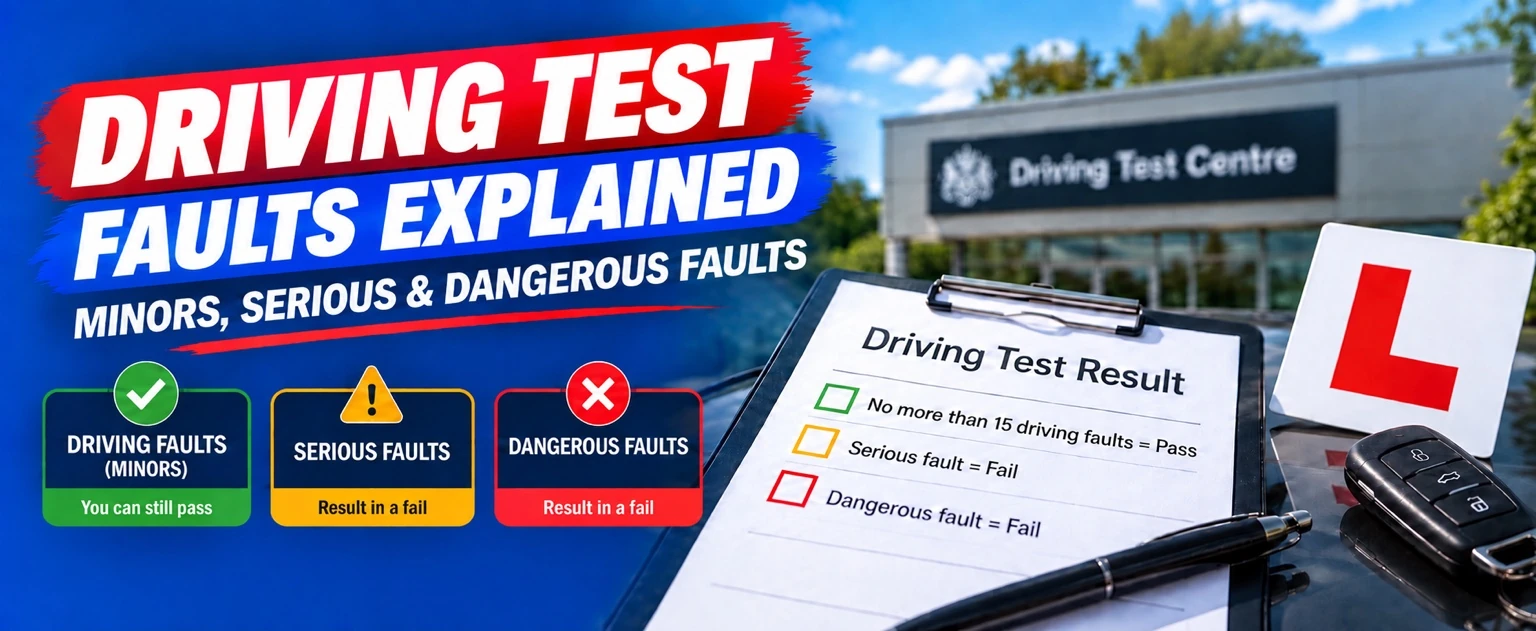
Driving Test Faults Explained: Minors, Serious & Dangerous Faults
If you are preparing for your practical driving test, understanding driving test faults is an important part of your preparation.
Many learner drivers worry about making a mistake during their test and immediately assume they have failed. However, not every mistake results in a failed driving test.
The DVSA divides driving test faults into three categories: driving faults, serious faults and dangerous faults.
In this guide, we explain what each type of fault means, how many driving faults you can get and still pass, and some of the common areas where the examiner will assess your driving.
This guide is based on the current GOV.UK guidance on driving test faults and your result and the DVSA's detailed Understanding your driving test result guidance.
What Are The Three Types Of Driving Test Fault?
According to the DVSA, there are three types of faults you can make during a car driving test:
- Driving fault – something that is not potentially dangerous, but if you keep making the same fault it could become a serious fault.
- Serious fault – something that is potentially dangerous.
- Dangerous fault – something that involves actual danger to you, the examiner, the public or property.
Driving faults are sometimes referred to as minors, while serious and dangerous faults are sometimes referred to as majors.
How Many Faults Can You Get And Still Pass?
The current DVSA pass mark is straightforward.
You can pass your driving test if you make:
- No more than 15 driving faults
- No serious faults
- No dangerous faults
Therefore, having some driving faults does not automatically mean you have failed.
However, if you receive a serious or dangerous fault, you will not pass the test.
It is also important to remember that repeatedly making the same driving fault can become more serious. The DVSA explains that a driving fault can become a serious fault if you keep making the same mistake.
What Is A Driving Fault?
A driving fault is something that is not potentially dangerous.
Driving faults are commonly known as minors.
You can receive driving faults during your test and still pass, provided you do not receive more than 15 driving faults and you do not receive a serious or dangerous fault.
For example, you might make a small mistake with your mirrors, signalling or positioning that the examiner records as a driving fault.
One driving fault does not necessarily mean you have failed.
Can The Same Driving Fault Become More Serious?
Yes.
The DVSA specifically explains that a driving fault could become a serious fault if you keep making the same fault.
This is why your driving instructor may encourage you to correct repeated mistakes during your lessons rather than simply accepting them because they have not yet resulted in a serious fault.
The aim should be to develop safe, consistent driving rather than trying to stay below a particular number of faults.
What Is A Serious Fault?
A serious fault is something that is potentially dangerous.
If you receive a serious fault during your practical driving test, you will fail the test.
A serious fault does not necessarily mean that an accident has happened. The DVSA definition is that the fault is potentially dangerous.
This is why a learner driver can fail even if there has been no collision or actual incident.
What Is A Dangerous Fault?
A dangerous fault involves actual danger to you, the examiner, the public or property.
A dangerous fault means you have failed your driving test.
Dangerous faults are more serious than driving faults because the DVSA defines them as involving actual danger.
What Does 'Examiner Took Action' Mean?
The DVSA also records when an examiner has had to take action during a test.
The official DVSA guidance explains that if the examiner had to tell you to do something or take control of the car to avoid an incident, your result will show “examiner took action”, also known as ETA.
If you receive this information on your result, your driving instructor can use it to understand what happened and identify the skills that need more practice.
What Driving Skills Does The Examiner Assess?
The DVSA's detailed guidance explains a number of different areas that can be assessed during the driving test.
These include:
- Ancillary controls
- Awareness and planning
- Clearance to obstructions
- Control
- Controlled stop or emergency stop
- Eyesight check
- Following at a safe distance
- Forward parking
- Fuel-efficient driving
- Judgement
- Junctions, including roundabouts
- Moving off
- Pedestrian crossings
- Position and normal stops
- Positioning
- Precautions
- Progress
- Response to signs and signals
- Reverse parking
- Pulling up on the right and reversing
- Signals
- Use of mirrors
- Use of speed
- Show Me Tell Me vehicle safety questions
The examiner monitors many of these areas throughout the test rather than assessing each one as a separate individual exercise.
Awareness And Planning Faults
You need to demonstrate that you can anticipate what other road users might do and react in good time.
This includes being aware of vulnerable road users such as:
- Pedestrians
- Cyclists
- Motorcyclists
- Horse riders
Common examples identified by the DVSA include not anticipating the actions of other road users, not noticing that pedestrians may be about to cross and pulling up behind a queue of parked vehicles without anticipating what may happen next.
Good observation and planning should help you recognise developing hazards early rather than reacting at the last moment.
Control Faults
You need to demonstrate that you can use the car's primary controls smoothly and at the appropriate time.
This includes:
- Accelerator
- Clutch
- Gears
- Brake
- Handbrake or parking brake
- Steering
Examples of faults listed by the DVSA include over-steering and mounting the pavement, coasting by keeping the clutch pedal down, selecting an inappropriate gear and using the brake too hard or not hard enough.
Your instructor can help you practise smooth and controlled use of the car's controls before your test.
Junction And Roundabout Faults
Junctions and roundabouts are an important part of your practical driving assessment.
The examiner will consider things such as:
- Approach speed
- Observation
- Judgement
- Position when turning right
- Position when turning left
- Avoiding cutting corners
The DVSA gives examples such as incorrectly judging the speed of an approaching vehicle, failing to check for other road users when emerging and approaching a junction too quickly to make effective observations.
Practising different types of junctions and roundabouts can help you become more confident and consistent.
Moving Off Faults
You need to be able to move off safely and under control throughout your driving test.
This can include moving off:
- From the side of the road
- On a slope or hill
- From behind a parked vehicle
- At junctions
You should use your mirrors, check your blind spots and signal when necessary.
The DVSA lists examples such as rolling backwards because of poor control, failing to check blind spots, moving into the path of an approaching vehicle and repeatedly stalling during the test.
Positioning Faults
Your positioning is assessed during normal driving and when changing lanes or dealing with different road layouts.
You need to keep your vehicle correctly positioned within the appropriate lane and avoid driving too close to the pavement or road markings.
Examples of faults include:
- Driving too close to the pavement
- Driving too close to the centre of the road
- Staying in the right-hand lane of a dual carriageway for too long without a reason
- Straddling lanes
Understanding lane markings and practising safe lane changes can help reduce positioning faults.
Progress And Undue Hesitation
The examiner will assess whether you make appropriate progress for the road and traffic conditions.
This does not mean that you should simply drive at the maximum speed limit.
You should choose a safe and appropriate speed for the conditions while avoiding unnecessary hesitation that holds up other road users.
The DVSA gives examples including:
- Not emerging from a junction when it is safe to do so
- Driving unnecessarily slowly and holding up following traffic
- Driving well below the speed limit on a clear road without a reason
- Waiting unnecessarily for another road user who has clearly given way to you
Response To Signs And Signals
You need to recognise and react correctly to signs and signals during your driving test.
This includes:
- Road signs
- Road markings
- Traffic lights
- Traffic controllers
- Other road users
The DVSA gives examples such as reacting late to a change in speed limit, failing to stop at a compulsory stop sign, driving in a bus lane when the signs say you should not, and choosing an incorrect lane when the lanes are clearly marked.
Use Of Mirrors
Effective mirror use is assessed throughout the driving test.
You need to demonstrate that you can use your rear-view mirror and door mirrors to see what is happening behind and alongside your vehicle.
The DVSA explains that mirrors should be checked in good time before situations such as:
- Signalling
- Changing direction
- Changing lanes
- Changing speed
- Pulling up at the side of the road
Common faults can include checking the mirrors after or at the same time as signalling and failing to check effectively before changing lanes.
Signalling Faults
Signals should be used when they are necessary, correctly and at the appropriate time.
Your signal should help communicate your intentions to other road users.
Examples of signalling faults include:
- Signalling left or right but not turning
- Using the wrong signal at a roundabout
- Signalling too late for the signal to be effective
Your instructor can help you understand when a signal is necessary and when it could confuse other road users.
Speed Faults
The examiner will assess whether you drive at a safe and reasonable speed for the circumstances.
You should take account of:
- The road conditions
- The amount of traffic
- Road signs and signals
- The speed limit
- Weather conditions
- What you can see ahead
The DVSA gives examples of speed faults including driving over the speed limit and failing to adjust your speed to the road conditions.
Remember that driving at the speed limit is not always appropriate if the road, traffic or weather conditions require you to slow down.
Following At A Safe Distance
You need to maintain an appropriate distance from the vehicle in front.
The distance should take account of the road and weather conditions.
For example, the DVSA identifies driving too close to the vehicle in front and failing to increase your following distance in conditions such as rain, ice or fog as common faults.
On faster-moving roads in dry conditions, the DVSA guidance refers to the 2-second rule as a way of maintaining an appropriate gap.
Pedestrian Crossing Faults
You need to recognise the different types of pedestrian crossing and react appropriately.
Examples of faults include:
- Stopping on the crossing rather than before it
- Moving off before a pedestrian has completely cleared the crossing
- Approaching a crossing too quickly
- Failing to stop at a crossing when required
Practising around different types of pedestrian crossings can help you become more familiar with how to approach them safely.
Pulling Up And Normal Stops
When the examiner asks you to pull up, you need to choose a safe place and stop appropriately.
The DVSA says that you should stop in the first safe place available and your vehicle should not create a hazard for other road users.
Examples of faults include:
- Partially or completely blocking a driveway
- Obstructing other road users
- Parking with one or more wheels on the pavement
- Parking too far from the kerb
Reversing And Manoeuvre Faults
Your reversing exercise assesses both your control of the vehicle and your observation of your surroundings.
Depending on the exercise, you may be asked to:
- Parallel park
- Reverse into a parking bay
- Pull up on the right and reverse for around two car lengths
The DVSA gives examples of faults during reversing exercises such as poor control, touching or driving over the pavement, failing to make effective all-round observations and not finishing within a marked bay.
During reversing, remember that observation is just as important as steering and vehicle control.
Pulling Up On The Right And Reversing
If you are asked to pull up on the right and reverse, you need to demonstrate good control and effective observation.
The DVSA guidance states that you should pull up on the right-hand side of the road and reverse for around two car lengths, remaining reasonably close to the pavement without touching it.
Common faults can include:
- Not noticing a hazard or another road user
- Relying only on the mirrors when checking around the vehicle
- Touching or driving onto the pavement
- Misjudging oncoming traffic when moving across to the right
- Parking too far from the pavement
Controlled Stop Or Emergency Stop Faults
If you are asked to carry out a controlled stop, you need to respond safely to the examiner's signal.
The DVSA says you need to bring the vehicle to a safe stop while maintaining control and avoiding locking the wheels and losing control.
Examples of faults include reacting too slowly or locking the wheels and causing a skid.
Show Me Tell Me Faults
You will be asked two vehicle safety questions during your practical driving test.
These are:
- Tell Me – asked at the start of the test before you start driving, where you explain how you would carry out a safety task.
- Show Me – asked while you are driving, where you demonstrate how you would carry out a safety task.
The DVSA gives examples of faults including losing control of the car while answering the Show Me question and getting one or both questions wrong.
You can prepare for these questions by practising them with your driving instructor before your test.
Read our complete guide:
Can You Fail For A Fault During Independent Driving?
Yes, a fault made during independent driving can contribute to your test result.
Independent driving does not mean that the normal rules of safe driving stop applying.
You still need to demonstrate appropriate observation, mirrors, signals, positioning, speed, judgement and response to signs and signals.
If you make a mistake with the route, do not panic. Concentrate on driving safely and follow the examiner's instructions.
For more information, read our guide:
Can You Get Driving Faults During A Manoeuvre?
Yes.
Your examiner continues to assess your driving when you carry out a reversing exercise.
This can include your control of the vehicle, your observation and how you respond to other road users or hazards.
Making a small mistake during a manoeuvre does not automatically mean you have failed. The seriousness of the fault depends on what happened and the level of risk involved.
What Happens If You Make A Mistake During The Test?
If you make a mistake, try not to assume that you have failed.
A driving fault does not automatically mean that your test is over.
The most important thing is to stay focused and continue driving safely.
Do not allow one mistake to affect the rest of your test. Listen carefully to the examiner's instructions and concentrate on the next situation.
What Happens If You Pass Your Driving Test?
If you pass your driving test, the examiner will:
- Tell you what faults you made, if any
- Give you a pass certificate
- Ask whether you want your full driving licence sent to you automatically
The current GOV.UK guidance states that you can start driving straight away after passing your test. You do not need to wait for your full driving licence to arrive, but you must have insurance that allows you to drive without supervision.
What Happens If You Fail Your Driving Test?
If you do not pass your driving test, the examiner will tell you what faults you made.
It is useful to discuss your result with your driving instructor so that you can identify which areas need more practice before you take another test.
You will need to book and pay for another driving test. The current GOV.UK guidance states that you must choose a new test date that is at least 10 working days away.
Your next test should be booked when you are ready and your instructor is satisfied that you have improved the areas that caused problems during the previous test.
Use Your Driving Test Result To Improve
If you do not pass your driving test, your result can be useful because it shows the areas where you need more practice.
The DVSA recommends discussing the result with your driving instructor so that future lessons can focus on the skills that need improvement.
For example, if your result shows faults relating to mirrors, junctions or positioning, your instructor can build those areas into your lessons.
You can also use your result alongside private practice to identify specific skills that need more work.
How Can You Reduce Driving Faults Before Your Test?
The best way to reduce driving faults is to practise consistently and understand why a mistake is happening.
Before your test, make sure you are comfortable with:
- Using your mirrors correctly
- Making effective observations
- Using signals appropriately
- Approaching junctions safely
- Dealing with roundabouts
- Maintaining appropriate speed
- Maintaining a safe following distance
- Moving off safely
- Changing lanes correctly
- Following road signs and markings
- Dealing with pedestrian crossings
- Parking and reversing
- Independent driving
- Show Me Tell Me questions
It is also useful to have mock tests with your instructor so that you can practise driving under test conditions.
Don't Focus On The Number Of Faults
Although the official pass mark allows up to 15 driving faults, this should not become a target for your lessons.
The aim of your driving lessons should be to become a safe, confident and independent driver.
Rather than thinking, “I can make up to 15 mistakes”, focus on identifying and correcting repeated faults before your test.
Good preparation is about developing safe and consistent driving habits rather than trying to count how many mistakes you can make.
Final Thoughts
Understanding driving test faults can make the practical test feel less confusing.
The DVSA has three categories of faults: driving faults, serious faults and dangerous faults.
You can pass with up to 15 driving faults, provided you have no serious or dangerous faults.
However, the best approach is not to aim for a particular number of faults. Instead, work with your driving instructor to identify any repeated mistakes and improve them before your test.
Remember that a mistake during your test does not automatically mean you have failed. Stay calm, continue to drive safely and concentrate on the road ahead.
For the latest official information, visit the GOV.UK guidance on driving test faults and your result and the DVSA's Understanding your driving test result guide.
Related Learner Driver Guides
You may also find these guides useful:
- First Driving Lesson Guide
- What Should You Bring To Your First Driving Lesson?
- How Many Driving Lessons Do I Need?
- How Often Should You Take Driving Lessons?
- Automatic vs Manual Driving Lessons
- Driving Lesson Costs UK
- Learning To Drive In Your Own Car
- Choosing A Driving Instructor
- Intensive Driving Courses Explained
- Can You Change Driving Instructors?
- What Makes A Good Driving Instructor?
- How To Take Driving Lessons
- Driving Test Waiting Times
- Driving Test Changes 2026
- Can You Swap A Driving Test?
- How To Get An Earlier Driving Test
- How Many Times Can You Change A Driving Test?
- How Long After Failing Can I Retake?
- Driving Test Day Checklist
- Common Reasons Learners Fail Their Driving Test
- How To Pass Your Driving Test First Time
- Show Me Tell Me Questions
- Independent Driving Explained
- What Happens During A Driving Test?
- Drug Driving: What Learner Drivers Need To Know
- Driving Test Waiting Times September 2026: DVSA Chief Executive Gives Update
- DVSA Driving Test Release Dates September 2026
Explore Our Complete Learner Driver Guides
Explore our complete guides covering every stage of learning to drive, from your first driving lesson and theory test to preparing for your practical driving test, understanding the Highway Code, mastering driving manoeuvres and keeping up to date with the latest DVSA news and updates related to driving.
- Learn To Drive: The Complete Guide For Learner Drivers
- Driving Tests: The Complete Guide For Learner Drivers
- Theory Test: The Complete Guide For Learner Drivers
- Highway Code: The Complete Guide For Learner Drivers
- Driving Manoeuvres: The Complete Guide For Learner Drivers
- Learner Driver Advice: The Complete Guide For Learner Drivers
- DVSA News & Updates: The Complete Guide For Learner Drivers
Or visit our Driving Lessons & Learner Driver Blogs to explore all our latest driving guides, advice and DVSA updates.
If you're ready to start learning, book your driving lessons online today and take the first step towards becoming a safe, confident and independent driver.
Written by A Class Learners
Providing professional driving lessons across London, Essex and the UK, alongside expert learner driver advice and comprehensive UK driving guides designed to help learners become safe, confident and independent drivers for life.