
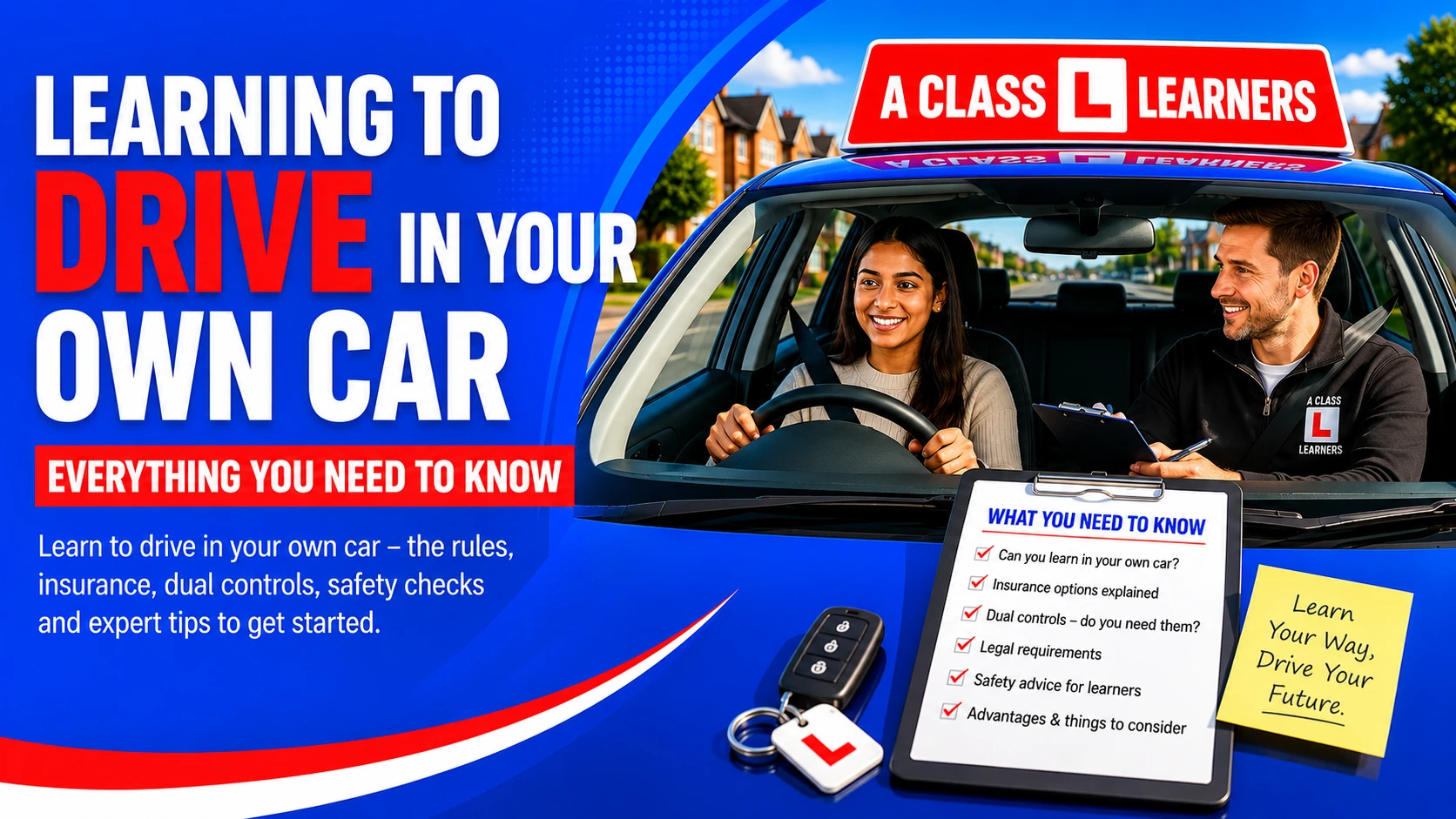
Learning to Drive in Your Own Car: Everything You Need to Know
Learning to drive doesn't have to take place entirely in your driving instructor's car. Many learner drivers choose to practise in their own car between professional driving lessons, giving them valuable additional experience behind the wheel.
Learning to drive in your own car can be an excellent way to build confidence, practise the skills you've learned during professional lessons and gain experience in a wider variety of road and traffic conditions.
It may also help reduce the overall cost of learning to drive because additional private practice can give you more time behind the wheel without paying for every hour of driving experience.
However, there are important rules you need to follow. Your car must be legal and safe to drive, you must have appropriate learner driver insurance, L plates must be displayed and the person supervising you must meet the legal requirements.
In this guide, we'll explain everything you need to know about learning to drive in your own car, from insurance and supervision to motorway restrictions and using your own vehicle for your practical driving test.
Can You Learn to Drive in Your Own Car?
Yes. You can learn and practise driving in your own car in the UK provided you meet the legal requirements.
There is no rule saying that all learner driver practice must take place in a driving instructor's vehicle.
In fact, combining professional driving lessons with private practice can be a very useful way to develop your driving skills.
Before driving your own car as a learner, you need to make sure:
- You have a valid provisional driving licence.
- You meet the legal eyesight requirements.
- You have appropriate learner driver insurance.
- Your vehicle is properly registered.
- Your vehicle is taxed.
- Your vehicle has a valid MOT if one is required.
- Your vehicle is safe and roadworthy.
- Correct L plates are displayed.
- You are accompanied by an eligible supervising driver.
What Does Your Car Need Before You Can Practise?
You can't simply buy a car, put an L plate on it and start practising.
The vehicle you're learning in must meet the normal legal requirements for driving on public roads.
Your car should be:
- Registered with the DVLA.
- Properly taxed.
- Covered by appropriate insurance.
- Covered by a valid MOT where one is required.
- Safe and roadworthy.
- Fitted with clearly visible L plates at the front and rear.
Before every practice session, it's sensible to check the condition of the car, including the tyres, lights, mirrors and windows.
Learning to carry out basic vehicle safety checks is also useful preparation for becoming an independent driver.
Do You Need L Plates on Your Own Car?
Yes.
When you're learning to drive, your vehicle must display an L plate on both the front and rear of the vehicle so they can easily be seen by other road users.
In Wales, learner drivers can display D plates instead.
The plates must meet the legal specifications for their size and appearance.
You should remove or cover the L plates when the vehicle is being driven by a full licence holder and is not being used by a learner.
Do You Need Learner Driver Insurance?
Yes. Insurance is one of the most important things to arrange before practising in your own car.
If you own the vehicle you're learning in, you need your own insurance policy that covers you to drive it as a learner.
Do not assume that another person's insurance automatically covers you simply because they're sitting beside you.
Always check the insurance policy carefully before driving.
Driving without the correct insurance is a serious offence and can result in penalty points, a driving ban and an unlimited fine.
What If You're Practising in Someone Else's Car?
You don't necessarily need to own a vehicle to complete private practice.
You can practise in a car belonging to a parent, family member or friend provided you're properly insured to drive it as a learner.
You may be added to the vehicle owner's insurance policy as a learner driver, or you may be able to purchase separate learner driver insurance.
Insurance policies vary considerably, so both you and the vehicle owner should check the exact terms of the policy before you start practising.
Some insurers also place additional requirements on supervising drivers, such as requiring them to be over 25.
Who Can Supervise a Learner Driver?
You can't practise driving alone while you hold a provisional licence.
The person supervising you must meet specific requirements.
In England, Scotland and Wales, the supervising driver must:
- Be at least 21 years old.
- Be qualified to drive the type of vehicle you're learning in.
- Have held a full driving licence for at least three years.
- Hold an eligible licence from the UK, EU, Switzerland, Norway, Iceland or Liechtenstein.
If you're practising in a manual car, the person supervising you must be qualified to drive a manual vehicle.
Someone with an automatic-only licence cannot supervise you while you're learning to drive a manual car.
Does Your Supervising Driver Need to Be Over 25?
Not necessarily.
The legal minimum age for supervising a learner driver is 21, provided the person meets the other licence requirements.
However, insurance companies can impose their own conditions.
Some insurers require the supervising driver to be at least 25 years old, so always check your insurance policy rather than assuming the legal minimum age is sufficient for your particular cover.
What Is the Supervising Driver Responsible For?
Supervising a learner driver isn't simply a matter of sitting in the passenger seat.
The supervising driver needs to remain alert and pay attention to what's happening throughout the journey.
They should be able to provide calm guidance, identify potential hazards and help the learner make safe decisions.
It's illegal for the supervising driver to use a handheld mobile phone while supervising a learner.
It can also be useful to fit an additional interior rear-view mirror so the supervising driver has a clearer view of traffic behind the vehicle.
Can a Driving Instructor Teach You in Your Own Car?
Potentially, yes.
Some driving instructors are willing to provide professional tuition in a learner's own vehicle.
However, this isn't something you should assume every instructor offers.
The instructor will normally want to make sure the vehicle is suitable and safe before agreeing to provide tuition in it.
You should also check your insurance carefully. GOV.UK advises learners to check with their insurance company if they intend to have driving lessons with a driving instructor in their own car because some policies may not cover this.
Always discuss this with both your instructor and insurance provider beforehand.
Does Your Own Car Need Dual Controls?
For ordinary private practice with a suitable family member or friend, your car does not normally need dual controls.
This means many learners can practise in an ordinary family car provided all the other legal requirements are met.
However, the absence of dual controls means the supervising driver cannot physically brake or operate the clutch for you.
For that reason, private practice is often most useful after you've already gained some basic vehicle control with a professional instructor.
When Should You Start Practising in Your Own Car?
It can be tempting to start private practice immediately, but it's often useful to have some professional driving lessons first.
Your instructor can teach you the fundamentals of:
- Moving away safely.
- Stopping safely.
- Steering.
- Clutch control if you're learning in a manual.
- Using mirrors correctly.
- Approaching junctions.
- Road positioning.
- Planning and observation.
Once you've developed basic control of the vehicle, private practice can help reinforce those skills.
It's worth telling your driving instructor that you intend to practise outside your lessons. They may be able to suggest particular skills or situations to practise between lessons.
Professional Driving Lessons and Private Practice Work Best Together
Private practice shouldn't necessarily be viewed as a replacement for professional driving lessons.
The two can work extremely well together.
Your driving instructor can introduce new skills, identify weaknesses and make sure you're developing safe driving habits.
You can then use private practice to repeat and reinforce those skills.
For example, your instructor may teach you how to approach roundabouts correctly during your lesson. During private practice, you can gain additional experience approaching different types of roundabouts once you're ready to do so.
This combination can give you significantly more experience behind the wheel.
Advantages of Learning to Drive in Your Own Car
There are several reasons why learners choose to practise in their own vehicle.
More Driving Experience
One of the biggest advantages is simply getting more time behind the wheel.
Professional driving lessons provide structured tuition, but private practice gives you additional opportunities to develop your skills.
You Become Familiar With Your Own Car
Every vehicle feels slightly different.
Clutch biting points, brakes, steering, mirrors and controls can vary between cars.
If you expect to drive your own car after passing your test, learning in it means you'll already be familiar with how it handles.
It Can Help Build Confidence
Regular practice can make driving feel more natural.
As your experience increases, actions such as checking mirrors, changing gear, steering and judging road position can become more familiar.
It May Reduce the Overall Cost of Learning
Private practice itself isn't necessarily free because you'll still have insurance, fuel and vehicle running costs.
However, additional practice may help you reinforce your professional tuition and potentially reduce the number of paid lessons you require.
For more information about budgeting for learning to drive, read our Driving Lesson Costs UK Guide.
Disadvantages of Learning in Your Own Car
There are also disadvantages to consider.
No Dual Controls
Most private cars aren't fitted with dual controls.
A professional driving instructor's vehicle normally allows the instructor to intervene if necessary, whereas a supervising family member usually won't have this option.
You Could Develop Bad Habits
Experienced drivers sometimes develop habits that don't reflect current best practice.
If your supervising driver teaches you differently from your instructor, it can become confusing.
Where possible, follow the methods taught by your professional driving instructor.
Insurance and Running Costs
Learner insurance, fuel, servicing and general vehicle wear all cost money.
Private practice should therefore be considered part of your overall learning budget rather than completely free driving tuition.
Different Cars Can Feel Different
If you take professional lessons in one car and practise privately in another, you may need some time to adjust between the two vehicles.
This is completely normal.
Can Private Practice Help You Need Fewer Driving Lessons?
It can.
The more useful driving experience you gain, the more opportunities you have to reinforce the skills taught during professional lessons.
However, the quality of practice matters just as much as the amount.
Driving around the same quiet streets repeatedly won't necessarily prepare you for everything you'll encounter during your practical driving test or after you've passed.
As your skills improve, your practice should gradually include different:
- Road types.
- Junctions.
- Roundabouts.
- Traffic conditions.
- Speed limits.
- Times of day.
- Weather conditions where appropriate.
Your driving instructor can help you identify which areas need the most practice.
For more information about the amount of tuition learners may require, read our How Many Driving Lessons Do I Need? Guide.
How Often Should You Practise in Your Own Car?
Regular practice can be more useful than completing a long session and then not driving again for several weeks.
How frequently you practise depends on your availability, confidence and access to a suitable supervising driver.
The important thing is that your practice remains safe, purposeful and appropriate for your current ability.
For more advice about lesson frequency, read our How Often Should You Take Driving Lessons? guide.
Can You Practise at Night?
Learner drivers can gain useful experience driving at different times of day provided they are properly supervised, insured and driving legally.
Driving after dark introduces additional challenges, including reduced visibility, headlights, glare and judging distances differently.
Don't rush into more difficult driving conditions before you're ready.
Gradually increasing the variety of situations you experience can help prepare you for independent driving after you pass your test.
Can You Drive on Dual Carriageways?
Yes, learner drivers can practise on dual carriageways when appropriately supervised.
Dual carriageways can provide valuable experience of joining faster-moving traffic, maintaining appropriate speeds, changing lanes and planning further ahead.
However, you should only attempt faster and more complex roads once you have sufficient vehicle control and your supervising driver is confident that you're ready.
Can a Learner Driver Go on the Motorway?
Yes, but there are very specific restrictions.
A provisional car licence holder can only drive on a motorway when:
- They are accompanied by a DVSA Approved Driving Instructor.
- The vehicle is fitted with dual controls.
- The appropriate learner plates are displayed.
This means you cannot practise motorway driving in your own ordinary car with a parent, friend or other family member.
Motorway driving lessons are voluntary, and your approved driving instructor will decide when you're ready for that experience.
Should You Buy a Car Before Passing Your Driving Test?
Some learners choose to buy their first car before passing their practical test.
This can have several advantages.
You can practise in the vehicle, become familiar with its controls and potentially use the same car after passing.
However, buying a car also introduces additional costs, including:
- Insurance.
- Vehicle tax.
- Fuel.
- MOT costs where applicable.
- Servicing.
- Repairs and maintenance.
Before buying a vehicle specifically for learning, make sure you consider the total cost rather than simply the purchase price.
Manual or Automatic Car for Private Practice?
The type of car you practise in should reflect the licence you're working towards.
If you're learning to drive a manual car, practising in another manual vehicle can help reinforce clutch control and gear changes.
If you're learning in an automatic, private practice in an automatic vehicle allows you to concentrate on observation, positioning, planning and decision-making without needing to operate a clutch.
If you're unsure which option is right for you, read our Automatic Driving Lessons vs Manual Driving Lessons Guide.
Can You Take Your Driving Test in Your Own Car?
Yes.
You don't have to take your practical driving test in your driving instructor's car.
You can use your own vehicle provided it meets the DVSA requirements for cars used during practical driving tests.
This can be particularly appealing if you've completed a lot of private practice in your own vehicle and feel more comfortable driving it.
What Does Your Car Need for the Driving Test?
The DVSA has specific requirements for vehicles used during practical driving tests.
Among other requirements, your car must:
- Be roadworthy.
- Have no warning lights showing safety problems.
- Have tyres that are undamaged and meet the legal tread-depth requirements.
- Not have a space-saver spare tyre fitted.
- Have an additional interior rear-view mirror for the examiner.
- Have a working passenger seatbelt.
- Have a proper passenger head restraint.
- Be capable of reaching at least 62mph.
- Have an officially fitted mph speedometer.
- Display appropriate L plates at the front and rear.
- Have four wheels.
- Meet the relevant maximum authorised mass requirement.
You should also make sure your insurance covers you for taking the practical driving test.
If your vehicle doesn't meet the required standard, your test can be cancelled and you may have to pay again.
Is It Better to Take Your Test in Your Own Car?
There isn't one answer that suits everyone.
If you've spent many hours practising in your own car, you may feel more confident using it during your test because you're familiar with the clutch, brakes, steering and controls.
On the other hand, your driving instructor's car normally has dual controls and is already set up for learner tuition and driving tests.
Your instructor may also know the vehicle extremely well and can help make sure it's prepared correctly before test day.
Choose the vehicle in which you feel safest and most confident, provided it meets all DVSA requirements.
Common Mistakes When Practising in Your Own Car
Private practice can be extremely valuable, but there are several mistakes learners should avoid.
- Practising without checking insurance cover.
- Using incorrect or poorly positioned L plates.
- Practising with someone who doesn't meet the supervision requirements.
- Attempting roads that are too difficult too soon.
- Allowing a supervising driver to teach habits that conflict with professional tuition.
- Driving for too long when you're tired.
- Only practising on familiar roads.
- Trying to practise on a motorway with a family member or friend.
The aim of private practice isn't simply to accumulate hours. It should help you become a safer, more confident and more independent driver.
Frequently Asked Questions
Can I Learn to Drive in My Own Car?
Yes. You can learn and practise in your own car provided you have a valid provisional licence, appropriate learner insurance, suitable supervision and a legal, roadworthy vehicle.
Do I Need Insurance to Practise in My Own Car?
Yes. If the vehicle belongs to you, you need insurance that specifically covers you to drive it as a learner driver.
Who Can Sit With a Learner Driver?
The supervising driver must be at least 21, be qualified to drive the type of vehicle you're learning in and have held a full eligible driving licence for at least three years. Your insurance provider may impose additional requirements.
Does My Own Car Need Dual Controls?
Not for ordinary private practice with an eligible supervising driver. However, learners can only drive on motorways when accompanied by an Approved Driving Instructor in a car fitted with dual controls.
Can I Practise on a Motorway With My Parents?
No. Learner drivers cannot practise motorway driving with parents, relatives or friends. Motorway driving by a provisional car licence holder must take place with a DVSA Approved Driving Instructor in a dual-controlled car.
Can My Driving Instructor Teach Me in My Own Car?
Some instructors may agree to provide tuition in your own vehicle. You should discuss this with the instructor and check with your insurance provider because some policies may not cover professional driving lessons in the learner's own car.
Can I Take My Driving Test in My Own Car?
Yes. You can use your own vehicle for your practical driving test provided it meets all of the DVSA requirements and you're appropriately insured.
Can Private Practice Save Money?
Private practice can provide additional driving experience between professional lessons and may help some learners progress more efficiently. However, you should consider insurance, fuel and vehicle running costs when calculating the overall cost.
Conclusion
Learning to drive in your own car can be an excellent way to gain additional experience, build confidence and reinforce the skills you develop during professional driving lessons.
It also gives you the opportunity to become familiar with the vehicle you may drive after passing your test and experience a wider variety of roads and traffic conditions.
However, private practice needs to be done legally and safely. Make sure you have appropriate learner driver insurance, display the correct L plates, use a roadworthy vehicle and always practise with someone who meets the legal supervision requirements.
Professional tuition and private practice can complement each other extremely well. Your instructor can teach you new skills and correct mistakes, while private practice gives you additional opportunities to put those skills into practice.
Remember that the aim isn't simply to pass your driving test as quickly as possible. The experience you gain while learning should help prepare you to drive safely and independently long after your test is over.
Related Learner Driver Guides
You may also find these guides useful:
- Learn To Drive Complete Guide
- What Happens On Your First Driving Lesson?
- How Many Driving Lessons Do I Need?
- How Often Should You Take Driving Lessons?
- Automatic Driving Lessons vs Manual Driving Lessons
- Driving Lesson Costs UK
- See our full list of locations we cover for driving lessons.
If you're ready to begin learning, book your driving lessons online today and take the first step towards becoming a safe, confident and independent driver.
Written by A Class Learners
Helping learner drivers across London and Essex with professional driving lessons, expert learner driver advice and comprehensive driving guides designed to help you become a safe and confident driver for life.