
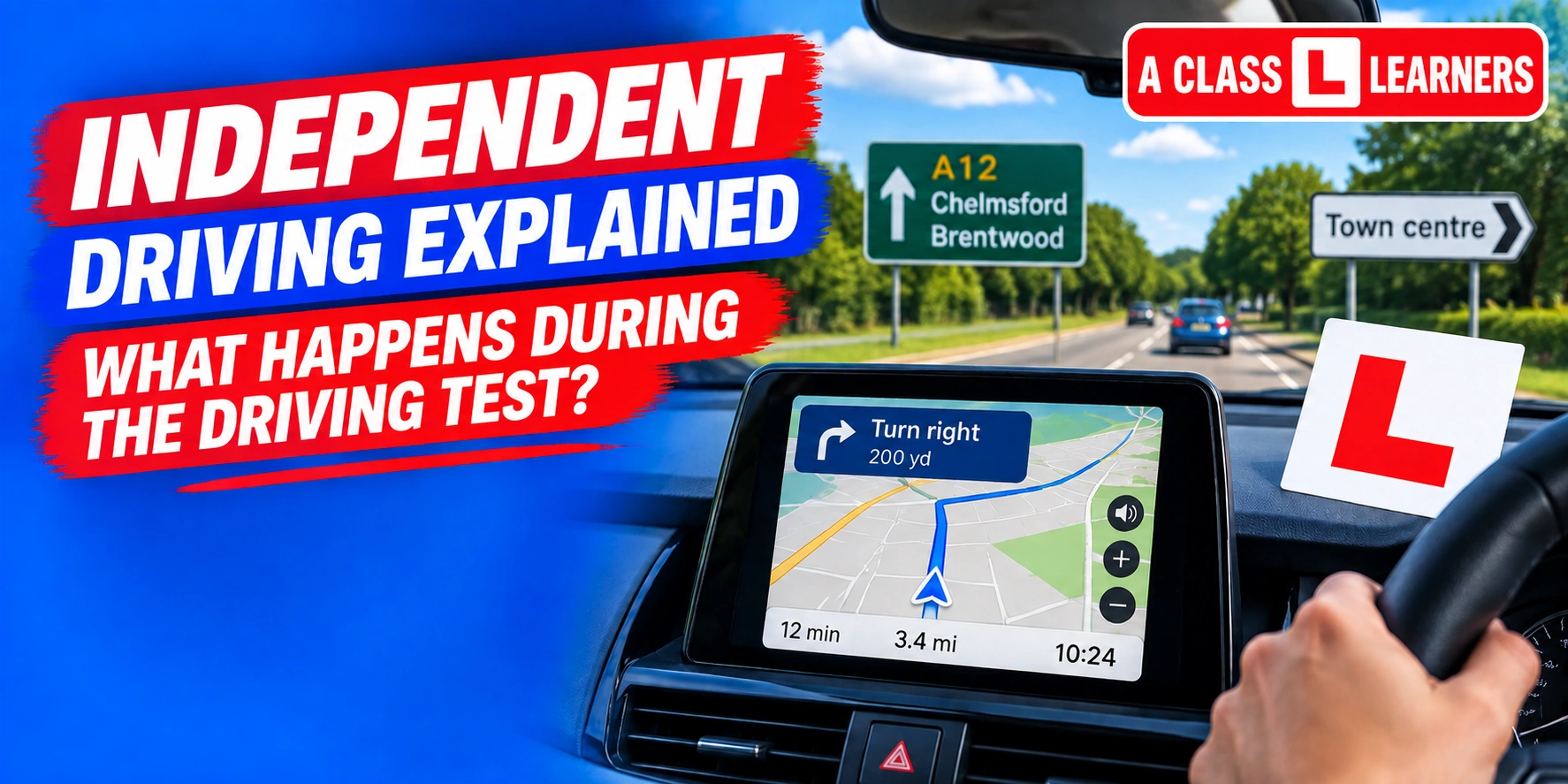
Independent Driving Explained: What Happens During Your Driving Test?
Independent driving is an important part of the practical driving test. During this section, you will be asked to drive independently while following directions and continuing to make safe decisions on the road.
Many learner drivers worry about independent driving because they are concerned about getting lost, taking a wrong turn or forgetting the directions they have been given.
However, independent driving is not designed to test whether you can memorise directions perfectly. The examiner is assessing whether you can continue to drive safely and independently while following directions.
What Is Independent Driving?
Independent driving is a section of your practical driving test where you will drive by following directions provided by the examiner.
You will drive independently for around 20 minutes during your practical driving test.
You will need to follow either:
- directions from a sat nav
- traffic signs
- a combination of both
The examiner will tell you which instructions you need to follow.
Throughout the independent driving section, you must continue to drive safely, observe the road properly and respond appropriately to other road users and changing road conditions.
Will I Use a Sat Nav During Independent Driving?
Many learner drivers will follow directions from a sat nav during the independent driving section of their driving test.
The DVSA has confirmed that approximately 4 out of 5 practical driving tests use directions from an examiner-provided sat nav during independent driving.
The remaining candidates may be asked to follow traffic signs or a combination of traffic signs and other directions.
The examiner will tell you which type of independent driving you will be completing before the section begins.
Can I Use My Own Sat Nav?
No. You cannot use your own sat nav during the practical driving test.
If you are asked to follow sat nav directions, the examiner will provide the sat nav and set it up for you.
You do not need to programme the destination or operate the sat nav while you are driving.
The important thing is that you listen to the directions and continue driving safely.
Do I Have to Follow Every Sat Nav Direction Exactly?
You should make a reasonable effort to follow the directions provided during the independent driving section.
However, taking a wrong turn does not automatically mean that you have failed your driving test.
The examiner is not expecting you to stop suddenly or make an unsafe manoeuvre simply to follow a direction.
If you miss a turning or take the wrong road, continue driving safely and follow the road correctly.
Your examiner can give you further directions if necessary.
What Happens If I Take a Wrong Turn?
Taking a wrong turn is something many learner drivers worry about, but it does not automatically result in a failed driving test.
The most important thing is how safely you deal with the situation.
If you realise that you have missed a turning, do not panic.
- Continue driving safely
- Do not suddenly change direction
- Do not brake sharply unless it is necessary for safety
- Do not make an unsafe manoeuvre to correct your route
- Continue following the road safely
Driving safely is always more important than following the exact route.
What Does the Examiner Look For During Independent Driving?
During independent driving, the examiner will continue assessing your overall ability to drive safely.
This includes your ability to:
- observe the road effectively
- check mirrors when necessary
- respond safely to hazards
- choose an appropriate speed
- position the vehicle correctly
- follow road signs and markings
- make safe decisions at junctions and roundabouts
- respond safely to other road users
- drive independently without constant instructions
The independent driving section is still part of your practical driving test, so the same standards of safe driving apply.
Following Traffic Signs During Independent Driving
Some candidates may be asked to follow traffic signs rather than using a sat nav.
The examiner may ask you to follow signs towards a particular destination.
This means you will need to look for and understand relevant road signs while continuing to concentrate on driving safely.
You should not become so focused on looking for signs that you stop paying attention to the road ahead.
Good observation and planning are important.
Independent Driving Does Not Mean You Are Completely Alone
The examiner will still be sitting in the car with you throughout your practical driving test.
If you are unsure about an instruction, you can ask the examiner to repeat it.
It is better to ask for clarification than to guess and become distracted.
The examiner may also give you directions when necessary to help keep the test progressing safely.
How to Prepare for Independent Driving
The best way to prepare for independent driving is to practise driving with less guidance from your instructor.
During your driving lessons, you could ask your instructor to practise situations where you:
- follow sat nav directions
- follow road signs
- plan your own route
- drive for longer periods without detailed instructions
- deal with unfamiliar roads
- make decisions independently
- respond to changing traffic conditions
The more experience you gain driving independently during your lessons, the more comfortable you may feel during this part of your driving test.
Practise Driving With a Sat Nav
Practising with a sat nav before your test can help you become more comfortable following spoken directions while driving.
However, remember that the sat nav is only providing directions. You are still responsible for driving safely and following the rules of the road.
You should always:
- follow road signs and markings
- observe the road ahead
- check mirrors when necessary
- respond safely to hazards
- make safe decisions
If a sat nav direction appears to conflict with what is safe or legal, you must always drive safely and follow the rules of the road.
Common Mistakes Learners Make During Independent Driving
Independent driving can sometimes cause learners to become distracted because they are concentrating too much on the directions.
Common problems can include:
- forgetting mirror checks
- missing road signs
- poor positioning
- rushing because of a missed turning
- making unsafe attempts to follow directions
- focusing too much on the sat nav
- forgetting to respond to hazards
- panicking after making a small mistake
Try to remember that the directions are only one part of the task. Safe driving must always remain your main priority.
Do You Need to Drive Perfectly During Independent Driving?
No. You do not need to drive perfectly during the independent driving section or any other part of your practical driving test.
You may make a minor mistake without failing your driving test.
However, serious or dangerous mistakes can result in an unsuccessful test.
The goal is to show that you can drive safely and independently.
How to Stay Calm During Independent Driving
Independent driving can feel different from a normal driving lesson because your instructor may usually give you more guidance.
Try to focus on one decision at a time.
If you make a mistake, avoid assuming that you have failed.
Instead:
- stay calm
- continue concentrating
- focus on the road ahead
- continue making safe decisions
- do not rush
One wrong turn or small mistake does not automatically mean that your test is over.
Independent Driving Checklist
- Listen carefully to the examiner's instructions
- Follow the sat nav, traffic signs or directions provided
- Remember that you cannot use your own sat nav
- The examiner will set up the test sat nav for you
- Keep checking your mirrors when necessary
- Continue looking for hazards
- Follow road signs and road markings
- Maintain safe speed and positioning
- Do not panic if you take a wrong turn
- Always prioritise safe driving over following a route
Final Thoughts
Independent driving is designed to show that you can continue driving safely without receiving constant step-by-step instructions.
You may be asked to follow directions from an examiner-provided sat nav, traffic signs or a combination of both.
Remember that taking a wrong turn does not automatically mean that you have failed. The most important thing is that you continue to drive safely and make good decisions.
The best preparation is to practise driving independently during your lessons and become comfortable making your own decisions while continuing to observe, plan and respond safely to the road around you.
Related Learner Driver Guides
You may also find these guides useful:
- First Driving Lesson Guide
- What Should You Bring To Your First Driving Lesson?
- How Many Driving Lessons Do I Need?
- How Often Should You Take Driving Lessons?
- Automatic vs Manual Driving Lessons
- Driving Lesson Costs UK
- Learning To Drive In Your Own Car
- Choosing A Driving Instructor
- Intensive Driving Courses Explained
- Can You Change Driving Instructors?
- What Makes A Good Driving Instructor?
- How To Take Driving Lessons
- Driving Test Waiting Times
- Driving Test Changes 2026
- Can You Swap A Driving Test?
- How To Get An Earlier Driving Test
- How Many Times Can You Change A Driving Test?
- How Long After Failing Can You Retake?
- Driving Test Day Checklist
- Common Reasons Learners Fail Their Driving Test
- How To Pass Your Driving Test First Time
- Show Me Tell Me Questions
- Drug Driving: What Learner Drivers Need To Know
- Driving Test Waiting Times September 2026: DVSA Chief Executive Gives Update
- DVSA Driving Test Release Dates September 2026
Explore Our Complete Learner Driver Guides
Explore our complete guides covering every stage of learning to drive, from your first driving lesson and theory test to preparing for your practical driving test, understanding the Highway Code, mastering driving manoeuvres and keeping up to date with the latest DVSA news and updates related to driving.
- Learn To Drive: The Complete Guide For Learner Drivers
- Driving Tests: The Complete Guide For Learner Drivers
- Theory Test: The Complete Guide For Learner Drivers
- Highway Code: The Complete Guide For Learner Drivers
- Driving Manoeuvres: The Complete Guide For Learner Drivers
- Learner Driver Advice: The Complete Guide For Learner Drivers
- DVSA News & Updates: The Complete Guide For Learner Drivers
Or visit our Driving Lessons & Learner Driver Blogs to explore all our latest driving guides, advice and DVSA updates.
If you're ready to start learning, book your driving lessons online today and take the first step towards becoming a safe, confident and independent driver.
Written by A Class Learners
Providing professional driving lessons across London, Essex and the UK, alongside expert learner driver advice and comprehensive UK driving guides designed to help learners become safe, confident and independent drivers for life.