
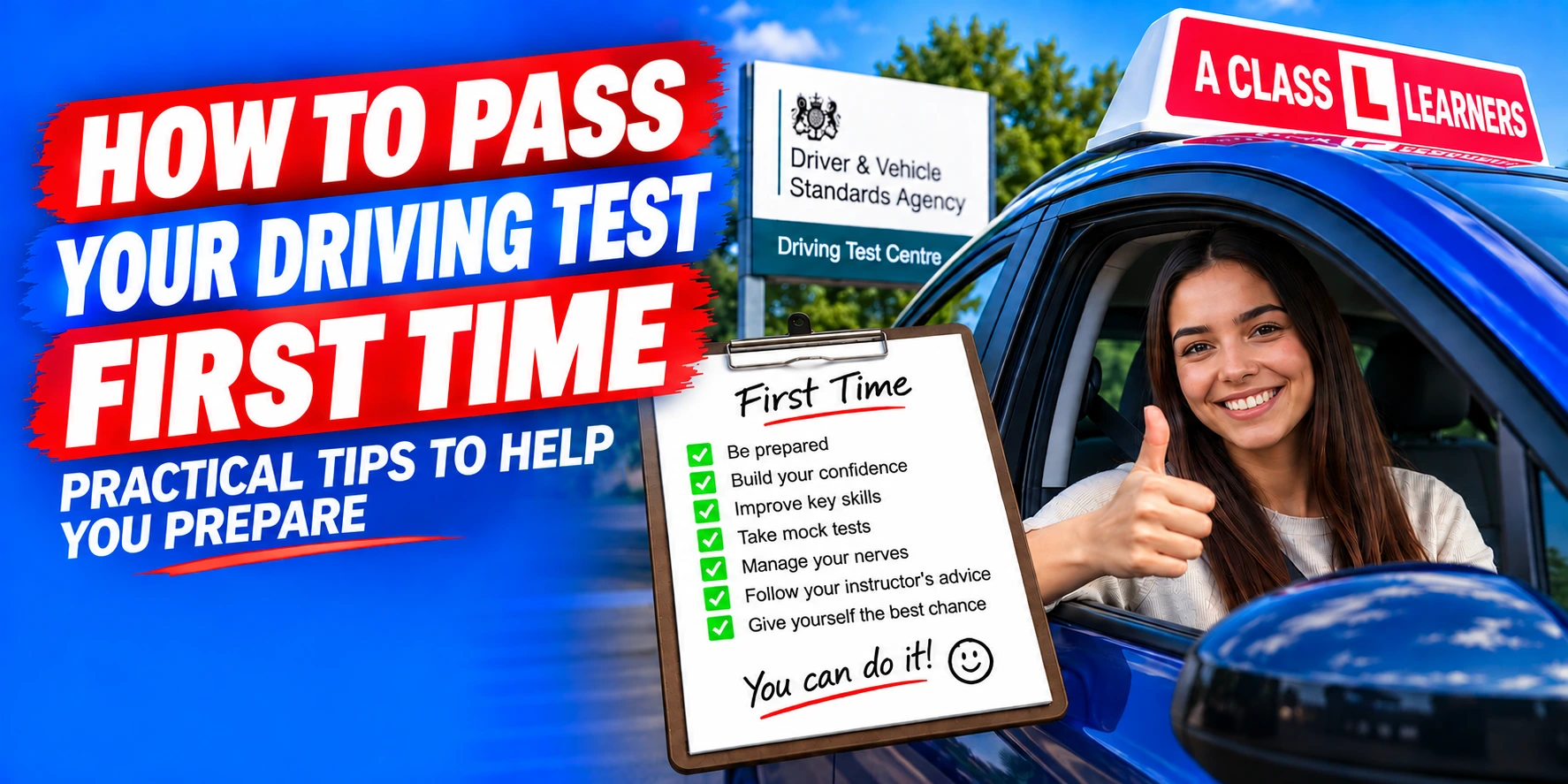
How To Pass Your Driving Test First Time
Passing your driving test first time is a goal for many learner drivers. While there is no guaranteed way to pass, good preparation, regular practice and being genuinely ready to drive independently can give you the best possible chance of success.
The practical driving test is not about driving perfectly or trying to impress the examiner. It is about showing that you can drive safely, make sensible decisions and deal with different situations independently.
One of the most important things to remember is that passing your driving test should not be the only goal. The skills you develop while preparing for your test are the same skills you will need when you are driving on your own after you pass.
Use this guide to understand how to prepare for your driving test, identify areas that may need more practice and feel more confident when test day arrives.
How To Give Yourself the Best Chance of Passing Your Driving Test First Time
- Make sure you are genuinely ready for your driving test
- Listen to your driving instructor's advice
- Take regular driving lessons
- Practise on different types of roads
- Develop your ability to drive independently
- Improve your observation and planning
- Practise junctions and roundabouts
- Improve your vehicle control
- Take mock driving tests
- Practise your manoeuvres
- Understand road signs and road markings
- Learn how to manage driving test nerves
- Learn from mistakes instead of worrying about them
- Focus on driving safely rather than trying to be perfect
Are You Really Ready to Take Your Driving Test?
One of the biggest decisions before taking your practical driving test is deciding whether you are genuinely ready.
Having a driving test booked does not automatically mean you are ready to take it. You may have waited a long time for your appointment, but it is important to think about whether you can consistently drive safely and independently.
The DVSA's Ready to Pass? campaign encourages learners to consider whether they can drive without prompts, avoid serious or dangerous mistakes, pass mock tests, manage their nerves and have their instructor's agreement that they are ready.
A useful question to ask yourself is:
If your driving instructor was not sitting beside you giving you advice or prompts, would you still be able to deal safely with everything happening around you?
Your practical driving test is designed to assess whether you are ready to drive independently after passing.
Listen to Your Driving Instructor
Your driving instructor sees your driving regularly and can identify areas where you may still need more practice.
Sometimes learners feel ready because they have been learning for a long time or because they have a driving test booked. However, the amount of time you have spent learning does not necessarily determine whether you are ready to pass.
Your instructor may identify issues that you do not notice yourself, such as:
- missing important observations
- needing prompts in unfamiliar situations
- hesitation at junctions
- difficulty judging safe gaps
- inconsistent vehicle control
- problems with road positioning
- struggling to drive independently
If your instructor recommends more practice, try to see this as useful advice rather than a setback.
Being fully prepared before taking your test can save you the disappointment and expense of taking a test before you are ready.
Develop the Skills You Need to Drive Safely
Passing your driving test requires more than simply learning a few manoeuvres or memorising routes around a test centre.
You need to develop a wide range of driving skills and be able to apply them consistently in different situations.
The DVSA Ready to Pass? campaign groups the skills learners develop into areas including vehicle control and positioning, observation and planning, junctions and roundabouts, manoeuvres, different road types, different driving conditions and independent route following.
The more experience you have dealing with different situations, the better prepared you are likely to feel when you encounter something unfamiliar during your driving test.
Take Regular Driving Lessons
Regular driving lessons can help you build your skills gradually and give you the opportunity to work on areas where you need improvement.
Long gaps between lessons can make it harder to maintain progress, particularly if you are still developing skills such as clutch control, observation, road positioning or judgement.
Regular lessons also give your instructor the opportunity to monitor your progress and introduce you to different roads, traffic conditions and driving situations.
Every learner progresses at a different speed, so try not to compare your progress with other people.
Practise on Different Types of Roads
It is important not to practise only on the same familiar roads.
Driving in different locations can help you develop the ability to adapt to unfamiliar situations.
Before your test, try to gain experience on different types of roads where appropriate to your level of experience.
This may include:
- quiet residential roads
- busy urban roads
- roads with parked vehicles
- different types of junctions
- roundabouts
- dual carriageways where appropriate
- country roads where appropriate
- roads with different speed limits
- multi-lane roads
- one-way systems
Different roads require you to adapt your speed, observation, positioning and planning.
Improve Your Observation and Planning
Good observation is one of the most important parts of safe driving.
You need to remain aware of what is happening around your vehicle and recognise developing hazards early enough to respond safely.
This includes using your mirrors effectively and checking what is happening around you before changing speed, direction or position.
Try to develop the habit of looking ahead and planning for what may happen next.
For example, you may need to consider:
- pedestrians approaching a crossing
- vehicles slowing down ahead
- cyclists travelling close to your vehicle
- parked vehicles causing an obstruction
- changes in speed limits
- road signs and lane markings
- traffic approaching from side roads
Good planning can help prevent you from having to make rushed decisions.
Practise Junctions and Roundabouts
Junctions and roundabouts require you to combine several important driving skills.
You may need to observe approaching traffic, judge speed and distance, choose the correct position, control your speed and decide when it is safe to proceed.
Try to practise different types of junctions rather than only repeating the same familiar locations.
Useful practice can include:
- emerging from side roads
- turning left and right
- meeting crossroads
- mini-roundabouts
- larger roundabouts
- multi-lane roundabouts
- busy junctions
The goal is not to memorise individual junctions. It is to develop the skills needed to deal safely with unfamiliar junctions.
Improve Your Vehicle Control
You need to show that you can control your vehicle safely and smoothly.
For learners driving a manual car, this may include developing good clutch control and being able to move away, change gear and control the vehicle without becoming distracted.
For all drivers, good vehicle control includes:
- smooth steering
- appropriate braking
- controlling your speed
- maintaining good road position
- moving away safely
- stopping safely
- controlling the vehicle during manoeuvres
You do not need to drive in an exaggerated or unnatural way. The aim is to develop safe control that becomes a normal part of your driving.
Take Mock Driving Tests
One of the best ways to prepare for your practical driving test is to take a realistic mock driving test with your instructor.
A mock test can help you experience what it feels like to drive without receiving your usual prompts and guidance.
The DVSA Ready to Pass? campaign explains that mock tests can help learners identify areas that still need improvement, become more familiar with test conditions and build confidence before taking the real test.
A realistic mock test can include many of the elements you may experience during a practical driving test, including an eyesight check, vehicle safety questions, general driving, independent driving, reversing and feedback afterwards.
A mock test can be particularly useful because it may reveal problems that are less noticeable during an ordinary lesson.
If you do not perform as well as you hoped during a mock test, try not to see it as a failure. It has done its job by helping you identify what needs more practice before your real test.
Practise Driving Independently
During your driving test, you need to show that you can drive independently.
For part of the test, you may be asked to follow directions from a sat nav or follow traffic signs.
Independent driving is not simply about following directions correctly. You still need to:
- make effective observations
- maintain safe road positioning
- respond to hazards
- follow road signs and markings
- choose the correct speed
- make safe decisions
Practising independent driving during your lessons can help you become more comfortable making decisions without regular prompts.
If you take a wrong turning, do not panic. Taking a wrong route does not automatically mean you have failed. What matters is how safely you deal with the situation.
Practise Your Manoeuvres
You should be comfortable carrying out the manoeuvres that may form part of your practical driving test.
However, the manoeuvre itself is only one part of the task.
You also need to maintain control of the vehicle and make effective observations throughout.
Take your time where necessary and remain aware of pedestrians, cyclists and other road users.
If you need to correct your position, do not automatically panic. Focus on continuing safely and maintaining proper observation.
Understand Road Signs and Road Markings
Road signs and road markings provide important information about how you should drive.
Before your driving test, make sure you are comfortable recognising and responding to:
- speed limit signs
- direction signs
- lane markings
- road arrows
- give way markings
- stop lines
- traffic lights
- pedestrian crossings
- temporary road signs
It is important not just to recognise signs but to respond to them early enough to drive safely.
Learn From Common Driving Test Mistakes
Understanding the mistakes that commonly cause learners problems can help you identify areas where you may need more practice.
Common issues can include problems with observation, judgement, positioning, responding to other road users, controlling speed and making safe decisions.
However, the purpose of learning about common mistakes is not to make yourself more nervous.
Instead, use this information to have an honest discussion with your instructor about your own driving.
Before your test, you may also find our guide useful:
Common Reasons Learners Fail Their Driving Test
This guide explains some of the areas that can cause learners difficulties and how better preparation can help.
Learn How to Manage Driving Test Nerves
Feeling nervous before a driving test is completely normal.
You will not fail simply because you feel nervous. However, nerves can affect concentration and decision-making if they cause you to rush, hesitate unnecessarily or overthink situations.
The DVSA Ready to Pass? campaign encourages learners to practise ways of managing their nerves before taking their test, so they can stay calm and focused while driving.
Some useful approaches may include:
- taking mock driving tests
- practising in unfamiliar situations
- taking your time when making decisions
- focusing on the road ahead
- not assuming one mistake means you have failed
- listening carefully to instructions
- using the breathing or relaxation techniques that work best for you
Managing nerves is something you can practise before test day rather than hoping you will suddenly feel completely relaxed on the day.
What Should You Do If You Make a Mistake During Your Driving Test?
One of the most important things to remember is that you should not assume you have failed because you think you have made a mistake.
You may make a minor mistake without failing your driving test.
If something does not go as planned:
- stay calm
- continue concentrating on the road
- do not replay the mistake in your mind
- focus on the next situation
- continue driving safely
Becoming distracted because you are worrying about something that happened several minutes earlier could lead to further mistakes.
Focus on what you can control — your driving from that moment onwards.
Do You Need to Drive Perfectly to Pass Your Driving Test?
No. You do not need to drive perfectly to pass your practical driving test.
The examiner is assessing whether you can drive safely and independently.
You may make some minor mistakes during your test without receiving an unsuccessful result.
However, serious or dangerous mistakes can result in a failed test.
Try not to concentrate on trying to make every movement look perfect. Focus instead on making safe decisions, maintaining good observation and responding appropriately to what is happening around you.
Should You Take Your Test If You Are Not Ready?
If you are not feeling ready, it is worth speaking honestly with your driving instructor before taking your test.
Having a test appointment can create pressure, particularly when driving test waiting times are long. However, taking a test before you are ready can lead to unnecessary disappointment and additional expense.
The DVSA Ready to Pass? campaign advises learners to take their test when they feel completely prepared and explains that additional preparation time can be used to improve driving skills, take mock tests and practise managing nerves.
If you need to change your test appointment, always check the current DVSA rules and notice requirements before making changes.
How To Prepare in the Final Weeks Before Your Driving Test
As your driving test approaches, focus your practice on the areas where you genuinely need improvement.
This may include:
- taking one or more mock driving tests
- practising independent driving
- driving on unfamiliar roads
- practising junctions and roundabouts
- improving mirror and observation routines
- working on vehicle control
- practising manoeuvres
- revising road signs and road markings
- practising ways to manage nerves
Try to avoid spending all your time practising only the things you already find easy.
Your final lessons should help you strengthen any areas that still need improvement while maintaining confidence in the skills you already have.
Final Tips for Passing Your Driving Test First Time
- Make sure you are genuinely ready before taking your test
- Drive independently without needing regular prompts
- Listen to your driving instructor's advice
- Take mock driving tests
- Practise on different types of roads
- Improve your observation and planning
- Practise junctions and roundabouts
- Develop good vehicle control
- Practise manoeuvres and independent driving
- Understand road signs and road markings
- Practise managing your nerves
- If you make a mistake, stay focused and continue driving safely
- Focus on being a safe driver rather than trying to drive perfectly
Final Thoughts
There is no guaranteed way to pass your driving test first time.
However, the best way to give yourself a strong chance is to make sure you are genuinely ready to drive safely and independently.
Good preparation is not about memorising test routes or trying to predict exactly what will happen during your test.
It is about developing the skills, experience and confidence needed to deal safely with whatever situations you encounter on the road.
Listen to your instructor, take mock tests, practise the areas where you need improvement and remember that becoming a safe and independent driver is more important than simply passing a test.
Related Learner Driver Guides
You may also find these guides useful:
- First Driving Lesson Guide
- What Should You Bring To Your First Driving Lesson?
- How Many Driving Lessons Do I Need?
- How Often Should You Take Driving Lessons?
- Automatic vs Manual Driving Lessons
- Driving Lesson Costs UK
- Learning To Drive In Your Own Car
- Choosing A Driving Instructor
- Intensive Driving Courses Explained
- Can You Change Driving Instructors?
- What Makes A Good Driving Instructor?
- How To Take Driving Lessons
- Driving Test Waiting Times
- Driving Test Changes 2026
- Can You Swap A Driving Test?
- How To Get An Earlier Driving Test
- How Many Times Can You Change A Driving Test?
- How Long After Failing Can You Retake?
- Driving Test Day Checklist
- Common Reasons Learners Fail Their Driving Test
- Drug Driving: What Learner Drivers Need To Know
- Driving Test Waiting Times September 2026: DVSA Chief Executive Gives Update
- DVSA Driving Test Release Dates September 2026
Explore Our Complete Learner Driver Guides
Explore our complete guides covering every stage of learning to drive, from your first driving lesson and theory test to preparing for your practical driving test, understanding the Highway Code, mastering driving manoeuvres and keeping up to date with the latest DVSA news and updates related to driving.
- Learn To Drive: The Complete Guide For Learner Drivers
- Driving Tests: The Complete Guide For Learner Drivers
- Theory Test: The Complete Guide For Learner Drivers
- Highway Code: The Complete Guide For Learner Drivers
- Driving Manoeuvres: The Complete Guide For Learner Drivers
- Learner Driver Advice: The Complete Guide For Learner Drivers
- DVSA News & Updates: The Complete Guide For Learner Drivers
Useful Official DVSA Advice
For further official guidance on preparing for your practical driving test, you can visit the DVSA's Ready to Pass? campaign, which includes advice about developing your driving skills, taking mock tests and managing driving test nerves.
Visit the official DVSA Ready to Pass? campaign
Or visit our Driving Lessons & Learner Driver Blogs to explore all our latest driving guides, advice and DVSA updates.
If you're ready to start learning, book your driving lessons online today and take the first step towards becoming a safe, confident and independent driver.
Written by A Class Learners
Providing professional driving lessons across London and Essex, alongside expert learner driver advice and comprehensive UK driving guides designed to help learners become safe, confident and independent drivers for life.