
Choosing a Driving Instructor: How to Find the Right Driving Instructor for You
Choosing a driving instructor is one of the most important decisions you'll make when learning to drive.
The right driving instructor doesn't simply teach you how to pass a driving test. They should help you understand the road, develop safe driving habits, recognise hazards, make confident decisions and gradually become capable of driving independently.
You'll potentially spend many hours sitting beside your driving instructor, so their teaching style, patience, reliability and ability to communicate with you can make a significant difference to your learning experience.
Price is obviously important, but choosing a driving instructor based entirely on the cheapest hourly rate can be a mistake. The quality and structure of your lessons, how efficiently you're progressing and whether your driving instructor suits the way you learn can have a much greater effect on the total cost of learning to drive.
There are also practical things to consider. Is the instructor properly registered? Do they teach manual or automatic? What happens if you cancel a lesson? Can you use their car for your practical driving test? How do they monitor your progress? And how can you tell whether you're genuinely progressing rather than simply paying for driving lesson after driving lesson?
In this complete guide, we'll explain what to look for when choosing a driving instructor, the difference between qualified and trainee driving instructors, questions to ask before booking, warning signs to look out for and what you can do if your current instructor simply isn't right for you.
Why Choosing the Right Driving Instructor Matters
Learning to drive is very different from many other things you'll learn.
You're developing practical skills while simultaneously learning to observe traffic, anticipate hazards, understand other road users and make safe decisions.
A good driving instructor needs to do far more than tell you when to change gear or turn the steering wheel.
They need to understand what you're struggling with, explain concepts in a way that makes sense to you and gradually increase the difficulty of your driving as your skills improve.
A driving instructor who is perfect for one learner won't necessarily be perfect for another.
Some learners prefer a driving instructor who talks through everything in considerable detail. Others learn better through demonstrations or by being allowed to attempt something and then discussing it afterwards.
Some learners are naturally confident behind the wheel. Others need more reassurance and time before moving on to challenging roads or situations.
Finding a driving instructor whose approach works for you can make learning more enjoyable and productive.
What Is an Approved Driving Instructor?
In Great Britain, someone who charges you for professional car driving instruction must be authorised to do so.
A fully qualified driving instructor is known as an Approved Driving Instructor, usually shortened to ADI.
Approved Driving Instructors are registered with the Driver and Vehicle Standards Agency (DVSA).
Becoming an ADI involves completing a qualification process covering driving theory, driving ability and instructional ability.
An ADI providing paid instruction must display their registration certificate in the vehicle.
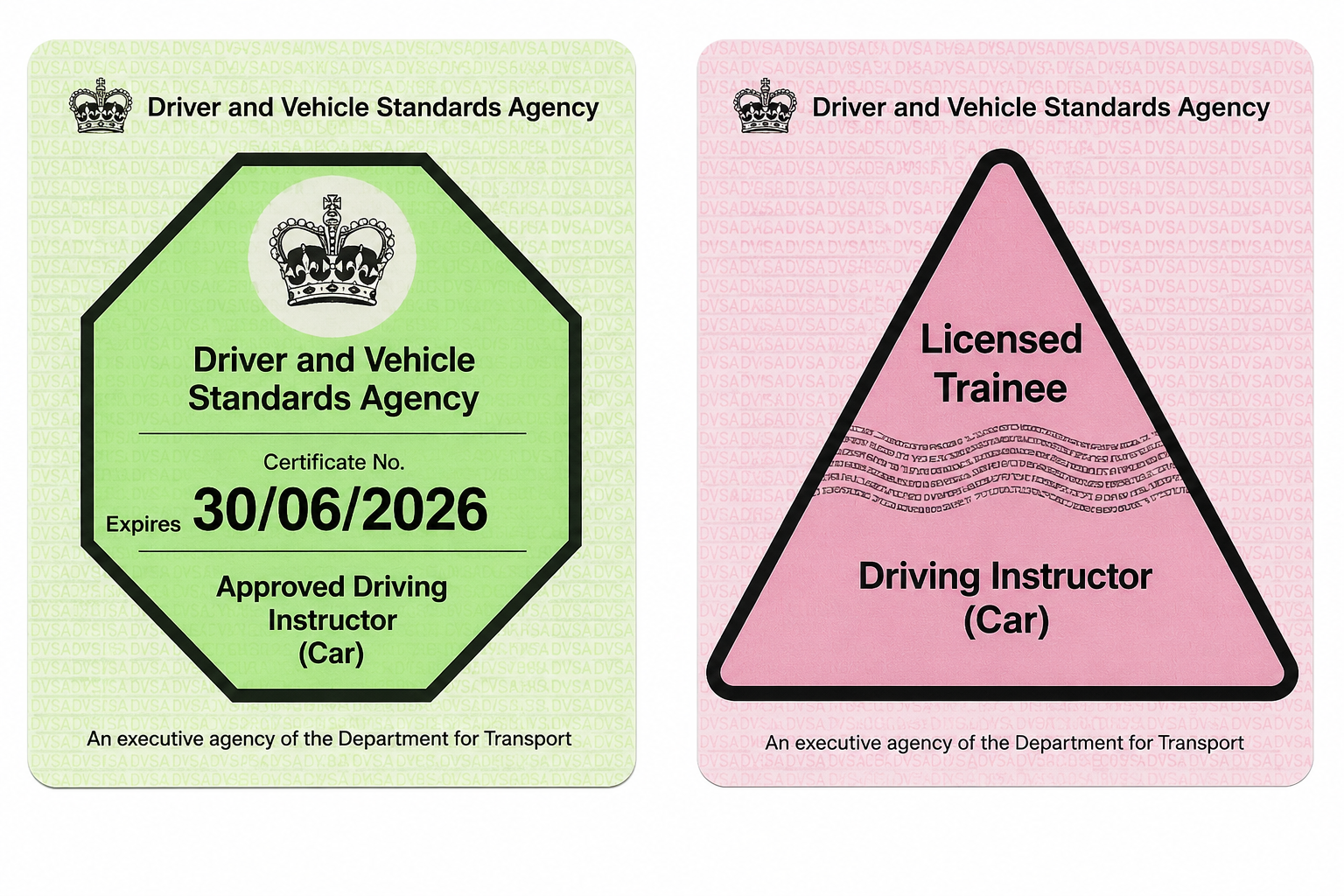
The badge displayed by a fully qualified ADI is green.
If you're paying someone for driving lessons, don't feel uncomfortable about checking that they're properly authorised. A legitimate professional driving instructor should have no problem with you checking their status.
What Does a Pink Driving Instructor Badge Mean?
You may sometimes notice that a driving instructor has a pink badge rather than a green one.
This means they're a trainee driving instructor who has been authorised to provide paid driving instruction while working towards completing the qualification process.
A trainee instructor isn't the same as an unregistered person simply deciding to charge people for lessons.
They have gone through part of the qualification process and have been granted permission to provide paid tuition while gaining experience.
Don't automatically assume that a trainee instructor will provide poor tuition. Some learners have excellent experiences with trainee instructors.
Equally, you are entitled to know whether the person teaching you is fully qualified or currently a trainee.
Green Badge or Pink Badge: Which Should You Choose?
Green Badge or Pink Badge: Which Should You Choose?
A green badge confirms that the instructor is a fully qualified ADI, while a pink badge identifies an authorised trainee driving instructor.
For many learners, choosing a fully qualified ADI may provide additional reassurance because the instructor has completed the full qualification process.
However, qualification status isn't the only thing that determines whether someone will be a good driving instructor for you.
A trainee driving instructor may be enthusiastic, well prepared and particularly focused on developing their teaching skills. A fully qualified instructor may have many years of experience dealing with different learners and difficult driving situations.
Consider the complete picture: professionalism, communication, reliability, teaching ability and how well you work together.
How Can You Check Whether a Driving Instructor Is Approved?
The DVSA provides an online service that allows members of the public to search for approved driving instructors.
However, not every ADI appears in the public search because instructors can choose whether their details are published.
This means you shouldn't automatically assume someone isn't qualified simply because you can't find them in an online search.
If you're uncertain, you can ask the instructor for their details and check their registration with the DVSA.
You should also be able to see the appropriate green or pink badge displayed in the vehicle when you're receiving paid driving instruction.
Start by Deciding Between Manual and Automatic Lessons
Before looking for an instructor, decide whether you want to learn in a manual or automatic car.
This will immediately narrow your search because not every instructor offers both.
If you pass your practical driving test in a manual car, your licence allows you to drive both manual and automatic cars.
If you pass in an automatic car, your licence is restricted to automatic cars unless you later pass the relevant test in a manual vehicle.
Automatic driving lessons have become increasingly popular with learners who prefer not to deal with clutch control and manual gear changes.
Manual lessons remain attractive to learners who want the flexibility of being able to drive both transmission types after passing.
There isn't one correct choice for everybody.
Your confidence, future driving plans, budget and personal preference should all be considered.
For a detailed comparison, read our Automatic Driving Lessons vs Manual Driving Lessons Guide.
Don't Choose a Driving Instructor on Price Alone
It's completely understandable to compare driving lesson prices.
Learning to drive can represent a significant financial commitment, particularly when you consider lessons, your provisional licence, theory test, practical test and other costs.
However, the cheapest hourly driving lesson isn't necessarily the cheapest way to learn.
Imagine one instructor charges a little less per hour but your lessons are poorly structured and progress is slow. Another charges more but identifies your weaknesses quickly, plans lessons effectively and helps you progress efficiently.
The second instructor could ultimately cost you less.
When comparing prices, look at the complete service rather than one number.
Consider lesson duration, teaching quality, reliability, progress, cancellation terms, block booking discounts and any additional charges associated with your practical test.
You can find more information about the overall cost of learning in our Driving Lesson Costs UK Guide.
Ask Exactly How Long a Driving Lesson Lasts
Make sure you understand the duration of the driving lesson you're paying for.
Driving schools and individual driving instructors may offer one-hour, 90-minute or two-hour lessons.
Don't compare two advertised prices without checking whether the lesson duration is actually the same.
You should also receive the amount of lesson time you've agreed to pay for.
Occasionally, part of a lesson will appropriately involve discussion rather than driving. Your driving instructor may need to explain a new subject, review what happened during a particular situation or discuss your progress.
That can be valuable tuition.
But repeatedly receiving lessons that are substantially shorter than you've paid for is different and should be questioned.
Consider the Driving Instructor's Availability
A brilliant driving instructor isn't much use if their availability doesn't fit your schedule.
Before committing, ask about the days and times they normally teach.
If you need lessons after college, after work, at weekends or at a particular time of day, establish whether those appointments are realistically available.
Also ask how frequently they can offer lessons.
If you want weekly lessons but the driving instructor can only accommodate you once every three weeks, that arrangement may not suit you.
Consistency can be useful when developing new skills because very long gaps may mean spending part of each lesson getting comfortable again.
For more guidance about lesson frequency, read our How Often Should You Take Driving Lessons? Guide.
Find Out Which Areas the Instructor Covers
Driving instructors usually work within defined areas because travelling long distances between pupils reduces the number of lessons they can provide.
Check whether the driving instructor covers your home, school, college or workplace if you need to be collected from those locations.
You can also ask whether lessons can start in one place and finish somewhere else when arranged in advance.
This can be particularly useful if you're trying to fit driving lessons around work or education.
Look for a Driving Instructor Who Adapts to the Way You Learn
One of the most important qualities of a good driving instructor is the ability to adapt.
People don't all learn in exactly the same way or at exactly the same speed.
If you don't understand an explanation, a good driving instructor should be able to explain the same concept differently rather than simply repeating the same words.
They might use a diagram, demonstration, question-and-answer approach or break the skill into smaller stages.
Your driving instructor should also recognise when you're ready for more independence.
At the beginning, you may need considerable guidance.
As you progress, your instructor should gradually reduce that assistance so you're making more decisions for yourself.
After all, the eventual goal is for you to drive safely without a driving instructor sitting beside you.
Patience Is Important, but So Is Constructive Feedback
A patient driving instructor can make an enormous difference, particularly if you're nervous or worried about making mistakes.
But patience doesn't mean ignoring mistakes.
You need accurate and constructive feedback to improve.
A good driving instructor should be able to tell you what went wrong without making you feel afraid to try again.
Instead of simply saying, "That was wrong", they should help you understand why it happened and what you can do differently next time.
You should gradually become better at identifying your own mistakes too.
That's an important part of developing independent driving skills.
You Should Feel Comfortable Asking Questions
You will almost certainly have questions while learning to drive.
Ask them.
You shouldn't feel embarrassed about not understanding something you're still learning.
A professional instructor should encourage sensible questions and explain things clearly.
If you're constantly afraid to ask because the instructor becomes irritated, dismissive or makes you feel foolish, the learning relationship probably isn't working as well as it should.
You don't need an instructor who agrees with everything you say, but you should have one with whom you can communicate comfortably and respectfully.
What Should a Well-Structured Driving Lesson Look Like?
Every lesson will be different, but good driving tuition should have purpose and structure.
At the beginning of a lesson, your driving instructor may review what you worked on previously and discuss what you're going to concentrate on next.
During the lesson, you should have opportunities to practise skills appropriate to your current ability.
Your instructor should observe your driving, provide feedback and adjust the level of support as necessary.
At the end, there should ideally be an opportunity to discuss what went well, what needs improvement and what you may work on during your next driving lesson.
You shouldn't finish every lesson wondering what you actually learned.
If you're about to start learning, our What Happens on Your First Driving Lesson? Guide explains what you can expect when you begin.
Your Progress Should Be Monitored
Good driving tuition shouldn't feel like an endless series of unrelated drives.
Your driving instructor should have an understanding of what you've covered, what you're currently developing and what still needs work.
The current ADI Code of Practice says driving instructors who follow the code should make a record of a client's progress, including the number of driving lessons provided, and make the learner aware of their progress and future training requirements.
You should therefore be able to ask questions such as:
- What am I doing well?
- What skills still need improvement?
- What are we working on next?
- What should I practise privately?
- What is stopping me from being test-ready?
There isn't a fixed number of professional driving lessons that every learner must complete.
Progress depends on the individual, lesson frequency, previous experience, private practice and many other factors.
Our How Many Driving Lessons Do I Need? Guide looks at this in more detail.
Ask About the Cancellation Policy Before You Book
Cancellation policies are easy to ignore until you actually need to cancel.
Ask about them before paying for lessons or a block booking.
Find out how much notice you need to give if you can't attend and whether you'll still be charged.
You should also understand what happens if the instructor cancels.
Life happens. Learners and instructors sometimes become ill, cars develop problems and unexpected events occur.
An occasional cancellation doesn't necessarily indicate an unreliable driving instructor.
Repeated last-minute cancellations are another matter.
Clear terms prevent misunderstandings later.
Be Careful When Paying for Large Block Bookings
Block bookings can reduce the average price of driving lessons and can be useful when you've found an instructor you're happy with.
However, consider taking an initial driving lesson before committing a large amount of money.
A recommendation or excellent online review can't guarantee that a driving instructor's teaching style will suit you personally.
Before purchasing a block, check:
- How many hours you're buying.
- How long you have to use them.
- Whether there are any restrictions.
- The cancellation terms.
- The refund policy.
- What happens if your instructor becomes unavailable.
Keep confirmation of payments and bookings.
A reputable driving school or instructor should be clear about the terms applying to money you've paid in advance.
Ask About Using the Driving Instructor's Car for Your Driving Test
Don't assume that paying for driving lessons automatically guarantees use of your driving instructor's car for your practical test.
Ask about this before test day.
Find out whether there is a separate charge, how much time is included and what conditions apply.
Your instructor also needs to be satisfied that you're ready to use their vehicle for the test.
Booking a test doesn't automatically mean an instructor has to consider you ready to take it in their car.
Discuss your test plans with your instructor rather than booking something and informing them afterwards.
How Useful Are Driving Instructor Reviews?
Online reviews can be useful when choosing a driving instructor, particularly when you look for patterns rather than individual comments.
Read what previous learners say about things such as:
- Patience.
- Reliability.
- Communication.
- Teaching style.
- Professionalism.
- Confidence building.
- Driving lesson structure.
A large number of detailed reviews mentioning similar strengths can give you useful information.
However, reviews shouldn't replace your own judgement.
A driving instructor who worked brilliantly with someone else may not necessarily be the best match for you.
Recommendations From Friends and Family Can Help
Personal recommendations remain a useful way to find driving instructors.
If a friend, relative, colleague or classmate recently learned to drive, ask about their experience.
Don't simply ask whether the instructor was "good".
Ask why.
Were they reliable? Did they explain things clearly? Were driving lessons structured? Did they remain calm when mistakes happened? Did the learner understand their progress?
The more specific the recommendation, the more useful it becomes.
Choosing a Driving Instructor If You're a Nervous Learner
If you're particularly nervous about learning to drive, the instructor's personality and teaching style may matter even more.
Tell potential instructors that you're nervous before booking.
Ask whether they regularly teach nervous learners and how they normally approach the first few lessons.
A good instructor shouldn't push you into situations you're clearly not ready to manage simply to prove a point.
At the same time, effective tuition should gradually challenge you as your skills improve.
Confidence doesn't usually develop by avoiding every difficult situation forever.
The aim is controlled progression: building the skills you need and then gradually applying them in more demanding situations.
Choosing a Driving Instructor After Failing a Driving Test
Failing a practical driving test can be disappointing, but it doesn't necessarily mean you need to start learning again from the beginning.
If you're looking for a new instructor after an unsuccessful test, explain your situation.
If you have your test feedback, discuss the areas that caused difficulty.
A new driving instructor may want to assess your overall driving before deciding what tuition you need.
Be wary of anyone who promises to get you through another test after a specific tiny number of lessons without first seeing you drive.
A proper assessment gives the driving instructor a much better basis for recommending what you should work on.
Choosing a Driving Instructor When You're Nearly Test-Ready
Sometimes learners need a new instructor relatively late in the learning process.
Your previous driving instructor may stop teaching, move away, change availability or you may simply decide the relationship isn't working.
Tell the new driving instructor exactly where you are in your learning journey.
Don't be surprised if they want to assess your driving before agreeing that you're test-ready.
Different driving instructors may notice different weaknesses.
This doesn't necessarily mean the new instructor is trying to sell you unnecessary driving lessons.
They need to understand your driving before allowing you to use their vehicle or advising you about test readiness.
Should You Choose an Independent Instructor or Driving School?
You may have the choice between booking directly with an independent driving instructor and using a larger driving school.
Neither option is automatically better.
An independent instructor may provide a very personal service and you'll usually deal directly with the person teaching you.
A driving school may have several instructors covering different areas, potentially giving you more choice of manual or automatic tuition and availability.
The individual driving instructor still matters enormously.
Whichever option you choose, look at professionalism, terms, communication, teaching quality and whether the service meets your needs.
What Car Will You Learn In?
The tuition vehicle shouldn't be your only consideration, but it's reasonable to ask what you'll be learning in.
You may want to know whether it's manual or automatic, petrol, diesel, hybrid or electric and whether the vehicle is suitable for your needs.
You may want to know whether it's manual or automatic, petrol, diesel, hybrid or electric and whether the vehicle is suitable for your needs.
If you're learning in a manual car, it's also worth knowing whether the car is petrol or diesel, as the way the vehicle feels when moving away can be slightly different.
In a petrol manual car, you'll usually need to apply a small amount of pressure to the accelerator before or as you bring the clutch up towards the biting point. Driving instructors often call this "setting the gas". The accelerator should be held steadily while you bring the clutch up smoothly, allowing the car to move away without stalling.
In a diesel manual car, the engine often has more pulling power at low engine speeds. Depending on the vehicle, you may be able to bring the clutch up to the biting point and begin moving with little or no accelerator on a level road. You can then apply the accelerator smoothly as the car moves away.
However, every car is slightly different. Some modern petrol and diesel cars automatically increase the engine speed as the clutch begins to engage, while others require more input from the driver. Your driving instructor should teach you how to coordinate the clutch and accelerator correctly for the particular car you're learning in.
A professional driving tuition car should be properly maintained and suitable for teaching.
You should also feel comfortable in the driving position and be able to operate the controls safely.
Don't choose a driving instructor purely because you like the car, though.
A good teacher in a less exciting car is considerably more valuable than a poor teacher in your favourite model.
Can You Combine Professional Driving Lessons With Private Practice?
Yes, and for many learners this can work extremely well.
Your driving instructor can introduce new skills, correct mistakes and provide structured professional tuition.
Private practice can then give you additional opportunities to reinforce those skills.
If you're practising outside your professional driving lessons, tell your instructor.
They may be able to suggest specific areas for you to work on between lessons.
Make sure any private practice is legal, appropriately insured and supervised.
If you're considering practising in your own vehicle, read our Learning to Drive in Your Own Car Guide.
Signs You've Found a Good Driving Instructor
There isn't a single personality type that makes someone a good instructor, but there are several positive signs to look for.
A good instructor will generally:
- Behave professionally and respectfully.
- Arrive reliably for agreed lessons.
- Provide the lesson duration you've booked.
- Explain things clearly.
- Adapt explanations when you don't understand.
- Allow you to ask questions.
- Give constructive feedback.
- Keep lessons appropriate to your ability.
- Gradually increase your independence.
- Help you understand your progress.
- Identify areas that need improvement.
- Be clear about prices and cancellation terms.
- Prioritise safe driving rather than simply rushing you towards a test.
Most importantly, you should feel that you're learning.
Warning Signs to Look Out For
One imperfect driving lesson doesn't necessarily mean you have a bad driving instructor.
However, repeated patterns can indicate a problem.
Warning signs may include:
- Frequently arriving late.
- Repeatedly cancelling lessons at short notice.
- Regularly ending lessons earlier than agreed.
- Spending excessive lesson time dealing with personal matters.
- Using a handheld mobile phone while supervising your driving.
- Shouting or swearing at you.
- Making inappropriate comments.
- Using unnecessary physical contact.
- Being unclear about money you've paid in advance.
- Refusing to explain your progress.
- Constantly making you repeat the same easy routes without a clear reason.
- Pressuring you to book large numbers of lessons immediately.
- Making unrealistic guarantees that you'll pass.
- Making you feel frightened to ask questions or admit mistakes.
Driving lessons should be professional.
You are paying for driving tuition and you're entitled to expect an appropriate standard of service and behaviour.
Your Driving Instructor Shouldn't Be Using Their Phone While You're Driving
This deserves particular attention.
Your driving instructor is supervising a learner driver and needs to pay attention to what's happening on the road.
The DVSA's guidance specifically identifies mobile phone use while a pupil is driving as inappropriate instructor behaviour.
An instructor being distracted by messages, social media or unrelated phone calls while you're driving isn't something you should simply accept as normal.
What If Your Driving Instructor Shouts at You?
Learning to drive involves making mistakes.
Your instructor may sometimes need to give a quick, firm instruction where immediate action is necessary for safety.
That's very different from routinely shouting at you, insulting you or swearing at you.
Constructive teaching should help you understand mistakes rather than make you afraid of making them.
If an instructor's behaviour makes you uncomfortable or prevents you from learning effectively, you don't have to continue lessons with them.
When Should You Consider Changing Driving Instructors?
Changing instructors shouldn't be your automatic response to one difficult lesson.
Learning isn't always easy, and there will be occasions when your instructor needs to challenge you or point out mistakes.
However, changing may be worth considering if:
- You consistently don't understand their explanations.
- You feel unable to communicate with them.
- Lessons are repeatedly cancelled.
- They're frequently late.
- You aren't receiving the lesson time you've paid for.
- You don't understand whether you're progressing.
- Their teaching style simply doesn't suit you.
- You feel uncomfortable because of their behaviour.
- Your availability no longer matches theirs.
- You want to switch from manual to automatic or vice versa.
Sometimes two perfectly reasonable people simply don't work particularly well together as instructor and learner.
Changing instructors isn't necessarily an accusation that the previous instructor was bad.
Will Changing Driving Instructors Set You Back?
Not necessarily.
A new instructor will usually need some time to assess your driving and understand what you've already learned.
They may also teach certain techniques slightly differently.
That adjustment can take a little time.
But staying indefinitely with an instructor whose teaching style doesn't work for you can slow your progress too.
If you do change, explain your previous experience honestly and tell the new instructor what you've covered.
This helps them plan your tuition appropriately.
What Should You Do If You're Unhappy With Your Instructor?
If the problem is relatively minor and you feel comfortable doing so, speak to your instructor first.
There may have been a misunderstanding that can easily be resolved.
If you booked through a driving school, you may also be able to raise the issue with the school.
For more serious problems involving professional service or inappropriate behaviour, complaints about approved driving instructors can be made to the DVSA.
Keep useful evidence such as booking confirmations, receipts and relevant messages if you believe you may need to make a complaint.
The DVSA can investigate matters relating to an instructor's conduct, although it cannot recover money for you.
Questions to Ask a Driving Instructor Before Booking
You don't need to conduct an interview lasting an hour before booking your first lesson, but a few sensible questions can prevent problems later.
Consider asking:
- Are you a fully qualified ADI or trainee instructor?
- Do you teach manual or automatic?
- How much do your lessons cost?
- How long is each lesson?
- Do you offer one-hour, 90-minute or two-hour lessons?
- Do you offer block booking discounts?
- What is your cancellation policy?
- What is your refund policy for prepaid lessons?
- Which areas do you cover?
- Can you collect me from home, work, school or college?
- What days and times are you available?
- How frequently can I have lessons?
- How do you monitor learner progress?
- Can I practise privately alongside my lessons?
- Can I use your car for my practical driving test?
- What do you charge for use of the car on test day?
You may not need to ask every question immediately, but you should understand the important terms before committing significant money.
What Should You Look for During Your First Lesson?
Your first lesson is an opportunity for the instructor to assess you, but it's also an opportunity for you to assess the instructor.
Pay attention to how they communicate.
Do they explain things clearly?
Can you ask questions comfortably?
Do they listen when you tell them you're unsure about something?
Does the lesson feel organised?
Do they treat you respectfully?
You don't need to decide within five minutes whether this is the instructor who will eventually take you to your test.
But after one or two lessons, you should begin to get a sense of whether their teaching style suits you.
Should Your Instructor Tell You When You're Ready for Your Driving Test?
Your instructor should give you an informed view of your progress and readiness.
Passing the practical driving test requires more than being able to perform individual manoeuvres or drive a familiar route.
You need to demonstrate safe, independent decision-making across different road and traffic situations.
A responsible instructor shouldn't encourage you to take a test simply because you want to get it over with if your driving isn't yet at the required standard.
Equally, you should be able to ask exactly what still needs improvement.
Rather than accepting a vague statement such as "you're not ready", ask what specific skills or situations need more work.
Be Wary of Guaranteed Pass Claims
No driving instructor can control what happens during your practical driving test.
The examiner assesses your driving on the day.
Traffic conditions, your decisions and how you respond to situations all matter.
An instructor can prepare you extremely well, but promising that you will definitely pass isn't realistic.
Look for instructors who focus on preparing you to drive safely and independently rather than making dramatic guarantees.
Is a More Expensive Driving Instructor Sometimes Better Value?
Yes, potentially.
Suppose an instructor charges slightly more but their lessons are well planned, they identify problems quickly and you make consistent progress.
That may represent better value than paying a lower hourly price for considerably more lessons.
That doesn't mean expensive automatically equals good either.
Price is simply one part of the decision.
The better question is:
What am I getting for the money I'm spending?
Look at the quality of tuition, lesson duration, reliability, communication and your actual progress.
How Many Lessons Should an Instructor Say You'll Need?
Be cautious if someone gives you an exact number before they've even seen you drive.
Every learner progresses differently.
Someone with previous driving experience and regular private practice may progress differently from a complete beginner who only drives during professional lessons.
A good instructor can discuss your progress and provide guidance as they get to know your driving, but predicting an exact number of lessons at the beginning isn't realistic.
The aim shouldn't be to reach an arbitrary number of hours.
It should be to develop the skills necessary to drive safely and independently.
Your Driving Instructor Should Help You Become Independent
One of the clearest signs of progress is needing less help.
Early in your learning, your instructor may need to provide frequent instructions and reminders.
Over time, those prompts should reduce.
You should increasingly notice hazards yourself, decide when to change speed, choose appropriate gaps, plan at junctions and respond to changing situations without waiting to be told what to do.
If you're approaching your test but your instructor still has to direct almost every decision, you may not yet be genuinely independent.
Good tuition gradually transfers responsibility from the instructor to the learner.
Don't Judge Progress Only by Whether You Made Mistakes
A lesson in which you make mistakes isn't necessarily a bad lesson.
Sometimes the most useful learning happens when you encounter something difficult, make an error and understand how to deal with it better next time.
As your skills improve, your instructor should expose you to more challenging situations.
That can temporarily make it feel as though you're making more mistakes.
What matters is whether you're understanding them, learning from them and gradually becoming more capable.
Driving Instructor Checklist
Before committing to a driving instructor, ask yourself:
- Are they properly authorised to provide paid driving tuition?
- Do they display the appropriate green or pink badge?
- Do they offer the manual or automatic tuition I want?
- Do they cover my area?
- Does their availability fit my schedule?
- Are their prices and lesson durations clear?
- Do I understand their cancellation policy?
- Do I understand the terms of any block booking?
- Do I know the conditions and cost of using their car for my test?
- Do they communicate clearly?
- Do I feel comfortable asking questions?
- Do they explain mistakes constructively?
- Do lessons appear structured?
- Do I understand my progress?
- Are they reliable?
- Do they behave professionally?
- Do I feel safe learning with them?
You don't need an instructor who is perfect in every imaginable way.
You need someone professional, competent and reliable whose teaching approach works for you.
Frequently Asked Questions
How Do I Choose a Good Driving Instructor?
Look for a properly registered instructor who is professional, reliable, patient and able to explain things clearly. Consider their teaching style, availability, prices, cancellation terms and reviews, but also pay attention to how comfortable you feel learning with them.
What Is an ADI Driving Instructor?
ADI stands for Approved Driving Instructor. An ADI is a fully qualified driving instructor registered with the DVSA to provide paid car driving tuition.
What Colour Badge Does a Qualified Driving Instructor Have?
A fully qualified Approved Driving Instructor displays a green badge in their vehicle while providing paid instruction.
What Does a Pink Driving Instructor Badge Mean?
A pink badge identifies an authorised trainee driving instructor. They are permitted to provide paid instruction while completing the qualification process.
Is a Trainee Driving Instructor Safe to Learn With?
An authorised trainee displaying the appropriate trainee licence is legally permitted to provide paid tuition. Being a trainee doesn't automatically mean they won't be a good instructor. Consider their teaching, professionalism and whether their approach suits you.
Should I Choose the Cheapest Driving Instructor?
Not necessarily. A low hourly rate can look attractive, but the total cost of learning matters more. Effective, well-structured tuition may help you progress more efficiently and provide better overall value.
Should I Pay for a Block of Driving Lessons Straight Away?
It may be sensible to have an initial lesson before committing to a large block. Once you're confident that you're happy with the instructor, block bookings can be a useful way to reduce the average lesson price. Check cancellation and refund terms before paying.
How Do I Know If My Driving Instructor Is Right for Me?
You should feel comfortable asking questions and understand the feedback you're receiving. Lessons should have purpose, your instructor should adapt to your progress and you should have a reasonable understanding of what you're doing well and what needs improvement.
Can I Change Driving Instructors?
Yes. You can change instructors at any point. Learners change because of availability, teaching style, reliability, relocation, switching between manual and automatic tuition or simply because another instructor suits them better.
Will Changing Driving Instructors Delay My Progress?
There may be a short adjustment period while your new instructor assesses your driving, but changing instructors doesn't necessarily delay progress. If the previous teaching relationship wasn't working, changing may actually help.
Can I Ask My Driving Instructor About My Progress?
Yes. You should be able to discuss your progress, strengths and areas requiring further development. Understanding what you need to improve is an important part of learning to drive.
Should I Ask About an Instructor's Pass Rate?
You can, but don't choose an instructor solely because of an advertised pass rate. Ask how the figure was calculated and consider other factors such as teaching quality, professionalism, reliability and how well the instructor suits you.
What Should I Do If My Driving Instructor Keeps Cancelling?
An occasional cancellation can happen, but repeated cancellations can seriously disrupt your learning. Raise the issue with the instructor or driving school. If the problem continues, you may wish to find another instructor.
What Should I Do If My Driving Instructor Shouts at Me?
An instructor may occasionally need to give an urgent instruction for safety, but routinely shouting, swearing or using inappropriate language isn't acceptable professional behaviour. You can raise concerns with the instructor or driving school and serious conduct concerns can be reported to the DVSA.
Can a Driving Instructor Use Their Phone During My Lesson?
An instructor supervising your driving needs to pay attention to the road. Using a handheld mobile phone while supervising a learner is not acceptable and concerns about this behaviour can be reported to the DVSA.
Can I Use My Driving Instructor's Car for My Test?
Potentially, but you should discuss this with your instructor. Ask about availability, charges and conditions. Your instructor will also need to be satisfied that you're ready to take the test using their vehicle.
How Many Driving Lessons Will I Need?
There isn't one number that applies to everybody. Your progress depends on factors including previous experience, lesson frequency, private practice, confidence and how quickly you develop safe independent driving skills.
Choosing a Driving Instructor With A Class Learners
At A Class Learners, we understand that finding the right driving instructor is about more than simply finding someone with an available appointment.
Learning to drive should help you develop the skills, knowledge and confidence you need to become a safe and responsible independent driver.
We provide both manual and automatic driving lessons across many areas of East London and Essex, with professional driving tuition designed around the individual learner.
Whether you're a complete beginner, returning to driving lessons after a break, looking for a new instructor or preparing for your practical driving test, our aim is to help you progress confidently at a pace appropriate for you.
You can see our full list of locations to find out whether A Class Learners covers your area.
Conclusion
Choosing a driving instructor isn't simply about finding the lowest price or the instructor with the first available appointment.
The person sitting beside you will play an important role in developing your driving skills, confidence and understanding of road safety.
Look for someone who is properly authorised, professional, reliable and able to adapt their teaching to your needs.
Ask about prices, lesson duration, availability, cancellation policies, block booking terms and use of the tuition car for your practical driving test before committing significant money.
Once lessons begin, pay attention to the quality of the tuition. You should understand what you're learning, receive constructive feedback and have an idea of how you're progressing.
Don't worry if you don't immediately find the perfect instructor. Sometimes you need a lesson or two to discover whether someone's teaching style works for you.
And if an instructor genuinely isn't right for you, you're allowed to change.
The ultimate goal isn't simply to find someone who can get you through a driving test. It's to find an instructor who can help you develop the skills and judgement you need to drive safely and confidently when nobody is sitting beside you.
Related Learner Driver Guides
You may also find these guides useful:
- What Happens On Your First Driving Lesson?
- How Many Driving Lessons Do I Need?
- How Often Should You Take Driving Lessons?
- Automatic Driving Lessons vs Manual Driving Lessons
- Driving Lesson Costs UK
- Learning to Drive in Your Own Car
- DVSA News & Updates
Explore Our Complete Learner Driver Guides
Explore our complete guides covering every stage of learning to drive, from your first driving lesson and theory test to preparing for your practical driving test, understanding the Highway Code, mastering driving manoeuvres and keeping up to date with the latest DVSA news and updates related to driving.
- Learn To Drive: The Complete Guide For Learner Drivers
- Driving Tests: The Complete Guide For Learner Drivers
- Theory Test: The Complete Guide For Learner Drivers
- Highway Code: The Complete Guide For Learner Drivers
- Driving Manoeuvres: The Complete Guide For Learner Drivers
- Learner Driver Advice: The Complete Guide For Learner Drivers
- DVSA News & Updates: The Complete Guide For Learner Drivers
Or visit our Driving Lessons & Learner Driver Blogs to explore all our latest driving guides, advice and DVSA updates.
If you're ready to start learning, book your driving lessons online today and take the first step towards becoming a safe, confident and independent driver.
Written by A Class Learners
Providing professional driving lessons across London and Essex, alongside expert learner driver advice and comprehensive UK driving guides designed to help learners become safe, confident and independent drivers for life.