
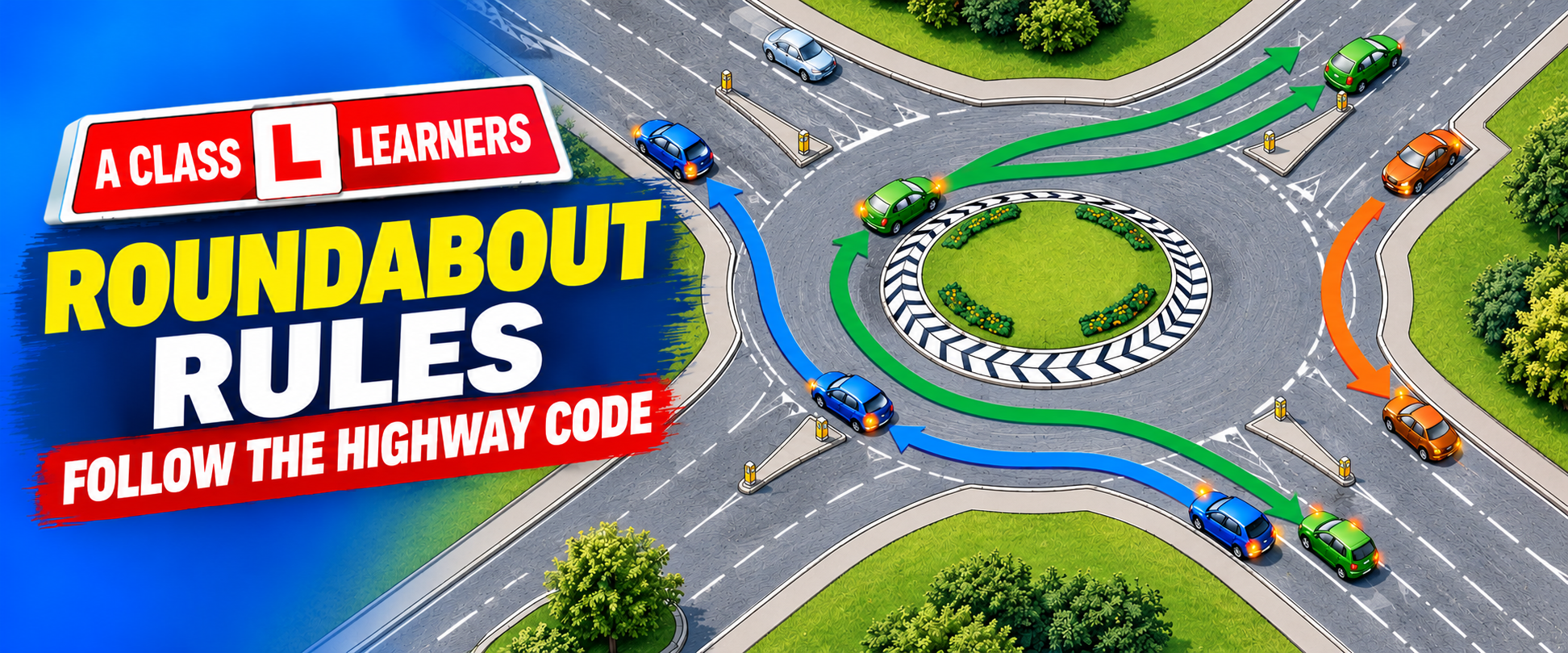
Roundabout Rules UK: A Complete Guide For Learner Drivers
Understanding roundabout rules in the UK is an essential part of learning to drive. Roundabouts can be challenging for learner drivers because you need to choose the correct lane, understand who has priority, signal at the right time and observe other road users while keeping your vehicle under control.
Whether you need to know which lane to use at a roundabout, how to take the third exit, when to indicate or how to approach a mini-roundabout, learning the Highway Code rules will help you make safer decisions. These skills are also important when preparing for your practical driving test.
In this guide, A Class Learners explains roundabout priority rules, lane selection, signalling, road markings, multi-lane roundabouts, mini-roundabouts and common mistakes. You will also learn how to approach and leave roundabouts safely and what to practise with your driving instructor.
What Are The Highway Code Rules For Roundabouts?
Highway Code Rules 184 to 190 explain how drivers should approach and use roundabouts, including lane positioning, signalling, priority and the rules for mini-roundabouts.
Before reaching a roundabout, you should:
- Read the direction signs and road markings.
- Identify which exit you need to take.
- Choose the appropriate lane as early as possible.
- Check your mirrors and signal when necessary.
- Adjust your speed so you can assess the traffic and stop if required.
- Look for traffic approaching from the right and vehicles already on the roundabout.
- Watch for cyclists, motorcyclists, pedestrians and large vehicles.
The normal lane and signalling arrangements are useful guidelines, but individual roundabouts can have different layouts. Always follow the signs, lane arrows, traffic lights and road markings provided for that junction.
Read the official Highway Code guidance on using the road for the full roundabout rules.
Who Has Priority At A Roundabout?
One of the most important roundabout rules is knowing when to give way. Under Highway Code Rule 185, you should normally give priority to traffic approaching from your right unless signs, road markings or traffic lights direct otherwise.
Traffic may already be travelling around the roundabout, approaching your entry point or moving towards an exit. You must assess the situation carefully before entering.
How to give way safely
- Approach at a speed that allows you to assess the traffic and stop if necessary.
- Look to your right for vehicles already on or approaching the roundabout.
- Check the road ahead and your intended route.
- Watch for pedestrians, cyclists and other road users who may be less visible.
- Wait if entering would force another driver to brake or change direction unexpectedly.
- Enter when there is a safe opportunity and your path is clear.
Do not assume that another driver will signal correctly. A vehicle may signal late, signal incorrectly or fail to signal at all. Consider its position and movement as well as its indicators.
Do you always have to give way to the right?
The normal rule is to give priority to traffic approaching from your right, but you must also follow signs, road markings and traffic lights. Some roundabouts have specific markings or traffic signals that change how traffic should enter.
Even when you believe you have priority, you must observe carefully and proceed only when it is safe.
Which Lane Should You Use At A Roundabout?
Choosing the correct lane is essential for safe roundabout driving. The appropriate lane depends on your intended exit, the number of lanes and the instructions displayed on approach.
On a conventional roundabout, the following guidance generally applies unless signs or road markings indicate otherwise.
Turning left at a roundabout: taking the first exit
If you are taking the first exit to the left, you should normally:
- Approach in the left-hand lane.
- Signal left before reaching the roundabout.
- Keep to the left as you enter and travel around the roundabout.
- Continue signalling left as you leave.
- Check for pedestrians and cyclists near the exit.
Adjust your speed to the conditions and make sure you can enter safely. Do not assume that another vehicle signalling left will definitely leave at the first exit.
Going straight ahead at a roundabout
If you are taking an intermediate exit, such as going straight ahead, choose the appropriate lane using the signs and road markings on the approach.
Where no signs or markings indicate otherwise, the left-hand lane is commonly used for going straight ahead on a conventional two-lane roundabout. However, this is not a universal rule. Some roundabouts direct straight-ahead traffic into another lane.
When going straight ahead, you should normally:
- Choose the appropriate lane before entering.
- Avoid signalling right on approach unless signs or markings indicate otherwise.
- Stay in your chosen lane as you travel around the roundabout.
- Signal left after passing the exit before the one you want.
- Check your mirrors and surrounding traffic before leaving.
Never assume that the left-hand lane is always correct for going straight ahead. Check the lane arrows and follow the instructions for that particular junction.
Turning right at a roundabout
If you intend to take an exit to the right, you should normally:
- Approach in the right-hand lane, unless signs or markings direct otherwise.
- Signal right on approach.
- Keep to the right on the roundabout until you need to move towards your exit.
- Check your mirrors and surrounding traffic before changing lanes.
- Signal left after passing the exit before the one you want.
- Move towards the appropriate exit lane only when it is safe.
Do not cut across another lane simply because your exit is approaching. If you cannot move into the correct position safely, continue around the roundabout if necessary and find a safe route.
How to take the third exit at a roundabout
The third exit at a roundabout is often to the right, but the number and direction of exits vary. You should always check the direction signs and road markings rather than assuming that the third exit is in the same position at every junction.
If the third exit is to the right, the usual approach is to:
- Identify the third exit on the direction signs, where provided.
- Choose the appropriate approach lane, normally the right-hand lane unless signs or markings indicate otherwise.
- Signal right on approach when the exit is to the right.
- Follow your lane and the road markings around the roundabout.
- Check your mirrors and surrounding traffic as you approach your exit.
- Signal left after passing the exit before the one you want.
- Leave the roundabout only when your path is clear.
If the third exit is straight ahead or to the left because of the particular layout, follow the signs and markings for that direction. The number of the exit alone does not determine which lane you should use.
Taking the fourth exit or going full circle
Taking the fourth exit may involve travelling most or all of the way around a roundabout, depending on its layout. If your intended exit is to the right or you are going full circle, you should normally approach in the right-hand lane and signal right, unless signs or markings direct otherwise.
Follow the marked lane around the roundabout, then signal left after passing the exit before the one you want. Check your mirrors and change lanes only when safe.
Multi-Lane Roundabout Rules
Multi-lane roundabouts can be more complicated because several vehicles may be travelling alongside one another while preparing to take different exits.
Some roundabouts have two lanes, while larger junctions may have three or more. The correct lane depends on the layout, direction signs and road markings.
Understanding roundabout lane arrows
Lane arrows indicate which directions are permitted or intended from a particular lane. They may direct drivers to turn left, continue straight ahead, turn right or use a specific exit.
Always check the arrows before entering. If the markings direct straight-ahead traffic into the right-hand lane, for example, follow those instructions rather than relying on the usual arrangement for a conventional roundabout.
Spiral roundabout rules
Some large roundabouts use spiral road markings to guide drivers towards their exits. The lane markings may gradually direct traffic outwards as it progresses around the roundabout.
On these roundabouts:
- Read the lane signs before entering.
- Follow the spiral markings rather than assuming you must change lanes in the usual way.
- Keep a safe distance from vehicles in adjacent lanes.
- Check your mirrors and blind spots when a lane change is necessary.
- Do not cross a lane boundary suddenly to reach an exit.
Spiral markings are designed to help organise traffic, but you must still observe other road users and make sure your path is clear.
Changing lanes on a roundabout
You may need to change lanes to reach your intended exit, but you should only do so when it is safe.
Use the Mirrors – Signal – Manoeuvre routine and check your blind spots when necessary. Make sure there is sufficient space and do not assume another driver will make room for you.
If you cannot move into the correct lane safely, do not force your way across another vehicle's path. Continue safely around the roundabout if necessary and take another route.
Roundabout Signalling Rules: When To Indicate
Correct signalling helps other road users understand your intentions. At roundabouts, it is particularly important because drivers may be waiting to enter, changing lanes or preparing to leave.
Highway Code Rule 186 explains the normal signalling procedure for different exits.
When should you signal left?
If you are taking the first exit to the left, signal left on approach and continue signalling as you leave.
If you are taking an intermediate exit or an exit to the right, you should normally signal left after passing the exit before the one you want. This helps other road users understand that you intend to leave.
When should you signal right?
If you are taking an exit to the right or going full circle, you should normally signal right on approach. After passing the exit before the one you want, signal left to indicate that you are leaving.
Do you signal when going straight ahead?
For an intermediate exit, you should not normally signal on approach unless signs or markings indicate otherwise. Signal left after passing the exit before the one you want.
Common roundabout signalling mistakes
- Signalling too late for other road users to understand your intention.
- Signalling right when taking an exit to the left.
- Forgetting to signal left when leaving.
- Leaving an indicator on when it could confuse other drivers.
- Assuming another driver's signal guarantees that they will take a particular exit.
Remember that signals do not give you priority. You must still check that it is safe to enter, change lanes or leave the roundabout.
Roundabout Road Markings And Direction Signs
Road markings and direction signs are essential for understanding how to use a roundabout. They can show the exits, destinations, lane arrangements and restrictions that apply to the junction.
Direction signs
Look for direction signs as you approach. They can help you identify your exit and choose the correct lane before reaching the roundabout.
Lane arrows
Lane arrows show which directions you can take from a particular lane. Follow them even if they differ from the usual lane arrangement for a conventional roundabout.
Give-way markings
Give-way lines and associated signs indicate where you must assess traffic and give way. Approach carefully and do not cross the line unless it is safe and permitted.
Spiral lane markings
Spiral markings can guide vehicles towards particular exits as they travel around a larger roundabout. Follow the markings and avoid sudden lane changes.
Do not wait until you reach the roundabout to decide which exit you need. Planning early helps you choose the correct lane and reduces the risk of a last-minute manoeuvre.
For further guidance, read the official Highway Code traffic signs guidance.
How To Approach A Roundabout Safely
A safe approach begins before you reach the roundabout. Looking ahead gives you time to identify your exit, read the road markings and position your vehicle correctly.
1. Look for signs and lane markings
Read the direction signs as early as possible. They can show the exits, destinations and lane arrangements.
2. Check your mirrors
Use your mirrors to understand the position of traffic behind and beside you. Apply the Mirrors – Signal – Manoeuvre routine before changing speed or position.
3. Select the appropriate lane
Choose your lane early enough to avoid a last-minute change. Follow the signs and markings rather than assuming every roundabout follows the same layout.
4. Adjust your speed
Reduce your speed as necessary so that you can observe traffic, respond to hazards and stop if required. The appropriate speed depends on visibility, road layout and traffic conditions.
5. Assess the traffic
Look to your right and check traffic already using the roundabout. Also watch for vehicles in front, traffic changing lanes and vulnerable road users.
6. Enter only when safe
Do not force your way into a gap that is too small. Wait for a safe opportunity and make sure the vehicle ahead has moved off before you proceed.
How To Leave A Roundabout Safely
Leaving a roundabout requires careful observation because other vehicles may be travelling alongside you, and pedestrians or cyclists may be crossing the exit road.
- Identify the exit you need and prepare for it in good time.
- Check your mirrors before changing position.
- Signal left after passing the exit before the one you want, where appropriate.
- Stay within your lane and avoid cutting across other traffic.
- Check for cyclists and motorcyclists who may be less visible.
- Look for pedestrians who may be crossing the exit road.
- Adjust your speed to the conditions as you leave.
Do not accelerate away without checking what is happening around you. Your responsibility to observe other road users continues until you have safely completed the manoeuvre.
Mini-Roundabout Rules
Mini-roundabouts are smaller junctions marked by a painted central circle or other prescribed central markings. They are common in residential streets and at junctions where space is limited.
Highway Code Rule 188 says that you should approach mini-roundabouts in the same way as normal roundabouts.
Important mini-roundabout rules
- Approach carefully and assess traffic from the right.
- Give way to traffic approaching from the right unless directed otherwise.
- Choose the appropriate position and signal for your intended exit.
- Pass around the central markings where possible.
- Be aware that there is less space to manoeuvre and less time to signal.
- Avoid making U-turns at mini-roundabouts.
Large vehicles that are physically incapable of passing around the central markings are an exception under the Highway Code. Other drivers should remain alert and give them room where necessary.
Double mini-roundabout rules
At a double mini-roundabout, treat each roundabout separately. Assess the traffic and give way to traffic from the right at each one, unless signs, road markings or signals direct otherwise.
Do not assume that because you have crossed the first mini-roundabout, you can automatically enter the second without checking again.
Multiple mini-roundabouts
Some complex junctions contain a series of mini-roundabouts. Highway Code Rule 190 advises treating each mini-roundabout separately and following the normal rules.
Concentrate on the next junction, check the signs and traffic, and avoid rushing through the series of roundabouts.
Roundabouts And Vulnerable Road Users
Roundabouts can present additional risks for cyclists, motorcyclists, pedestrians, horse riders and drivers of large vehicles. You need to be aware of their position and give them sufficient space.
Cyclists on roundabouts
Cyclists may be travelling more slowly than motorised traffic and may be less visible, particularly when a driver is entering or leaving a roundabout.
Highway Code Rule 186 advises drivers to give cyclists plenty of room and not attempt to overtake them within their lane.
- Check for cyclists before entering the roundabout.
- Avoid cutting across a cyclist who is continuing around the junction.
- Give cyclists sufficient space and allow for their movement.
- Check carefully before leaving, particularly if a cyclist is travelling alongside you.
Motorcyclists
Motorcyclists can be harder to see than larger vehicles, especially in busy traffic or poor visibility. Check your mirrors and blind spots and avoid moving across their path.
Pedestrians
Pedestrians may be crossing the approach or exit roads. Look carefully for people waiting to cross and be prepared to slow down or stop when necessary.
Do not focus exclusively on circulating traffic. Check the exit road as well as the roundabout itself.
Horse riders and horse-drawn vehicles
Horse riders and horse-drawn vehicles may use the left-hand lane to continue across or around a roundabout. They may signal right to show that they are not leaving.
Take extra care when entering or leaving, and do not cut across their path.
Large vehicles
Lorries, buses and vehicles towing trailers may need extra room because of their size and turning path. They may straddle lanes or take a different course when approaching or travelling around a roundabout.
Keep a safe distance, watch their signals and do not try to squeeze alongside them where space is limited.
Common Roundabout Mistakes Learner Drivers Should Avoid
Roundabouts involve several decisions in a short space of time. Understanding common mistakes can help you recognise problems during practice and work on them before your driving test.
1. Approaching too quickly
Approaching too quickly can leave you with insufficient time to read signs, assess traffic and choose the correct lane. Adjust your speed to the layout and conditions.
2. Choosing the wrong lane
Entering the wrong lane may make it difficult to reach your intended exit safely. Look for signs and road markings early and follow them.
3. Failing to give way
Entering when another vehicle has priority can force that driver to brake or change direction. Check the traffic and wait until it is safe.
4. Signalling incorrectly
Incorrect or late signals can confuse other drivers. Signal in accordance with your intended exit and the Highway Code guidance.
5. Forgetting to signal left when leaving
Other road users may be waiting to enter the roundabout. Signalling left at the appropriate time helps them understand that you intend to leave.
6. Changing lanes without checking
Moving across another vehicle's path can create a serious hazard. Check your mirrors, signal where appropriate and ensure the lane is clear before moving.
7. Cutting across cyclists
Always check for cyclists travelling around the roundabout, particularly when taking an exit. Give them space and do not cut across their path.
8. Following another vehicle without checking
Do not enter a roundabout simply because the vehicle in front has moved. Assess the traffic yourself and ensure you have a safe opportunity to proceed.
9. Panicking after missing an exit
Never make a sudden turn or cross another lane to reach an exit you have missed. Continue safely and find another route.
Roundabout Driving Test Tips For Learners
Roundabouts may form part of your practical driving test. Your examiner will expect you to demonstrate safe observations, appropriate lane selection, effective signalling and good control of your vehicle.
Use these roundabout driving test tips when practising with your instructor:
- Read the signs early: Identify your intended exit and lane before reaching the junction.
- Use the correct lane: Follow road markings rather than relying on assumptions.
- Make effective observations: Check your mirrors and assess traffic from the right before entering.
- Adjust your speed: Approach at a speed that allows you to respond safely.
- Give way when required: Do not enter if doing so would interfere with traffic that has priority.
- Signal clearly: Indicate at the appropriate time when approaching and leaving.
- Maintain lane discipline: Avoid drifting or cutting across other vehicles.
- Check for vulnerable road users: Watch for cyclists, motorcyclists and pedestrians.
- Stay calm: If you miss an exit, continue safely rather than making a sudden manoeuvre.
Do not focus solely on memorising the rules. Your aim is to apply them safely and consistently while responding to the conditions around you.
For more practical test preparation, read our How To Pass Your Driving Test First Time guide and Driving Test Faults Explained.
How To Practise Roundabouts Before Your Driving Test
Regular driving practice can help you become more confident at roundabouts. Your instructor can help you develop observation skills, lane discipline and the ability to make safe decisions under pressure.
Start with simpler roundabouts
Begin with quieter roundabouts where you have more time to observe traffic and practise choosing the correct lane. Build up to busier and more complex junctions as your confidence improves.
Practise every exit direction
Practise turning left, going straight ahead, turning right and taking later exits. This helps you understand how your lane position and signals change according to your intended route.
Develop your observations
Practise checking your mirrors, looking to the right, observing traffic in front and watching for vulnerable road users. Avoid concentrating on just one part of the junction.
Learn from mistakes
If you select the wrong lane, signal too early or hesitate unnecessarily, discuss the situation with your instructor. Understanding what happened and how to respond next time can help you improve.
Build confidence gradually
Work at a pace that allows you to develop your skills safely, then progress to more demanding situations as your instructor considers appropriate.
Frequently Asked Questions About Roundabout Rules
Who has priority at a roundabout in the UK?
Drivers should normally give priority to traffic approaching from their right, unless signs, road markings or traffic lights direct otherwise. Always check that it is safe before entering.
Which lane should I use at a roundabout?
For the first exit to the left, normally approach in the left-hand lane and signal left. For an exit to the right or a full circle, normally approach in the right-hand lane and signal right. For an intermediate exit, choose the appropriate lane using signs and markings. Follow lane instructions where they differ from these general guidelines.
How do I take the third exit at a roundabout?
Check the direction signs and lane markings because the third exit is not always to the right. If it is to the right, you would normally approach in the right-hand lane and signal right, unless the road markings indicate otherwise. Signal left after passing the exit before the one you want and leave only when safe.
Do I signal when going straight ahead?
You should not normally need to signal on approach for an intermediate exit, unless signs or markings indicate otherwise. Signal left after passing the exit before the one you want.
When should I signal left to leave a roundabout?
For an intermediate exit or an exit to the right, signal left after passing the exit before the one you want. If you are taking the first exit to the left, signal left on approach and continue signalling as you leave.
What are the rules for mini-roundabouts?
Approach them in the same way as normal roundabouts, give way to traffic approaching from the right unless directed otherwise, and normally pass around the central markings. Large vehicles physically incapable of doing so are an exception. Avoid U-turns at mini-roundabouts.
Can I change lanes on a roundabout?
You may need to change lanes to reach your exit, but you must do so only when safe. Check your mirrors, signal where appropriate, check your blind spots when necessary and avoid cutting across another vehicle.
What are spiral roundabouts?
Spiral roundabouts use road markings to guide traffic towards particular exits. Follow the lane markings, check the direction signs and avoid sudden lane changes.
What should I do if I miss my exit?
Do not make a sudden turn or cut across another lane. Continue safely around the roundabout if necessary and take another route.
Which Highway Code rules cover roundabouts?
Highway Code Rules 184 to 190 cover approaching roundabouts, priority, signalling, lane position, mini-roundabouts, double mini-roundabouts and multiple roundabouts.
Final Thoughts On Roundabout Rules
Understanding roundabout rules is an essential part of learning to drive safely. By choosing the appropriate lane, giving way when required, signalling clearly and observing other road users, you can approach roundabouts with greater confidence.
Remember that signs and road markings determine the appropriate lane for your route, so do not assume every roundabout follows the same layout. Whether you are going straight ahead, taking the third exit or navigating a multi-lane roundabout, always assess the traffic and enter only when it is safe.
With regular practice and guidance from your driving instructor, you can develop the observation, positioning and decision-making skills needed to handle roundabouts confidently during everyday driving and your practical driving test.
For the complete official guidance, read the Highway Code rules on using the road.
Explore Our Complete Learner Driver Guides
Explore our complete guides covering every stage of learning to drive, from your first driving lesson and theory test to preparing for your practical driving test, understanding the Highway Code, mastering driving manoeuvres and keeping up to date with the latest DVSA news and updates related to driving.
- Learn To Drive: The Complete Guide For Learner Drivers
- Driving Tests: The Complete Guide For Learner Drivers
- Theory Test: The Complete Guide For Learner Drivers
- Highway Code: The Complete Guide For Learner Drivers
- Driving Manoeuvres: The Complete Guide For Learner Drivers
- Learner Driver Advice: The Complete Guide For Learner Drivers
- DVSA News & Updates: The Complete Guide For Learner Drivers
Or visit our Driving Lessons & Learner Driver Blogs to explore all our latest driving guides, advice and DVSA updates.
If you're ready to start learning, book your driving lessons online today and take the first step towards becoming a safe, confident and independent driver.
Written by A Class Learners
Providing professional driving lessons across London, Essex and the UK, alongside expert learner driver advice and comprehensive UK driving guides designed to help learners become safe, confident and independent drivers for life.