
Pelican Crossing Guide: Traffic Lights, Signals and Safety Rules
Pelican crossings are a familiar sight on UK roads. They allow pedestrians to cross using traffic signals operated by a push-button control. For drivers, understanding the signal sequence is essential because pelican crossings use a distinctive flashing amber phase that differs from the signals at many other pedestrian crossings.
If you are learning to drive, you need to know when to stop, when you may proceed, what the flashing amber light means and how to respond if pedestrians are still crossing after your signal changes. Understanding these rules helps you drive safely and prepare for your practical driving test.
This guide explains pelican crossing rules, the meaning of each signal, pedestrian responsibilities, central islands and common mistakes, using the relevant Highway Code guidance.
What Is a Pelican Crossing?
A pelican crossing is a signal-controlled pedestrian crossing operated by pedestrians using a push-button control. The name comes from “PEdestrian LIght CONtrolled”.
Unlike a zebra crossing, which relies on drivers observing pedestrians and giving way, a pelican crossing uses traffic lights to control vehicle movements and pedestrian signals to indicate when people should cross.
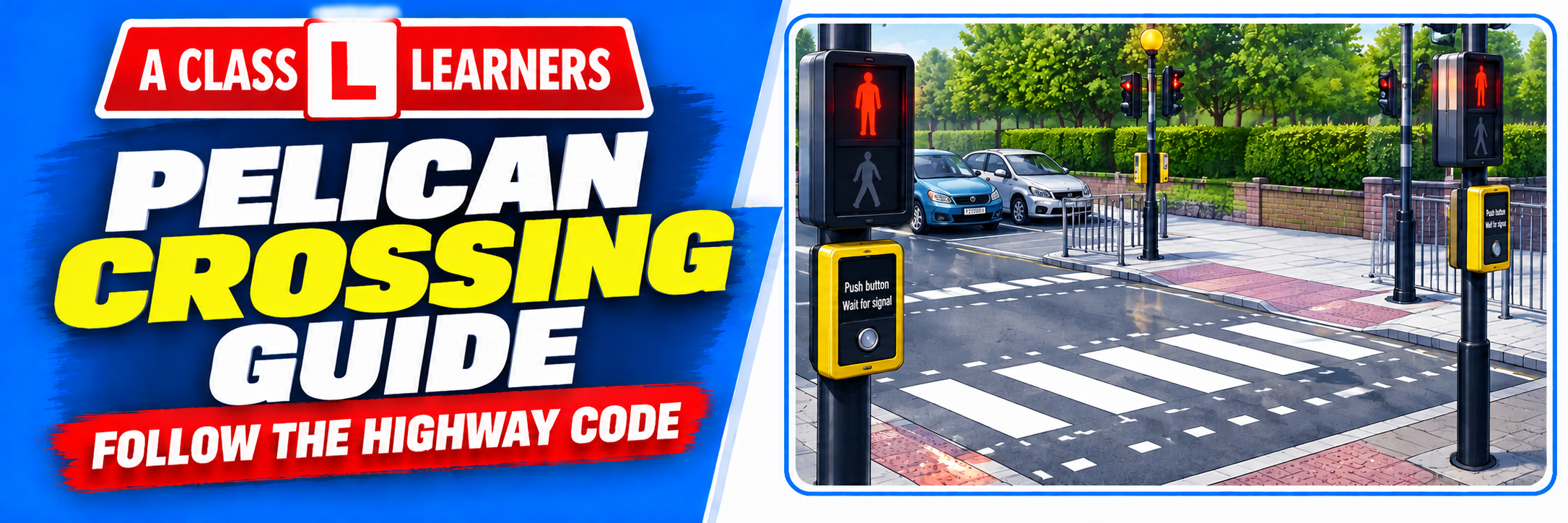
A traditional pelican crossing has:
- Traffic lights facing drivers.
- A red and green pedestrian figure facing people who want to cross.
- A push-button control that pedestrians use to request a crossing phase.
- A flashing amber phase for vehicles near the end of the crossing sequence.
- Road markings identifying the crossing area.
Pelican crossings are an older type of signal-controlled crossing. They are no longer installed as the standard choice for new crossings, but many remain in use. You may encounter one during everyday driving or a practical driving test.
Highway Code Rule 196: Pelican Crossing Rules
Highway Code Rule 196 explains the key rules for drivers at pelican crossings.
The most important points are:
- Red vehicle light: You MUST stop at the stop line.
- Flashing amber vehicle light: You MUST give way to any pedestrians still on the crossing.
- Flashing amber with no pedestrians on the crossing: You may proceed, but only with caution.
- Pedestrians still crossing: Never move forward into their path.
- Changing signals: Check that the crossing is clear before proceeding.
The flashing amber phase is the feature that makes pelican crossings different from many other signal-controlled crossings. It allows traffic to proceed cautiously if the crossing is clear, but pedestrians still on the crossing have priority.
Read the official Highway Code guidance on using the road for Rules 196 to 199.
Pelican Crossing Signals Explained
Understanding the signals is one of the most important parts of using a pelican crossing safely. Drivers and pedestrians see different signals, and each has a specific meaning.
Red Light for Drivers
When the vehicle traffic light turns red, you must stop at the stop line. Do not proceed through the crossing while the red light is showing.
Stop smoothly and leave the crossing clear. Look out for pedestrians who may already be crossing or who are about to begin crossing.
Flashing Amber Light for Drivers
The flashing amber light follows the red vehicle signal at a pelican crossing. During this phase, you must give way to any pedestrians still on the crossing.
If the crossing is completely clear, you may proceed with caution. Check carefully before moving because a pedestrian may be finishing the crossing or may be less visible from your driving position.
Do not treat flashing amber as permission to accelerate through the crossing. It means you can proceed only when doing so is safe and the crossing is clear.
Green Light for Drivers
When the vehicle signal turns green, you may proceed if the way is clear. However, the Highway Code says you must give way to anyone still crossing after the signal for vehicles has changed to green.
Check the crossing carefully before moving off, especially if a pedestrian is walking slowly or has difficulty crossing quickly.
Red Pedestrian Figure
When the red standing figure is showing, pedestrians should not start crossing. They should wait for the appropriate signal before stepping onto the road.
Steady Green Pedestrian Figure
When the steady green figure appears, pedestrians may begin crossing after checking that traffic has stopped. Drivers must obey their traffic signals and must not enter the crossing while their signal prohibits them from doing so.
Flashing Green Pedestrian Figure
When the green pedestrian figure starts flashing, pedestrians who have not yet started crossing should wait for the next green signal. Anyone already crossing should continue and reach the other side safely without unnecessary delay.
For drivers, this phase is associated with the flashing amber vehicle signal. You must give way to pedestrians who remain on the crossing.
When Must Drivers Stop at a Pelican Crossing?
You must stop at the stop line when the red vehicle signal is showing. This is a mandatory requirement, and you should not cross the stop line simply because you cannot see any pedestrians.
When the vehicle signal changes to flashing amber, the rule changes. You must give way to pedestrians still on the crossing. If nobody is on the crossing and the way ahead is clear, you may proceed cautiously.
When the signal changes to green, you may proceed if it is safe, but you must still give way to anyone who has not finished crossing.
Example: A Pedestrian Is Still Crossing
You have stopped at a red light. The pedestrian signal begins flashing green, and the vehicle signal changes to flashing amber. A pedestrian is still walking across your lane.
You must wait. Proceed only after the pedestrian has cleared your path and you can move safely.
Example: The Crossing Is Clear During Flashing Amber
The vehicle signal is flashing amber, and you can see that no pedestrians remain on the crossing. Check carefully in both directions and make sure the crossing is clear before proceeding with caution.
Do not assume the crossing is clear simply because the nearest pedestrian has reached the pavement. Check for other pedestrians who may still be crossing from the opposite side.
What If the Vehicle Light Turns Green While Someone Is Still Crossing?
Drivers must give way to anyone still crossing after the vehicle signal changes to green. The change in the signal does not mean you can drive into a pedestrian's path.
Wait until the pedestrian has cleared your path and check that the road ahead is safe. This is particularly important when someone is walking slowly, using a mobility aid, accompanying a child or pushing a pram.
Good observation and patience help prevent collisions. Never use your horn, rev the engine or move forward in a way that pressures a pedestrian to hurry.
Pelican Crossings with a Central Island
Highway Code Rule 197 explains that a pelican crossing that goes straight across the road is treated as one crossing, even if there is a central island.
Drivers must wait for pedestrians who are crossing from the other side of the island. Do not assume that the island means the pedestrian has finished crossing the road.
Look across the full crossing before moving. A pedestrian may be walking towards your lane from the far side and may still have priority even if the area directly in front of your vehicle appears clear.
Be especially careful when pedestrians are moving slowly or are difficult to see because of other traffic, poor weather or limited visibility.
Pelican Crossings Compared with Puffin and Toucan Crossings
Pelican, puffin and toucan crossings are all types of signal-controlled crossings, but their operation differs.
- Pelican crossing: Uses a flashing amber phase for drivers and a flashing green pedestrian figure near the end of the pedestrian phase.
- Puffin crossing: Uses pedestrian detection technology to help determine when people need time to cross. It does not have the pelican crossing's flashing amber phase.
- Toucan crossing: Allows pedestrians and cyclists to cross together. It does not use the pelican crossing's flashing amber phase.
At puffin and toucan crossings, the vehicle signal sequence is similar to ordinary traffic lights. Do not expect the flashing amber phase used at a pelican crossing.
To learn more about other crossings, read our guide to zebra crossing rules.
Common Pelican Crossing Mistakes
Drivers can make mistakes at pelican crossings when they misunderstand the signal sequence or fail to check whether pedestrians have finished crossing.
1. Moving Off While the Red Light Is Showing
You must stop when the red vehicle signal is showing. Never move forward through the crossing because you believe there is no one crossing.
2. Treating Flashing Amber Like Green
Flashing amber does not mean you can automatically proceed. You must give way to pedestrians on the crossing and move only when it is clear and safe.
3. Forgetting to Check for Pedestrians on the Far Side
Pedestrians may still be crossing from the opposite side, even if your side appears clear. Check the whole crossing before moving.
4. Moving Off as Soon as the Vehicle Light Turns Green
Some pedestrians may still be crossing when the signal changes. Wait until they have cleared your path before proceeding.
5. Confusing Pelican and Puffin Crossings
Puffin crossings do not use the flashing amber phase associated with pelican crossings. Identify the type of crossing and follow the signals displayed at that location.
6. Approaching Too Quickly
Approaching too fast reduces the time available to respond to changing signals and pedestrians. Look ahead and be ready to stop safely.
Pelican Crossing Tips for Your Driving Test
If you are preparing for your practical driving test, you may encounter a pelican crossing. Your examiner will expect you to recognise the signals, respond correctly and give pedestrians enough time to cross safely.
- Identify the crossing early and reduce your speed when appropriate.
- Stop at the stop line when the red vehicle light shows.
- During flashing amber, give way to pedestrians still on the crossing.
- Proceed during flashing amber only when the crossing is clear and it is safe.
- When the vehicle light turns green, check for pedestrians who have not finished crossing.
- Be aware of pedestrians on the far side of a crossing with a central island.
- Do not rush or pressure pedestrians.
- Maintain good observation and control throughout the approach and departure.
Remember that the aim is not simply to react to the lights. You must also observe what pedestrians are doing and make sure your vehicle can move safely without putting anyone at risk.
For more preparation advice, explore our complete guide to driving tests and our learner driver advice.
Pelican Crossing Rules: Quick Summary
- Red vehicle light: You must stop at the stop line.
- Flashing amber vehicle light: You must give way to pedestrians on the crossing.
- Flashing amber with a clear crossing: You may proceed with caution if it is safe.
- Green vehicle light: Proceed only if the way is clear, and give way to anyone still crossing.
- Flashing green pedestrian figure: Pedestrians who have not started should not begin crossing; those already crossing should continue.
- Central island: A pelican crossing that goes straight across the road is treated as one crossing, even when there is an island.
For the official guidance, read Highway Code Rules 196 to 198. You can also consult the official government guide to pedestrian, cycle and equestrian crossings.
Frequently Asked Questions About Pelican Crossings
What is a pelican crossing?
A pelican crossing is a pedestrian crossing controlled by traffic lights and pedestrian signals. It has a distinctive flashing amber phase for drivers after the red light.
What does a flashing amber light mean at a pelican crossing?
You must give way to pedestrians still on the crossing. If the crossing is completely clear, you may proceed with caution.
Must you stop at a red light at a pelican crossing?
Yes. You must stop at the stop line when the red vehicle signal shows and wait until the signal permits you to proceed.
Can pedestrians start crossing when the green man is flashing?
No. Pedestrians should not start crossing when the green figure is flashing. Anyone already crossing should continue to the other side safely.
Do you have to wait for pedestrians after the vehicle light turns green?
Yes. Give way to anyone still crossing after the vehicle signal changes to green. Check that the crossing is clear before moving.
Are pelican crossings still being installed?
Pelican crossings are no longer being installed as the standard choice for new crossings, but many existing ones remain in use.
Explore Our Complete Learner Driver Guides
Explore our complete guides covering every stage of learning to drive, from your first driving lesson and theory test to preparing for your practical driving test, understanding the Highway Code, mastering driving manoeuvres and keeping up to date with the latest DVSA news and updates related to driving.
- Learn To Drive: The Complete Guide For Learner Drivers
- Driving Tests: The Complete Guide For Learner Drivers
- Theory Test: The Complete Guide For Learner Drivers
- Highway Code: The Complete Guide For Learner Drivers
- Driving Manoeuvres: The Complete Guide For Learner Drivers
- Learner Driver Advice: The Complete Guide For Learner Drivers
- DVSA News & Updates: The Complete Guide For Learner Drivers
Or visit our Driving Lessons & Learner Driver Blogs to explore all our latest driving guides, advice and DVSA updates.
If you're ready to start learning, book your driving lessons online today and take the first step towards becoming a safe, confident and independent driver.
Written by A Class Learners
Providing professional driving lessons across London, Essex and the UK, alongside expert learner driver advice and comprehensive UK driving guides designed to help learners become safe, confident and independent drivers for life.