
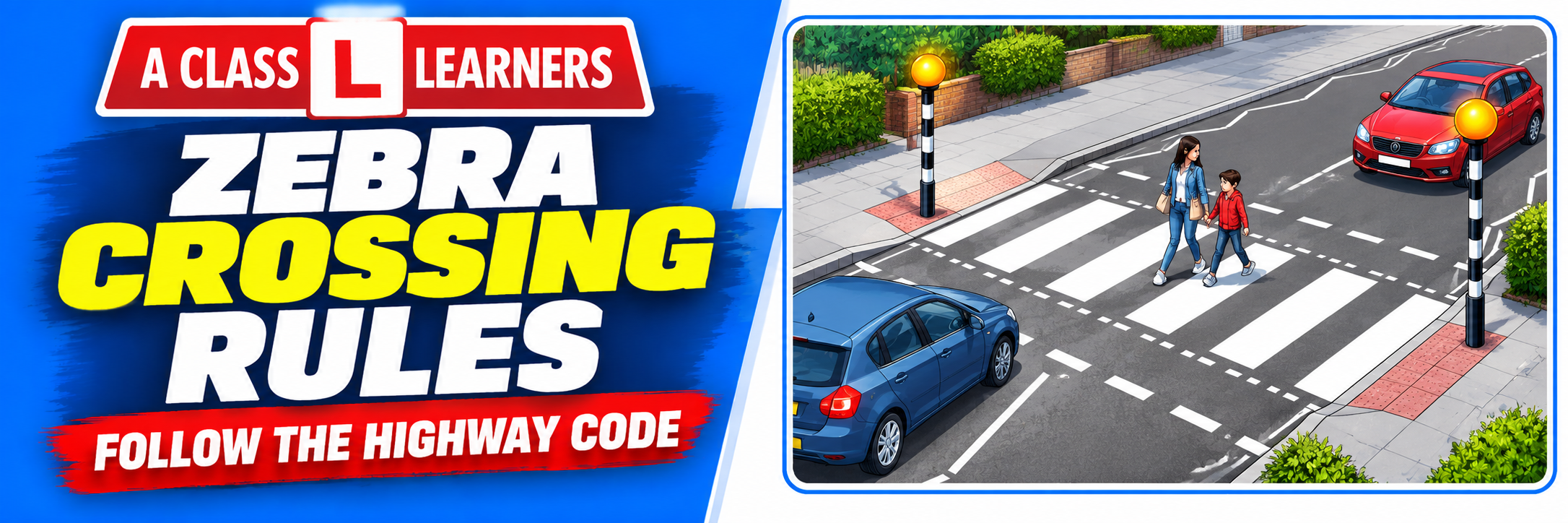
Zebra Crossing Rules: A Complete Guide for Learner Drivers
Zebra crossings are an important part of road safety in the UK. They provide pedestrians with a designated place to cross the road and help drivers recognise where people may be crossing. For learner drivers, understanding zebra crossing rules is essential for safe driving and preparing for the practical driving test.
Knowing when to slow down, when to stop and when pedestrians have priority can help you avoid dangerous situations. You also need to understand the rules about overtaking near a crossing, parking on zigzag lines and approaching crossings when visibility is limited.
This guide explains the main UK zebra crossing rules, including Highway Code Rules 191 to 195, with practical advice for drivers and learner drivers.
What Is a Zebra Crossing?
A zebra crossing is a pedestrian crossing marked by black and white stripes across the road. It is usually accompanied by flashing amber beacons on black-and-white striped poles, known as Belisha beacons.
Zebra crossings allow pedestrians to cross at a designated point without the usual traffic-light sequence found at signal-controlled crossings. Drivers must look out for people approaching the crossing and be ready to slow down or stop.
You may find zebra crossings:
- In town centres and shopping areas.
- Near schools and residential streets.
- Close to bus stops and pedestrian routes.
- On roads where pedestrians regularly need to cross.
- Near junctions, community facilities and public spaces.
Because zebra crossings do not normally use traffic lights to control vehicles, drivers must pay close attention to pedestrians and make safe decisions based on what is happening around the crossing.
Highway Code Rule 195: Zebra Crossing Rules
Highway Code Rule 195 explains how drivers should approach zebra crossings. You should look out for pedestrians waiting to cross and be ready to slow down or stop to let them cross.
The main rules include:
- Look out for pedestrians approaching or waiting at the crossing.
- Be prepared to slow down or stop.
- You MUST give way when a pedestrian has moved onto the crossing.
- Allow more time to stop on wet or icy roads.
- Do not wave, flash your lights or use your horn to invite pedestrians across, as this could be dangerous if another vehicle is approaching.
- Be patient and avoid sounding your horn or revving your engine in a way that could intimidate pedestrians.
- Watch for pedestrians approaching from either side of the crossing.
Rule H2 in the introduction to the Highway Code also states that drivers must give way to pedestrians on a zebra crossing. It says drivers should give way to pedestrians waiting to cross as well.
Read the official Highway Code guidance on using the road for Rules 191 to 195.
When Must Drivers Stop at a Zebra Crossing?
Drivers must give way when a pedestrian has moved onto a zebra crossing. You should approach slowly enough to stop safely if someone starts crossing.
The Highway Code also says drivers should give way to pedestrians waiting to cross. This means you should not simply continue because a pedestrian has not yet stepped onto the black and white stripes. Observe their intentions, assess the traffic behind you and prepare to stop when it is safe to do so.
Example: A Pedestrian Is Already Crossing
If someone is walking across a zebra crossing, you must give way. Slow down and stop before the crossing, leaving the marked crossing area clear. Wait until the pedestrian has crossed your path and it is safe to continue.
Example: Someone Is Waiting at the Kerb
If a pedestrian is standing at the side of the crossing and appears ready to cross, you should give way where it is safe to do so. Check your mirrors, slow down and stop smoothly if necessary.
Do not make a sudden stop without checking the traffic behind you, but do not use that concern as a reason to ignore a pedestrian. Approach crossings early enough to respond safely.
Do Pedestrians Always Have Priority at a Zebra Crossing?
Pedestrians have priority when they are on a zebra crossing. Drivers must give way to them.
The Highway Code also says drivers should give way to pedestrians waiting to cross. You should therefore approach a zebra crossing with the expectation that someone may wish to cross, rather than waiting until they step into the road before reacting.
However, pedestrians should still take care. They should allow traffic time to see them and stop, and should check that vehicles have stopped before stepping onto the crossing. Drivers must remain alert because some pedestrians may be difficult to see, particularly in poor weather or low light.
Never assume a vehicle in another lane has stopped just because the vehicle nearest to you has done so. Check that the crossing is safe across the full width of the road before proceeding.
How to Approach a Zebra Crossing Safely
Safe driving around zebra crossings depends on observation, speed control and anticipating what pedestrians may do.
- Look ahead: Watch for the crossing signs, flashing beacons, road markings and pedestrians approaching the kerb.
- Check your mirrors: Be aware of vehicles behind you before slowing down.
- Reduce your speed: Approach at a speed that allows you to stop safely if someone wants to cross.
- Observe both sides: Look for pedestrians approaching from either pavement and check for people who may be obscured by parked or queued vehicles.
- Stop when required: Give way to pedestrians who have moved onto the crossing and be prepared to give way to those waiting.
- Keep the crossing clear: Do not stop on the crossing or block the pedestrian route.
- Move off carefully: Check that pedestrians have cleared your path and that it is safe to proceed.
Do not accelerate towards a crossing because you think a pedestrian will wait. Good anticipation gives you more time to react and helps make the crossing safer for everyone.
Zebra Crossing Zigzag Lines: What Do They Mean?
Zigzag lines are painted on the road near a zebra crossing to identify the controlled approach and exit areas. They help protect visibility around the crossing and warn drivers that pedestrians may be crossing.
Under Highway Code Rule 191:
- You MUST NOT park on a crossing.
- You MUST NOT park in the area covered by the zigzag lines.
- You MUST NOT overtake the moving vehicle nearest to the crossing.
- You MUST NOT overtake the vehicle nearest the crossing that has stopped to give way to pedestrians.
Parking on zigzag lines can obstruct the view of pedestrians and approaching drivers. This can make it harder to see someone stepping onto the crossing and can increase the risk of a collision.
Keep the approach and exit areas clear, and never use the zigzag area as a place to wait, park or overtake.
Can You Overtake Near a Zebra Crossing?
No. The Highway Code prohibits overtaking the moving vehicle nearest to a zebra crossing or the vehicle nearest to the crossing that has stopped to give way to pedestrians.
This rule helps prevent drivers from passing a vehicle that has slowed or stopped because a pedestrian is crossing. A pedestrian may be hidden from your view by the vehicle in front, so overtaking could put someone in danger.
If a vehicle ahead slows down or stops near a zebra crossing, reduce your speed and be prepared to stop as well. Do not assume that the road ahead is clear just because you cannot see a pedestrian from your position.
Zebra Crossings in Wet or Icy Weather
Wet and icy roads increase stopping distances. This means drivers need more time and space to stop before a zebra crossing.
When approaching a crossing in poor weather:
- Reduce your speed earlier than you would on a dry road.
- Leave a larger gap between your vehicle and the vehicle ahead.
- Brake smoothly and avoid sudden movements.
- Watch carefully for pedestrians wearing dark clothing or carrying umbrellas.
- Be prepared for pedestrians who may be harder to see in rain, mist or darkness.
Remember that a pedestrian may step onto the crossing while you are approaching. Driving at an appropriate speed gives you more time to respond safely.
Zebra Crossings with a Central Island
Some zebra crossings have a central island that divides the road. Under the Highway Code, a zebra crossing with a central island is treated as two separate crossings.
Drivers should approach each half carefully and look for pedestrians who may be waiting on the island or preparing to cross the next section of road.
Pedestrians should also treat each half separately. After reaching the island, they should check the traffic again and follow the zebra crossing rules before crossing the second half.
Do not assume that a pedestrian who has crossed one half of the road will immediately continue across the second. Allow them time to assess the next section safely.
Common Zebra Crossing Mistakes
Drivers can put pedestrians at risk when they fail to anticipate a crossing or misunderstand the rules. Avoid these common mistakes.
1. Failing to Notice Pedestrians Waiting
Look for people approaching the crossing from both sides. The Highway Code says you should give way to pedestrians waiting to cross, so do not wait until someone steps onto the stripes before thinking about stopping.
2. Approaching Too Quickly
Driving too fast towards a zebra crossing leaves less time to react. Reduce your speed and be prepared to stop.
3. Overtaking a Vehicle Near the Crossing
Never overtake the vehicle nearest to the crossing if it is moving or has stopped to give way to pedestrians. A pedestrian may be hidden from view.
4. Parking on Zigzag Lines
Parking in the controlled area can obstruct visibility and create danger for pedestrians. Keep the crossing and zigzag areas clear.
5. Assuming Every Lane Is Clear
On a road with more than one lane in each direction, a vehicle may stop while another vehicle continues. Check that the crossing is clear across the road and never proceed without making sure it is safe.
6. Flashing Your Lights to Invite Someone Across
Do not wave, flash your lights or use your horn to invite pedestrians across. Another vehicle may be approaching and may not have seen the pedestrian.
7. Moving Off Too Early
Wait until pedestrians have cleared your path and check that no one else is still crossing. Do not edge forward in a way that pressures pedestrians or puts them at risk.
Zebra Crossing Rules for Your Driving Test
Zebra crossings may appear during your practical driving test. Your examiner will expect you to recognise them early, adjust your speed, observe pedestrians and respond safely.
- Look well ahead for crossing signs, beacons and road markings.
- Check mirrors before slowing down.
- Approach at a speed that allows you to stop safely.
- Look for pedestrians waiting at the kerb or approaching the crossing.
- Give way to pedestrians on the crossing.
- Be prepared to give way to pedestrians waiting to cross.
- Do not overtake a vehicle nearest to the crossing.
- Keep the crossing clear when traffic is queuing.
- Take extra care in poor weather and when visibility is limited.
- Move off only when it is safe and pedestrians have cleared your path.
Good observation and anticipation are especially important. Your examiner wants to see that you can identify potential hazards early and respond without harsh braking, hesitation that creates risk or unsafe acceleration.
For more preparation advice, explore our complete guide to driving tests.
Zebra Crossing Rules: Quick Summary
- Pedestrians on the crossing: You MUST give way.
- Pedestrians waiting: You should give way and be ready to stop.
- Approaching a crossing: Look ahead, check both sides and reduce speed as needed.
- Overtaking: Do not overtake the vehicle nearest to the crossing.
- Parking: Do not park on the crossing or in the area covered by zigzag lines.
- Wet or icy roads: Allow more time and distance to stop.
- Central island: Treat each half as a separate crossing.
For the full official rules, read the Highway Code guidance on zebra crossings and using the road. You can also read the official Highway Code rules for pedestrians.
Frequently Asked Questions About Zebra Crossing Rules
When must drivers stop at a zebra crossing?
Drivers must give way when a pedestrian has moved onto the crossing. Drivers should also give way to pedestrians waiting to cross and be ready to slow down or stop when approaching.
Do drivers have to stop for someone waiting at a zebra crossing?
The Highway Code says drivers should give way to pedestrians waiting to cross. You should approach carefully, check your surroundings and stop when necessary to allow them to cross safely.
Can you overtake near a zebra crossing?
You must not overtake the moving vehicle nearest to a zebra crossing or the vehicle nearest to the crossing that has stopped to give way to pedestrians.
Can you park on a zebra crossing or its zigzag lines?
No. You must not park on a zebra crossing or in the area covered by its zigzag lines.
What should drivers do when the road is wet near a zebra crossing?
Allow more time and distance to stop on wet or icy roads. Reduce your speed and approach the crossing ready to stop.
Is a zebra crossing with a central island one crossing or two?
It is treated as two separate crossings. Drivers and pedestrians should assess each half separately and take care before proceeding.
Explore Our Complete Learner Driver Guides
Explore our complete guides covering every stage of learning to drive, from your first driving lesson and theory test to preparing for your practical driving test, understanding the Highway Code, mastering driving manoeuvres and keeping up to date with the latest DVSA news and updates related to driving.
- Learn To Drive: The Complete Guide For Learner Drivers
- Driving Tests: The Complete Guide For Learner Drivers
- Theory Test: The Complete Guide For Learner Drivers
- Highway Code: The Complete Guide For Learner Drivers
- Driving Manoeuvres: The Complete Guide For Learner Drivers
- Learner Driver Advice: The Complete Guide For Learner Drivers
- DVSA News & Updates: The Complete Guide For Learner Drivers
Or visit our Driving Lessons & Learner Driver Blogs to explore all our latest driving guides, advice and DVSA updates.
If you're ready to start learning, book your driving lessons online today and take the first step towards becoming a safe, confident and independent driver.
Written by A Class Learners
Providing professional driving lessons across London, Essex and the UK, alongside expert learner driver advice and comprehensive UK driving guides designed to help learners become safe, confident and independent drivers for life.