
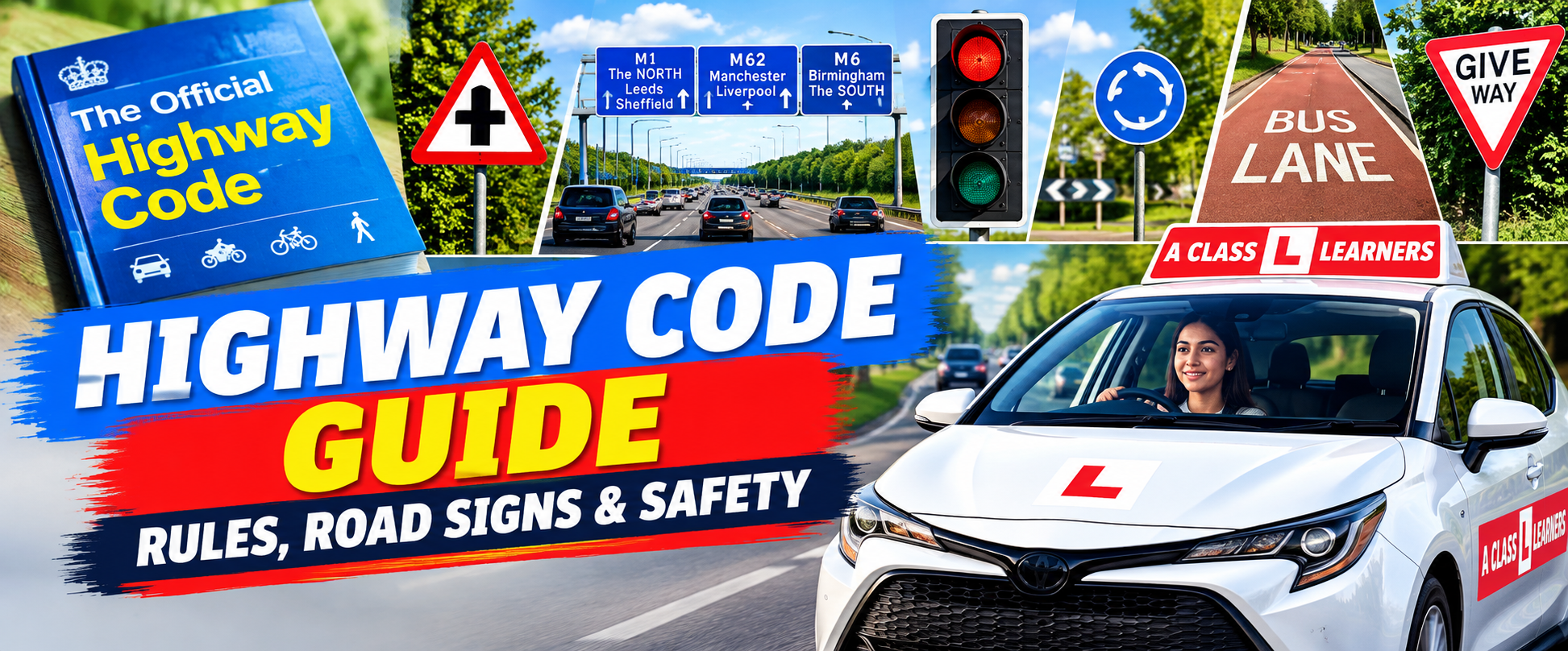
Highway Code Guide: Essential UK Road Rules For Learner Drivers
The Highway Code is one of the most important resources for anyone learning to drive in the UK. It explains the rules of the road, the meaning of traffic signs and road markings, and how drivers should behave to help keep themselves and other road users safe.
Whether you are preparing for your driving theory test, taking your first driving lesson or getting ready for your practical test, understanding the Highway Code will help you make safer decisions behind the wheel.
It covers much more than road signs. You will also need to understand speed limits, stopping distances, junction priorities, pedestrian crossings, motorway driving, vulnerable road users and the responsibilities that come with driving.
This guide from A Class Learners introduces the main areas of the Highway Code and explains how to use it as part of your driving test preparation.
The official Highway Code is available free on GOV.UK. Always refer to the official version for the complete rules and the latest updates.
1. What Is The Highway Code?
The Highway Code is the official guide to road use in England, Scotland and Wales. It provides rules, advice and guidance for drivers, motorcyclists, cyclists, horse riders, pedestrians and other road users.
Its purpose is to help everyone use roads safely and responsibly. The rules explain how to recognise hazards, understand road signs, share road space and respond appropriately to different traffic situations.
The Highway Code includes:
- Rules for pedestrians and people crossing roads.
- Rules for cyclists, motorcyclists and horse riders.
- Traffic signs, signals and road markings.
- General rules for drivers and riders.
- Speed limits and stopping distances.
- Junctions, roundabouts and overtaking.
- Motorway driving and breakdown procedures.
- Road users who may need extra care and consideration.
- Vehicle safety, legal responsibilities and emergency situations.
Learning these rules will help you prepare for your theory test and develop the knowledge needed to drive independently.
2. Why Is The Highway Code Important For Learner Drivers?
Learning to drive involves more than operating the controls of a car. You must understand what is happening around you, recognise possible hazards and know how to respond safely.
The Highway Code gives you the knowledge to make informed decisions when you encounter other road users, junctions, traffic signs and changing road conditions.
It is particularly important for three reasons.
Preparing For Your Theory Test
The car theory test includes multiple-choice questions about road rules, traffic signs, safe driving and other topics covered by the Highway Code.
You need to understand the rules rather than simply memorise answers. Understanding why a particular action is safe or unsafe will help you deal with questions presented in different ways.
For more help, read our Theory Test Guide.
Improving Your Practical Driving
Your instructor will help you apply the rules during your driving lessons. You will learn how to approach junctions, respond to traffic signs, give way when necessary and interact safely with pedestrians and cyclists.
Understanding the Highway Code before your lessons can make it easier to understand your instructor's explanations and recognise situations that require extra care.
Becoming A Safer Driver
The Highway Code encourages drivers to anticipate hazards, drive at appropriate speeds and consider the safety of other road users.
These habits are important long after you pass your test. Safe driving depends on applying the rules consistently and adapting your driving to the conditions around you.
3. Understand The Language Used In The Highway Code
When studying the Highway Code, pay attention to the wording used in each rule. The terms are important because they help distinguish legal requirements from recommendations and advice.
MUST And MUST NOT
Rules using the words MUST or MUST NOT identify legal requirements. The relevant legislation is generally referenced within the rule.
Breaking a legal requirement may result in consequences such as a fine, penalty points or disqualification, depending on the offence and circumstances.
SHOULD And SHOULD NOT
The words SHOULD and SHOULD NOT generally indicate recommended behaviour or advice.
Although a recommendation is not necessarily a specific legal requirement, it is still important to understand it. Ignoring advice about safe driving could put you or other road users at risk, and other laws may apply to the situation.
Why The Difference Matters
When revising, do not assume that every rule has exactly the same legal status. Read the wording carefully and understand whether it describes a legal obligation or recommended practice.
You can learn more in the official Highway Code introduction on GOV.UK.
4. Learn The Main Categories Of Traffic Signs
Traffic signs provide essential information about restrictions, hazards, directions and road conditions. Recognising them quickly is an important part of learning to drive.
Many signs follow recognisable shapes and colour patterns, which can help you understand their general purpose.
Red Circular Signs
Red circular signs generally give orders or indicate restrictions. Examples include signs prohibiting certain movements or setting a maximum speed limit.
Always read the symbol and any supplementary plate to understand exactly what the sign means.
Blue Circular Signs
Blue circular signs generally give positive instructions. They may tell drivers to keep left, follow a particular direction or use a designated route.
Triangular Warning Signs
Triangular signs usually warn drivers about hazards or changes in the road ahead. Examples include bends, crossroads, road narrowing, roundabouts and traffic signals.
When you see a warning sign, consider what action may be needed. You might need to reduce your speed, increase your observation or prepare to change position safely.
Rectangular Information Signs
Rectangular signs provide directions, route information or other useful information. The background colour can help you identify the type of route or information being shown.
For example, motorway direction signs generally use blue backgrounds, while primary route signs generally use green backgrounds.
Do not rely on colour alone. Learn the symbols, wording and circumstances in which each sign applies.
For a detailed reference, visit the official Highway Code traffic signs section.
5. Understand Road Markings
Road markings help control traffic, indicate where vehicles should position themselves and identify places where stopping, overtaking or turning may be restricted.
They work alongside traffic signs and signals, so it is important to understand both.
Give Way Lines
Give way markings identify a point where drivers must give way to traffic on the major road or follow the priority indicated by the layout and signs.
Approach carefully, observe the road and be prepared to stop if necessary.
Stop Lines
A stop line may appear at traffic signals or at a STOP sign. Where the rules require you to stop, bring the vehicle to a complete stop at the appropriate line and follow the sign or signal.
White Centre Lines
White lines along the centre of a road can help separate traffic travelling in opposite directions. Different line patterns have different meanings and restrictions.
Learn the difference between broken lines, double white lines and other road markings, and understand when crossing them is permitted or prohibited.
Yellow Lines
Yellow lines at the side of a road can indicate waiting restrictions. The exact restrictions may depend on whether the line is single or double, the applicable rules and any accompanying signs or time plates.
Always check the signs and markings before stopping or parking.
Box Junctions
Yellow box junctions help keep junctions clear. You should not enter a box junction unless you can exit it without stopping, subject to the specific exceptions in the Highway Code, including certain right turns where you are waiting for oncoming traffic or other vehicles to clear.
Blocking a junction can obstruct other road users and contribute to congestion.
Read the official Highway Code road markings guidance to learn more.
6. Know The Speed Limits And Drive At A Safe Speed
Speed limits are an essential part of the Highway Code. You must not exceed the applicable maximum speed limit for the road and your vehicle.
However, the speed limit is not a target. You may need to drive more slowly when conditions make the maximum limit unsafe.
Factors that can affect your safe speed include:
- Rain, ice, snow or fog.
- Poor visibility or darkness.
- Sharp bends and narrow roads.
- Pedestrians, cyclists and horse riders nearby.
- Parked vehicles and restricted space.
- Traffic queues and busy junctions.
- Roadworks or temporary traffic arrangements.
For cars, a 30 mph limit generally applies to roads with street lights in built-up areas in England and Scotland unless signs indicate otherwise. In Wales, a 20 mph default limit generally applies to restricted roads, unless signs indicate otherwise.
Always check the signs and the rules that apply to the road you are using. Different limits may apply to different road types and vehicles.
During your driving lessons, your instructor will help you judge your speed, identify changes in speed limits and adjust your driving to suit the conditions.
The official Highway Code rules for drivers and riders explain speed limits and safe driving techniques.
7. Learn Stopping Distances And Following Distances
Stopping distances explain how far a vehicle travels from the moment the driver recognises a hazard to the point where the vehicle comes to a complete stop.
The overall stopping distance includes two main parts:
- Thinking distance: The distance travelled while the driver recognises the hazard and reacts.
- Braking distance: The distance travelled while the brakes slow the vehicle to a stop.
Stopping distances increase when you travel faster. They can also increase significantly in wet or icy conditions, and the condition of the road, tyres and brakes can affect how quickly a vehicle stops.
Do not assume that the figures in revision materials will always match the distance needed in real driving conditions. They are useful for understanding the principle, but you must always leave enough room to stop safely.
Keep A Safe Gap
Leave enough space between your vehicle and the vehicle ahead so that you can stop safely if it slows down suddenly.
The Highway Code recommends the two-second rule as a minimum gap in good conditions on faster roads. You should leave a greater gap when the road is wet and increase it further in difficult conditions such as ice.
Never follow so closely that you would be unable to stop safely if the driver ahead braked suddenly.
8. Understand Junctions And Priority Rules
Junctions are common locations for conflicts between road users. You need to know how to approach them safely, identify who has priority and respond to other traffic.
Approaching A Junction
As you approach a junction, check your mirrors, assess the road layout and look for signs, road markings, pedestrians and other vehicles.
Choose the correct position and speed for your intended direction. Be prepared to stop if you cannot proceed safely.
Give Way And Stop Signs
Give Way signs and markings indicate that you must give way to traffic on the major road. A STOP sign requires a complete stop at the stop line before proceeding when it is safe to do so.
Do not emerge simply because you are in a hurry or because another driver appears to be allowing you through. Make sure the road is safe before moving.
Turning Left And Right
When turning, check for pedestrians, cyclists and other road users who may be crossing or travelling alongside you.
Signal clearly when appropriate, position your vehicle correctly and make sure you can complete the manoeuvre safely.
Remember that signalling does not give you priority. You must still check that your intended movement will not endanger or inconvenience other road users.
Pedestrians At Junctions
When turning into or out of a junction, the Highway Code says drivers should give way to pedestrians crossing or waiting to cross the road into which or from which they are turning.
Take particular care around children, older people and disabled people, who may need more time to cross.
9. Learn How To Use Roundabouts Safely
Roundabouts help traffic flow through junctions, but you must approach them with care and understand the correct lane position and signalling.
When approaching a roundabout:
- Look for signs and road markings showing the available exits and lanes.
- Reduce your speed and observe traffic approaching from the right.
- Give way to traffic from the right unless signs or markings indicate otherwise.
- Choose the appropriate lane for your intended exit.
- Signal as required and check your mirrors before changing position.
- Watch carefully for cyclists, motorcyclists and other vulnerable road users.
- Leave enough room to complete your manoeuvre safely.
The correct lane and signalling depend on the layout of the roundabout and the exit you intend to take. Always follow road signs, markings and the applicable Highway Code rules.
Mini-roundabouts require particular care because the available space is limited. Approach slowly, give way as required and avoid making a manoeuvre that could put another road user at risk.
10. Understand Pedestrian Crossings
Pedestrian crossings help people cross roads safely, but drivers must understand how each type works and when they must stop or give way.
Zebra Crossings
Zebra crossings are identified by black and white stripes across the road, with flashing amber beacons at the sides.
You must give way to pedestrians on a zebra crossing. You should also give way to pedestrians waiting to cross. Approach at a speed that allows you to stop safely if someone steps onto the crossing.
Traffic-Light-Controlled Crossings
At traffic-light-controlled crossings, obey the signals and watch for pedestrians who may still be crossing when the lights change.
Do not move off simply because your signal has changed. Check that the way ahead is clear and that it is safe to proceed.
Parallel Crossings
Parallel crossings provide a crossing point for pedestrians and cyclists. Drivers must give way to pedestrians and cyclists on the crossing and should give way to those waiting to cross.
School Areas And Vulnerable Pedestrians
Children may be difficult to see and may move unpredictably near schools, parked cars and residential streets.
Reduce your speed when necessary, observe carefully and be prepared to stop. Never assume a child will wait for traffic before crossing.
You can read the official Highway Code introduction and hierarchy of road users for more information about protecting vulnerable road users.
11. Understand The Hierarchy Of Road Users
The Highway Code includes a hierarchy of road users. It recognises that people using the road are not all equally protected in the event of a collision.
Those who can cause the greatest harm have the greatest responsibility to reduce the danger they pose to others. This is particularly important for drivers of larger vehicles and motor vehicles.
The hierarchy does not remove the responsibility of every road user to behave safely and considerately.
As a driver, you should take extra care around:
- Pedestrians, especially children, older adults and disabled people.
- Cyclists travelling beside or ahead of your vehicle.
- Motorcyclists, who may be less visible and more vulnerable in a collision.
- Horse riders and horse-drawn vehicles.
- People with impaired sight, hearing or mobility.
- Learner and inexperienced drivers and riders.
Always allow sufficient space, avoid intimidating vulnerable road users and be prepared to adjust your speed or position to reduce risk.
12. Know The Rules For Mobile Phones And Distractions
Drivers need to concentrate fully on the road. Distractions can delay your reaction, affect your judgement and make it harder to recognise hazards.
In general, it is illegal to hold and use a mobile phone while driving. The law applies in situations including when you are stopped at traffic lights or queuing in traffic.
There are limited legal exceptions, but you should not assume that holding a phone is permitted simply because your vehicle is stationary. Hands-free use may be permitted in certain circumstances, but it must not distract you or affect your control of the vehicle.
Before setting off:
- Set your navigation route if you need one.
- Put your phone somewhere you will not be tempted to handle it.
- Adjust your mirrors, seat and controls.
- Make sure you understand your route before moving off where possible.
- Avoid activities that take your attention away from driving.
Never let a phone, navigation device or conversation interfere with your ability to drive safely.
13. Learn The Rules For Motorway Driving
Motorways have specific rules and require good observation, planning and awareness of other traffic.
Learner drivers may drive on motorways only when they are accompanied by an approved driving instructor in a dual-control car displaying L plates. The instructor must be qualified to give driving lessons in a car.
When learning about motorway driving, pay particular attention to:
- Joining from a slip road.
- Choosing the correct lane.
- Maintaining a safe following distance.
- Understanding motorway signs and variable speed limits.
- Overtaking safely and returning to the left when appropriate.
- Responding to breakdowns and emergencies.
- Understanding the meaning of the hard shoulder and emergency areas.
Do not stop on a motorway except in an emergency or where instructed by the authorities. If you experience a breakdown, follow the official guidance for reaching a safe place and obtaining help.
Read the relevant official Highway Code rules before driving on motorways.
14. Understand The Rules For Overtaking
Overtaking requires careful judgement. You must be able to see that the road ahead is clear enough and that you can complete the manoeuvre safely without forcing another road user to change speed or direction.
Before overtaking, consider:
- Whether road markings or signs prohibit the manoeuvre.
- Whether you have a clear view of the road ahead.
- Whether another vehicle is already overtaking you.
- Whether a junction, bend, hill or other hazard makes overtaking unsafe.
- Whether there is enough space to return to your lane safely.
- Whether you could endanger pedestrians, cyclists or other road users.
Do not overtake simply because another vehicle is travelling slowly. If the road ahead is not clear or you cannot complete the manoeuvre safely, remain in your position and wait.
Take extra care when passing cyclists, horse riders and other vulnerable road users. Give them adequate space and do not squeeze past when there is insufficient room.
15. Learn About Road Conditions And Weather
The Highway Code explains how drivers should adapt to changing road and weather conditions. A speed that is safe in dry daylight conditions may be inappropriate in rain, fog, snow or darkness.
Driving In Rain
Wet roads can reduce tyre grip and increase stopping distances. Slow down when necessary, leave a greater following distance and avoid sudden braking or steering.
Driving In Fog
Fog can make it difficult to see other vehicles, pedestrians and road markings. Reduce your speed, increase the distance from the vehicle ahead and use your lights appropriately.
Driving In Snow And Ice
Snow and ice can significantly reduce grip. Accelerate, brake and steer gently, leave a much greater gap and avoid journeys when conditions are too dangerous.
Driving At Night
Darkness reduces visibility and can make it harder to identify pedestrians, cyclists and other hazards. Drive at a speed that allows you to stop within the distance you can see to be clear.
Always adapt your driving to the actual conditions rather than assuming the normal speed limit is safe in every situation.
16. Understand Vehicle Safety And Driver Responsibilities
The Highway Code also covers vehicle safety and the responsibilities drivers have before and during a journey.
Before driving, make sure your vehicle is safe and suitable for the journey. You should understand the basic checks required for tyres, lights, brakes, mirrors and other important equipment.
Drivers must also comply with relevant legal requirements relating to seat belts, vehicle condition, insurance, driving licences and the use of child restraints.
Remember these essential principles:
- Wear your seat belt and ensure passengers use seat belts where required.
- Use an appropriate child restraint when one is legally required.
- Never drive under the influence of alcohol or illegal drugs.
- Do not drive if you are unfit through tiredness, illness or medication.
- Keep your vehicle properly maintained and roadworthy.
- Make sure you have the correct licence and insurance.
- Secure loose items so they cannot interfere with your driving.
Safe driving starts before you turn the key. If your vehicle is not safe or you are not fit to drive, do not begin the journey.
17. How The Highway Code Helps With Your Theory Test
The Highway Code is an important part of preparing for the car theory test. You should understand the meaning of road signs, the rules at junctions, speed limits, safe following distances and the responsibilities drivers have towards other road users.
When revising, concentrate on understanding the rules rather than memorising isolated answers.
For example, if you understand why you must leave enough space behind another vehicle, you are more likely to answer questions about stopping distances and safe following distances correctly.
Use this approach when revising:
- Study one topic at a time: Start with road signs, junctions, speed limits or another subject.
- Learn the reasons behind the rules: Understanding the safety purpose can make information easier to remember.
- Practise theory questions: Test your understanding and identify areas that need more revision.
- Review incorrect answers: Return to the relevant Highway Code section and understand why your answer was wrong.
- Practise hazard perception: Learn to identify developing hazards and respond appropriately.
- Revise regularly: Short, consistent sessions can help you retain information.
18. How The Highway Code Helps With Your Practical Driving Test
The practical driving test assesses whether you can drive safely and independently. Understanding the Highway Code helps you make appropriate decisions and demonstrate good awareness of the road environment.
Your examiner will assess your driving throughout the test, including how you observe, position your vehicle, respond to signs and signals, deal with other road users and manage hazards.
For example, you should be able to:
- Approach junctions at an appropriate speed.
- Choose the correct position when turning.
- Observe signs and road markings.
- Give way when required.
- Recognise and respond to hazards.
- Maintain a safe distance from other vehicles.
- Show consideration for pedestrians and cyclists.
- Make safe decisions without unnecessary prompting.
Learning the Highway Code does not replace practical experience. You need to apply the rules during your lessons and develop the observation, judgement and vehicle control skills needed to drive safely.
Read our How To Pass Your Driving Test First Time guide for more preparation advice.
19. How To Revise The Highway Code Effectively
The Highway Code contains a lot of information, so trying to learn everything in one sitting can feel overwhelming. A structured revision plan can make the process more manageable.
Try these practical tips:
- Use the official online version: Read the Highway Code on GOV.UK so you can check the current rules.
- Divide your revision into topics: Study traffic signs, road markings, junctions, vulnerable road users and other subjects separately.
- Use practice questions: Check how well you understand each topic.
- Make revision notes: Write down important rules and topics you repeatedly get wrong.
- Learn road signs visually: Practise recognising their shapes, colours, symbols and meanings.
- Discuss rules during driving lessons: Ask your instructor to explain how the rules apply to real road situations.
- Review your mistakes: Revisit difficult topics until you can explain the correct action and why it is necessary.
Make sure you use current learning materials. If a rule or piece of advice appears different between sources, check the official Highway Code and any relevant legislation rather than relying on an old revision note.
You can access the complete official guide here: Read The Highway Code on GOV.UK.
Frequently Asked Questions About The Highway Code
What is the Highway Code?
The Highway Code is the official guide to road rules and safe road use in England, Scotland and Wales. It covers traffic signs, road markings, speed limits, junctions, pedestrians, cyclists and other road users.
Do learner drivers need to know the Highway Code?
Yes. Learner drivers should study the Highway Code to prepare for the theory test and develop the knowledge needed to drive safely. Understanding the rules also helps learners apply what they learn during driving lessons.
Is the Highway Code part of the driving theory test?
Yes. Knowledge of the Highway Code helps you answer multiple-choice questions in the car theory test. Understanding road signs, road markings, priorities and safe driving rules is also important for hazard perception and practical driving.
Where can I read the official Highway Code?
You can read the official Highway Code free of charge on GOV.UK. It includes rules for different road users, traffic signs, road markings and general driving advice.
What is the difference between MUST and SHOULD in the Highway Code?
Rules using MUST or MUST NOT indicate legal requirements, with the relevant legislation identified in the rule. SHOULD or SHOULD NOT generally indicates advice or recommended practice rather than a direct legal requirement, although other laws may still apply.
How can I learn the Highway Code for my theory test?
Study the official Highway Code in manageable sections, learn road signs and markings, practise theory test questions and review any mistakes. Regular revision and understanding why a rule exists can help you remember it.
Explore Our Complete Learner Driver Guides
Explore our complete guides covering every stage of learning to drive, from your first driving lesson and theory test to preparing for your practical driving test, understanding the Highway Code, mastering driving manoeuvres and keeping up to date with the latest DVSA news and updates related to driving.
- Learn To Drive: The Complete Guide For Learner Drivers
- Driving Tests: The Complete Guide For Learner Drivers
- Theory Test: The Complete Guide For Learner Drivers
- Highway Code: The Complete Guide For Learner Drivers
- Driving Manoeuvres: The Complete Guide For Learner Drivers
- Learner Driver Advice: The Complete Guide For Learner Drivers
- DVSA News & Updates: The Complete Guide For Learner Drivers
Or visit our Driving Lessons & Learner Driver Blogs to explore all our latest driving guides, advice and DVSA updates.
If you're ready to start learning, book your driving lessons online today and take the first step towards becoming a safe, confident and independent driver.
Written by A Class Learners
Providing professional driving lessons across London, Essex and the UK, alongside expert learner driver advice and comprehensive UK driving guides designed to help learners become safe, confident and independent drivers for life.