
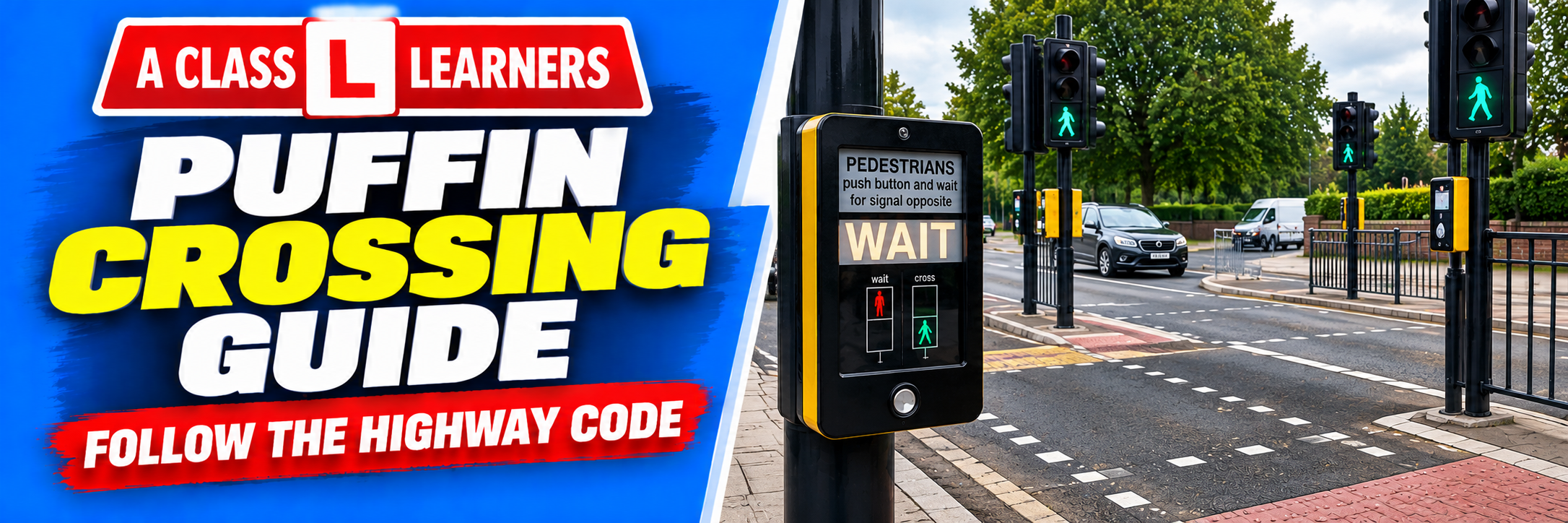
Puffin Crossing Guide: Rules, Signals and Safety
Puffin crossings are an important part of everyday road safety. As a driver, you need to recognise their signals, understand how they work and know when to stop for pedestrians. For learner drivers, understanding puffin crossing rules is also useful when preparing for the practical driving test and studying the Highway Code.
Unlike older pelican crossings, puffin crossings use pedestrian signals positioned on the same side of the road as the person waiting to cross. They also use sensors to help detect pedestrians and manage the time allowed for crossing.
In this guide, we explain what a puffin crossing is, how its signals work, the difference between puffin and pelican crossings, and the mistakes drivers should avoid.
Contents
- What Is a Puffin Crossing?
- How Do Puffin Crossings Work?
- Puffin Crossing Signals Explained
- Puffin Crossing Rules for Drivers
- Rules for Pedestrians at Puffin Crossings
- How Puffin Crossing Sensors Work
- Puffin Crossing vs Pelican Crossing
- Puffin Crossings with Central Islands
- Common Puffin Crossing Mistakes
- Puffin Crossings and Your Driving Test
- Official Highway Code Guidance
- Frequently Asked Questions
What Is a Puffin Crossing?
A puffin crossing is a signal-controlled pedestrian crossing designed to help people cross roads safely while managing traffic flow efficiently.
The name puffin stands for Pedestrian User-Friendly Intelligent crossing. One of its main identifying features is the position of the pedestrian signals. The red standing figure and green walking figure are located on the same side of the road as the pedestrian, usually above the push-button control.
This arrangement allows pedestrians to look at the signals while also watching approaching traffic. Sensors can detect whether pedestrians are waiting or crossing, helping the system manage the crossing phase.
Puffin crossings are particularly useful on roads where pedestrian safety and the movement of traffic both need to be considered.
How Do Puffin Crossings Work?
A puffin crossing combines traffic lights, pedestrian signals, a push-button control and detection equipment. The system responds to pedestrian demand and can adjust the crossing period according to whether people are still crossing.
Although individual installations can vary, the process generally works as follows.
1. A pedestrian requests to cross
Where a push button is provided, the pedestrian presses it and waits at the kerb. The request is registered by the crossing system. Pedestrians should remain near the control and wait for the green walking figure rather than stepping into the road prematurely.
2. The vehicle traffic lights change
When the signal sequence allows pedestrians to cross, the traffic lights change to red for approaching vehicles. Drivers must stop at the stop line and remain stopped while the red signal is displayed.
3. The pedestrian signal turns green
The green walking figure tells pedestrians that they may begin crossing. They should still check that traffic has stopped before stepping into the road and continue to take care while crossing.
4. Sensors monitor the crossing
Detection equipment helps identify whether pedestrians are still crossing. Depending on the installation, the system can allow additional time when necessary and avoid holding traffic at red longer than needed when the crossing is clear.
5. Traffic is allowed to move again
When the crossing phase ends and the vehicle signal returns to green, drivers may proceed if the way is clear. They must still look for pedestrians who have not finished crossing and give way to anyone remaining on the crossing.
Puffin Crossing Signals Explained
Understanding the signals is essential for both pedestrians and drivers. At a puffin crossing, the pedestrian signals and vehicle traffic lights communicate different instructions to different road users.
Red standing figure
The red standing figure means pedestrians must wait and must not start crossing. If you are waiting to cross, remain at the kerb until the green walking figure appears.
Green walking figure
The steady green walking figure means pedestrians may cross. Before stepping into the road, check that traffic has stopped. Continue to look and listen while crossing.
Unlike a pelican crossing, a puffin crossing does not use a flashing green pedestrian figure at the end of the crossing phase. If the red figure appears before you have started crossing, wait and request the crossing again if necessary.
Red vehicle traffic light
For drivers, a red traffic light means stop. Stop at the stop line and do not proceed until the vehicle signal changes to green.
Green vehicle traffic light
A green vehicle signal means you may proceed if the way is clear. It does not mean you can ignore pedestrians who are still crossing. Check the crossing carefully and give way to anyone remaining in the road.
Important: Puffin crossings do not have the flashing amber vehicle signal associated with pelican crossings. Their vehicle signals follow the normal traffic-light sequence.
Puffin Crossing Rules for Drivers
Drivers must approach puffin crossings carefully and obey the traffic signals. The presence of sensors does not remove your responsibility to observe the road, anticipate pedestrians and drive safely.
Stop when the red light shows
You must stop when the red vehicle signal is displayed. Stop at the marked stop line and wait until the signal permits you to proceed.
Approach at a safe speed
Look well ahead for pedestrian crossings, traffic signals and people waiting near the kerb. Reduce your speed when necessary so that you can stop smoothly and safely if the lights change or a pedestrian's presence creates a hazard.
Keep the crossing clear
Do not enter a crossing if traffic ahead is stationary and you cannot clear the crossing completely. Stopping on the crossing can obstruct pedestrians and create a dangerous situation.
This is particularly important in queues and slow-moving traffic. Leave enough space beyond the crossing before moving forward.
Give way to pedestrians still crossing
If the vehicle lights turn green while someone is still crossing, wait until it is safe to proceed. Do not assume that a green light means the crossing is completely clear.
Watch for pedestrians who are difficult to see
Children, older people and people with mobility or visual impairments may need additional time to cross. A pedestrian may also be obscured by stationary vehicles, street furniture or poor visibility.
Stay observant and be prepared to stop if someone enters the crossing or remains in your path.
Never rush or intimidate pedestrians
Do not rev the engine, sound the horn unnecessarily or edge forward to pressure someone who is crossing. Be patient and give pedestrians the time and space they need to reach the other side safely.
Rules for Pedestrians at Puffin Crossings
Puffin crossings are designed to help pedestrians cross safely, but people using them should still pay attention to traffic and their surroundings.
- Press the push button where one is provided.
- Wait at the kerb for the steady green walking figure.
- Check that approaching traffic has stopped before stepping onto the road.
- Keep looking and listening while crossing.
- Cross at a steady pace and avoid unnecessary delays in the road.
- If the red standing figure appears before you have started crossing, do not begin crossing.
- If you are already crossing when the pedestrian signal changes, continue to the other side without unnecessary delay, remaining alert to traffic.
- At a staggered crossing, follow the signals for each separate section.
Pedestrians should not assume that every driver has seen them. Even when the crossing signal is in their favour, they should check that the road is safe before stepping out.
How Puffin Crossing Sensors Work
One of the main differences between puffin crossings and older pelican crossings is their use of pedestrian detection technology.
Sensors can monitor the waiting area and the crossing itself. This information helps the traffic signal controller determine whether a pedestrian is waiting, whether a crossing request is still needed and whether someone is still crossing the road.
Detecting pedestrians waiting to cross
Detection equipment can identify whether a pedestrian remains in the waiting area after requesting to cross. If someone presses the button but then walks away or crosses during a suitable gap in traffic, the system may cancel the request when the installation's detection system allows it to do so.
Allowing time for pedestrians to finish crossing
Other detection equipment can monitor pedestrians on the crossing. This helps the system provide sufficient time for people to reach the other side before traffic is released.
This is useful for pedestrians who may walk more slowly, including some older people and people with mobility difficulties.
Reducing unnecessary delays
Because the crossing can respond to pedestrian detection, it may avoid keeping traffic stopped unnecessarily when no pedestrian needs to use the crossing or when the crossing is clear.
However, sensors are not a substitute for safe driving. Drivers must always obey the traffic signals and check that the road ahead is clear before moving.
Puffin Crossing vs Pelican Crossing
Puffin and pelican crossings both allow pedestrians to cross using traffic signals, but they operate differently. Knowing how to identify each type is useful for everyday driving and for the practical driving test.
| Feature | Puffin Crossing | Pelican Crossing |
|---|---|---|
| Pedestrian signals | On the near side, beside the waiting pedestrian | Traditionally on the far side of the road |
| Pedestrian green signal | Steady green walking figure; no flashing green phase | Green walking figure followed by a flashing green phase |
| Vehicle signals | Normal traffic-light sequence, without a flashing amber phase | Includes a flashing amber phase after red |
| Detection technology | Uses sensors to monitor pedestrian presence and crossing activity | Uses a different signal sequence and does not operate in the same sensor-controlled way as a puffin crossing |
| Crossing time | Can be adjusted using pedestrian detection | Uses its established crossing signal sequence |
Pelican crossings are older installations and are no longer being installed as standard for new crossings. Many existing pelican crossings remain in use, so drivers should understand both types.
The most important practical difference is that you must not expect a flashing amber light at a puffin crossing. If you are driving, wait for the vehicle traffic light to turn green and then proceed only when it is safe.
Puffin Crossings with Central Islands
Some pedestrian crossings have a central island or refuge between the two sides of the road. This allows pedestrians to cross in stages where the layout and signals provide for separate crossing sections.
At a staggered puffin crossing, the two halves are separate crossings. When pedestrians reach the central island, they should press the button for the second half, where provided, and wait for the green walking figure before continuing.
Drivers should be alert to pedestrians who may be waiting on the island or crossing the second half of the road. Do not assume that the whole road is clear simply because pedestrians have reached the refuge.
The precise operation depends on the crossing layout. Always follow the signals and road markings at the location.
Common Puffin Crossing Mistakes
Some errors at pedestrian crossings happen because drivers misunderstand the signal sequence or fail to anticipate what pedestrians might do. Avoiding these mistakes helps keep everyone safe.
1. Expecting a flashing amber light
Puffin crossings do not have the flashing amber phase used at pelican crossings. Drivers must follow the normal traffic-light sequence and wait for green before proceeding.
2. Moving off as soon as the lights turn green
Before moving, check that the crossing is clear. A pedestrian may still be crossing, including someone who needs more time to reach the pavement.
3. Approaching too quickly
Failing to look ahead can leave you with insufficient time to respond safely to changing lights or pedestrians near the kerb. Scan the road ahead and adjust your speed to the conditions.
4. Blocking the crossing in traffic
Entering a crossing without enough room to clear it can obstruct pedestrians. Wait behind the crossing until there is space on the other side.
5. Failing to look for pedestrians
Pedestrians can be difficult to see when parked vehicles, queues or other obstructions block your view. Look carefully on both sides of the road and be prepared for someone to emerge from behind a stationary vehicle.
6. Confusing puffin and pelican crossings
Remember the key difference: puffin crossings use near-side pedestrian signals and do not have a flashing amber vehicle phase. Pelican crossings use a different signal sequence.
Puffin Crossings and Your Driving Test
During your practical driving test, your examiner will expect you to recognise pedestrian crossings, respond correctly to traffic signals and show consideration for people walking near the road.
You should demonstrate that you can approach crossings safely, observe the lights, stop at the correct position and move away only when it is safe.
Look well ahead
Scan the road for crossings, traffic lights, pedestrians and queues. Early observation helps you respond smoothly instead of braking sharply at the last moment.
Use your speed appropriately
Adjust your speed as you approach a crossing. You should be able to stop safely if the lights change or a pedestrian creates a hazard.
Stop correctly
If the vehicle light is red, stop at the stop line. Avoid stopping beyond the line or on the crossing.
Check before moving off
When the light turns green, look for pedestrians still crossing and check that the road ahead is clear. Move off smoothly when it is safe to do so.
Show consideration for pedestrians
Do not rush people who are crossing. Give them time to reach the pavement and be especially patient when someone appears to need additional time.
Avoid unnecessary hesitation
Good driving requires safe, timely decisions. Once the light is green and the crossing is clear, proceed when safe, maintaining proper observation of the road and other road users.
Official Highway Code Guidance
The Highway Code provides guidance on pedestrian crossings, traffic signals and the responsibilities of drivers and pedestrians.
For puffin crossings, the most relevant guidance includes:
- Highway Code Rule 23: explains how puffin crossings differ from pelican crossings, including the position of pedestrian signals and the absence of a flashing green figure phase.
- Highway Code Rule 24: explains why pedestrians should press the button and wait for the green figure, even where traffic on their side of the road has stopped because of congestion.
- Highway Code Rule 28: explains how staggered crossings with a central island operate as two separate crossings.
- Highway Code Rule 199: explains that puffin crossings have no flashing amber phase and that drivers should proceed with extreme caution if a signal-controlled crossing is not working.
Read the official guidance here:
- The Highway Code: Rules for pedestrians, including Rules 23, 24 and 28
- The Highway Code: Using the road, including Rule 199
- Department for Transport: Pedestrian, cycle and equestrian crossings
Always follow the signals, road markings and conditions at the crossing you are using.
Frequently Asked Questions About Puffin Crossings
What is a puffin crossing?
A puffin crossing is a signal-controlled pedestrian crossing that uses sensors to help detect pedestrians and manage the crossing period. Its red and green pedestrian signals are positioned on the near side of the road, where the pedestrian waits.
What does puffin crossing stand for?
Puffin stands for Pedestrian User-Friendly Intelligent crossing.
Do puffin crossings have a flashing amber light?
No. Puffin crossings do not have the flashing amber vehicle signal used at pelican crossings. Their vehicle lights follow the normal traffic-light sequence.
Where are the pedestrian lights on a puffin crossing?
The pedestrian signals are on the same side of the road as the person waiting to cross, usually above or beside the push-button control.
What should drivers do at a puffin crossing?
Stop at the stop line when the vehicle light is red. Wait for green, then check that the crossing is clear before proceeding. Give way to pedestrians who are still crossing.
Can I drive through a puffin crossing when the lights turn green?
You may proceed when the vehicle signal is green, provided it is safe. Check carefully for pedestrians who may still be on the crossing and allow them to finish crossing.
What is the difference between a puffin and a pelican crossing?
Puffin crossings have near-side pedestrian signals and use sensors to monitor pedestrians. Pelican crossings traditionally have far-side pedestrian signals and use a flashing green pedestrian figure and flashing amber vehicle signal during the final stage of the crossing sequence.
What should pedestrians do at a puffin crossing?
Press the button if one is provided, wait for the steady green walking figure, check that traffic has stopped and cross with care. Do not start crossing while the red standing figure is showing.
What happens if a puffin crossing has a central island?
If it is a staggered crossing, the two halves are separate. Reach the island, press the button for the second half where provided and wait for the green walking figure before continuing.
What should I do if a puffin crossing is not working?
Proceed with extreme caution. Watch carefully for pedestrians, be prepared to stop and do not enter the crossing if you cannot clear it completely.
Can puffin crossings detect slow-moving pedestrians?
Puffin crossing sensors monitor pedestrian presence and movement. The system can adjust the crossing period to help pedestrians finish crossing, although the exact operation depends on the equipment installed at that crossing.
Explore Our Complete Learner Driver Guides
Explore our complete guides covering every stage of learning to drive, from your first driving lesson and theory test to preparing for your practical driving test, understanding the Highway Code, mastering driving manoeuvres and keeping up to date with the latest DVSA news and updates related to driving.
- Learn To Drive: The Complete Guide For Learner Drivers
- Driving Tests: The Complete Guide For Learner Drivers
- Theory Test: The Complete Guide For Learner Drivers
- Highway Code: The Complete Guide For Learner Drivers
- Driving Manoeuvres: The Complete Guide For Learner Drivers
- Learner Driver Advice: The Complete Guide For Learner Drivers
- DVSA News & Updates: The Complete Guide For Learner Drivers
Or visit our Driving Lessons & Learner Driver Blogs to explore all our latest driving guides, advice and DVSA updates.
If you're ready to start learning, book your driving lessons online today and take the first step towards becoming a safe, confident and independent driver.
Written by A Class Learners
Providing professional driving lessons across London, Essex and the UK, alongside expert learner driver advice and comprehensive UK driving guides designed to help learners become safe, confident and independent drivers for life.