
Mini Roundabout Rules UK: A Complete Guide for Learner Drivers
Mini roundabouts are a common feature of UK roads, particularly at smaller junctions where there is not enough space for a full-sized roundabout. Although they look simple, they can be challenging for learner drivers because there is less room to manoeuvre, less time to signal and often several vehicles approaching from different directions.
Understanding mini roundabout rules is essential for driving safely, following the Highway Code and preparing for your practical driving test. You need to know who has priority, how to position your vehicle, when to signal and how to pass around the central markings correctly.
This guide explains the rules for mini roundabouts, double mini roundabouts and multiple mini roundabouts, with practical advice to help you approach them safely and confidently.
What Is a Mini Roundabout?
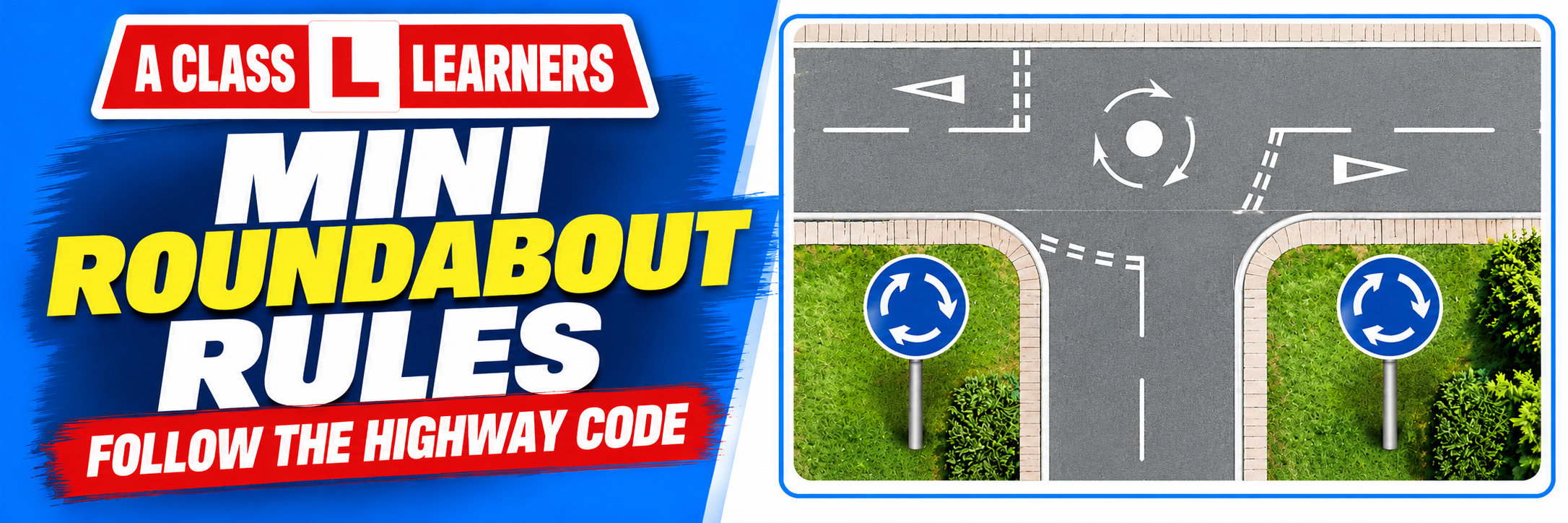
A mini roundabout is a type of road junction marked by a small painted circle or other prescribed central markings on the road. It allows traffic from different directions to move through the junction in an organised way without the need for a large raised central island.
Mini roundabouts are often found where several roads meet, including at T-junctions and smaller crossroads. You may encounter them in residential streets, town centres, local shopping areas and on routes commonly used during driving lessons and practical driving tests.
Unlike a conventional roundabout, a mini roundabout usually has no raised central island. This means drivers must pay particular attention to the painted markings and avoid cutting across the centre.
Highway Code Rule 188: Mini Roundabout Rules
Highway Code Rule 188 explains how drivers should approach and use mini roundabouts. The rule states that you should approach them in the same way as normal roundabouts.
The key requirements are:
- Approach carefully and assess the traffic around you.
- Give way to traffic approaching from the right unless signs, road markings or traffic lights direct you otherwise.
- Pass around the central markings rather than driving straight across them.
- Use appropriate signals to show your intended direction.
- Allow for the limited space and the shorter time available to manoeuvre.
- Avoid making U-turns at mini roundabouts.
Rule 188 uses the word MUST for passing around the central markings, except for large vehicles that are physically incapable of doing so. This is an important distinction: you should not cut across the centre simply because the roundabout is small or the manoeuvre appears easier.
Read the official Highway Code rules for using the road for the full guidance on roundabouts in Rules 184 to 190.
Who Has Priority at a Mini Roundabout?
One of the most common questions from learner drivers is who has priority at a mini roundabout. The normal rule is to give priority to traffic approaching from your right, unless signs, road markings or traffic lights indicate otherwise.
However, you should never assume that another driver will behave correctly. Look carefully at vehicles approaching from the right, as well as traffic already moving through the junction. Check their speed, position and direction before deciding whether it is safe to proceed.
How to Decide When It Is Safe to Enter
- Reduce your speed: Approach at a speed that allows you to assess the junction and stop if necessary.
- Look to the right: Check whether traffic approaching from your right has priority.
- Check ahead and to the left: Look for vehicles already on the mini roundabout, including those that may be turning across your path.
- Assess the gap: Make sure you can enter and leave safely without forcing another driver to brake or change direction.
- Proceed when safe: Enter smoothly when you have sufficient space and the way is clear.
If another vehicle is approaching from your right but is clearly far enough away for you to enter safely, you may be able to proceed. You must make a careful judgement based on the traffic conditions rather than automatically stopping at every mini roundabout.
Equally, do not pull out simply because a vehicle from the right appears to be signalling left. Its signal may be misleading or incorrect, so wait until you are confident that it is safe to move.
How to Approach a Mini Roundabout
A safe approach gives you time to observe other road users, choose your position and prepare to turn. Mini roundabouts often require quicker decisions than larger roundabouts, so planning ahead is important.
- Check your mirrors: Be aware of traffic behind you before slowing down.
- Look for signs and road markings: Check the layout of the junction and any arrows or lane instructions.
- Choose your position: Select an appropriate position for your intended exit, taking account of the road layout.
- Adjust your speed: Slow down early enough to assess the junction without harsh braking.
- Check for traffic: Look right, ahead and left, watching for vehicles already entering or crossing the roundabout.
- Signal where appropriate: Let other road users know what you intend to do without giving a misleading indication.
- Move off smoothly: Enter only when it is safe and continue around the central markings.
Remember the Mirrors – Signal – Manoeuvre routine. It helps you stay aware of the traffic around you before changing speed, position or direction.
Mini Roundabout Signals: When Should You Indicate?
Signalling at a mini roundabout follows the same general principles as signalling at a normal roundabout. The main difference is that you have less time and space to complete the manoeuvre, so your signals need to be timely and clear.
Turning Left at a Mini Roundabout
If you intend to take the first exit to the left, signal left as you approach, provided it is safe and appropriate to do so. Position your vehicle towards the left side of your approach where the road layout allows, and check for pedestrians and cyclists near the exit.
Going Straight Ahead at a Mini Roundabout
If you are going straight ahead, you would not normally signal on approach unless the road layout or circumstances make a signal necessary. Once you have passed the exit before the one you intend to take, signal left where appropriate to show that you are leaving the roundabout.
Because mini roundabouts are compact, you may need to time this signal carefully. Avoid signalling so early that another driver mistakes your intention.
Turning Right at a Mini Roundabout
If you intend to turn right, signal right on approach and position your vehicle appropriately for the road layout. Keep checking the traffic around you and follow the correct path around the central markings.
After passing the exit before the one you want, signal left when appropriate to show that you are leaving. Check your mirrors and look for cyclists, motorcyclists and other road users who may be alongside you.
Always remember that signals communicate your intentions; they do not give you priority. You must still check that the manoeuvre is safe.
Which Lane Should You Use at a Mini Roundabout?
Many mini roundabouts are on single-carriageway roads with no marked lanes. In these situations, your road position should reflect your intended direction and the available space.
- Turning left: Keep towards the left where the road layout permits.
- Going straight ahead: Use a sensible position for your approach and follow any road markings or signs.
- Turning right: Position appropriately towards the centre of the road where it is safe and permitted, taking account of the junction layout.
There is no single lane arrangement that applies to every mini roundabout. Road markings, directional arrows and signs take priority in determining the correct position. Avoid moving across another vehicle's path or squeezing alongside traffic where there is insufficient room.
If the approach has marked lanes, follow the signs and arrows. If you are unsure of the layout, reduce your speed and assess the junction early rather than making a sudden change of position.
Do You Have to Go Around the Centre of a Mini Roundabout?
Yes. Under Highway Code Rule 188, vehicles must pass around the central markings unless they are large vehicles that are physically incapable of doing so.
Although the central marking may be small, you should not drive straight across it to save time or make a turn easier. Follow the intended route around the marking, maintaining a safe speed and watching the position of other vehicles.
Large vehicles, such as certain buses or lorries, may be unable to pass around the markings because of their size. Rule 188 recognises this practical limitation. Ordinary cars should not treat that exception as permission to cut across the centre.
Can You Make a U-Turn at a Mini Roundabout?
The Highway Code advises drivers to avoid making U-turns at mini roundabouts. The space is limited, and attempting a U-turn can create confusion or conflict with vehicles approaching from other directions.
You should also be alert to other drivers who may attempt a U-turn. Do not assume that every vehicle will follow the expected route around the junction.
If you need to change direction, it is usually safer to choose a suitable alternative route rather than attempt a U-turn at a mini roundabout.
Double Mini Roundabout Rules
A double mini roundabout is a junction where two mini roundabouts are positioned close together. These layouts can be difficult for learner drivers because you may need to make two separate decisions in quick succession.
Highway Code Rule 189 says that you should treat each mini roundabout separately and give way to traffic from the right.
How to Drive Through a Double Mini Roundabout
- Approach the first mini roundabout at a suitable speed.
- Check for traffic from the right and other vehicles using the junction.
- Give way where required and proceed when safe.
- Follow the correct path around the first set of central markings.
- Reassess the traffic and road layout before entering the second mini roundabout.
- Give way to traffic from the right at the second roundabout as required.
- Continue towards your intended exit, maintaining control and looking out for other road users.
Do not assume that being able to enter the first mini roundabout means you can automatically continue through the second. Traffic conditions can change quickly, so assess each junction independently.
Multiple Mini Roundabouts
Some complex junctions have a series of mini roundabouts rather than just one or two. Highway Code Rule 190 explains that you should treat each mini roundabout separately and follow the normal rules.
When approaching several mini roundabouts, plan your route early, follow signs and road markings, and avoid rushing from one junction to the next. Make sure you have enough space to complete each manoeuvre safely.
Keep checking for vehicles approaching from the right, traffic crossing your path, cyclists, motorcyclists and pedestrians near the entrances and exits. Your priority is to make safe decisions at each individual roundabout.
Common Mini Roundabout Mistakes
Mini roundabouts are a frequent source of uncertainty for learner drivers. The following mistakes can lead to unsafe decisions and may affect your performance during a practical driving test.
1. Approaching Too Quickly
Driving too fast towards a mini roundabout leaves less time to observe traffic and decide whether to stop or proceed. Reduce your speed early enough to assess the junction properly.
2. Failing to Check to the Right
One of the most important checks is for traffic approaching from the right. Failing to look properly can cause you to enter the junction when another vehicle has priority.
3. Assuming Other Drivers Will Signal Correctly
Some drivers signal too early, too late or not at all. Never rely entirely on another vehicle's indicators. Consider its speed, road position and movement before entering.
4. Driving Across the Central Markings
Cutting across the centre is not the correct route for an ordinary car. Pass around the central markings in accordance with Rule 188.
5. Forgetting to Signal
Failing to signal can leave other road users uncertain about your intentions. Use appropriate signals, but make sure they are timed correctly and do not mislead other drivers.
6. Choosing the Wrong Position
Poor positioning can confuse other road users or place your vehicle in the path of traffic turning in a different direction. Look for signs, arrows and lane markings before reaching the junction.
7. Treating a Double Mini Roundabout as One Junction
Each mini roundabout must be assessed separately. Check the traffic again before entering the second roundabout, even if you have already crossed the first.
8. Making a U-Turn
U-turns should be avoided at mini roundabouts because there is limited space and the manoeuvre can confuse or endanger other road users.
Mini Roundabout Tips for Your Driving Test
If you are preparing for your UK practical driving test, practise approaching mini roundabouts in different traffic conditions. Your examiner will expect you to demonstrate safe observation, appropriate positioning, effective signalling and sound judgement.
- Look for mini roundabout signs and road markings well in advance.
- Use your mirrors before slowing down or changing position.
- Reduce your speed sufficiently to assess the junction.
- Look carefully to the right and check for traffic already using the roundabout.
- Give way when required and avoid forcing another driver to change speed or direction.
- Choose an appropriate position for your intended exit.
- Signal clearly and at the correct time.
- Pass around the central markings rather than cutting across them.
- Check carefully for pedestrians, cyclists and motorcyclists.
- At double mini roundabouts, treat each roundabout separately.
If you make a minor mistake, remain calm and continue driving safely. Do not make a sudden correction that creates another hazard. Your aim is to demonstrate that you can assess risks, make appropriate decisions and maintain control of the vehicle.
For further preparation, explore our complete guide to driving tests.
Mini Roundabouts and the Highway Code: Rules 188, 189 and 190
The main Highway Code rules for mini roundabouts are:
- Rule 188: Approach mini roundabouts in the same way as normal roundabouts. Vehicles must pass around the central markings, except large vehicles physically incapable of doing so. Remember that there is less room to manoeuvre and less time to signal, and avoid U-turns.
- Rule 189: At double mini roundabouts, treat each roundabout separately and give way to traffic from the right.
- Rule 190: At complex junctions with multiple mini roundabouts, treat each one separately and follow the normal rules.
You can read the official guidance in the Highway Code: Using the Road, Rules 159 to 203.
Frequently Asked Questions About Mini Roundabout Rules
Who has priority at a mini roundabout in the UK?
You should normally give priority to traffic approaching from your right, unless signs, road markings or traffic lights direct you otherwise. Check carefully for vehicles already using the roundabout before entering.
Do you have to drive around the centre of a mini roundabout?
Yes. Rule 188 states that vehicles must pass around the central markings, except large vehicles that are physically incapable of doing so. You should not cut across the centre for convenience.
Do you need to indicate at a mini roundabout?
Yes, use appropriate signals to show your intentions, following the general rules for normal roundabouts. Signal left when turning left, signal right when turning right, and signal left when leaving after going straight ahead where appropriate. Remember that you have less time to signal at a mini roundabout.
Can you make a U-turn at a mini roundabout?
The Highway Code advises drivers to avoid U-turns at mini roundabouts. The limited space makes them difficult and potentially confusing for other road users.
How do you drive through a double mini roundabout?
Treat each roundabout separately. Check for traffic from the right, give way as required and reassess the traffic before entering the second mini roundabout.
What are the most common mini roundabout mistakes?
Common mistakes include approaching too quickly, failing to check to the right, relying on other drivers' signals, cutting across the central markings, poor positioning and forgetting to signal.
Which Highway Code rules cover mini roundabouts?
Rules 188, 189 and 190 cover mini roundabouts, double mini roundabouts and multiple mini roundabouts. They explain how to approach the junctions, give way and navigate them safely.
Explore Our Complete Learner Driver Guides
Explore our complete guides covering every stage of learning to drive, from your first driving lesson and theory test to preparing for your practical driving test, understanding the Highway Code, mastering driving manoeuvres and keeping up to date with the latest DVSA news and updates related to driving.
- Learn To Drive: The Complete Guide For Learner Drivers
- Driving Tests: The Complete Guide For Learner Drivers
- Theory Test: The Complete Guide For Learner Drivers
- Highway Code: The Complete Guide For Learner Drivers
- Driving Manoeuvres: The Complete Guide For Learner Drivers
- Learner Driver Advice: The Complete Guide For Learner Drivers
- DVSA News & Updates: The Complete Guide For Learner Drivers
Or visit our Driving Lessons & Learner Driver Blogs to explore all our latest driving guides, advice and DVSA updates.
If you're ready to start learning, book your driving lessons online today and take the first step towards becoming a safe, confident and independent driver.
Written by A Class Learners
Providing professional driving lessons across London, Essex and the UK, alongside expert learner driver advice and comprehensive UK driving guides designed to help learners become safe, confident and independent drivers for life.