
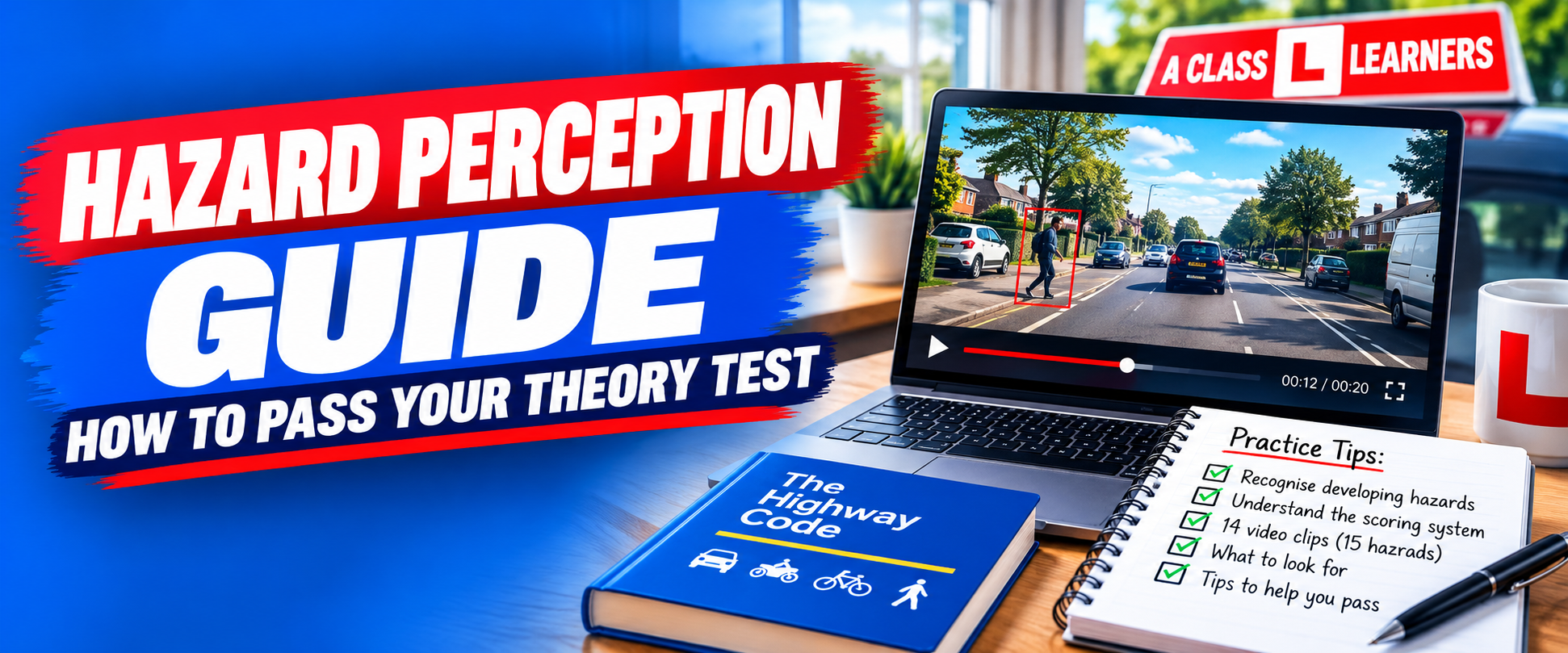
Hazard Perception Guide: How To Pass Your Theory Test
The hazard perception test is an important part of the UK car theory test. It assesses how well you recognise developing hazards on the road and how quickly you respond when a situation could require you to slow down, change direction or take another appropriate action.
For many learner drivers, hazard perception can feel unfamiliar at first. Unlike multiple-choice questions, you are watching moving road scenes and must identify the moment a potential danger starts to develop.
The good news is that you can improve your hazard perception skills with regular practice. Learning what to look for, understanding how the scoring system works and developing your awareness of road conditions can help you prepare for the test.
In this guide, A Class Learners explains how the hazard perception test works, what counts as a developing hazard, how points are awarded and how to prepare effectively.
What Is The Hazard Perception Test?
The hazard perception test is the video-based section of the car theory test. It is designed to assess whether you can recognise situations that may become dangerous and respond appropriately.
You will watch video clips showing everyday road scenes. These may include residential streets, busy junctions, country roads, pedestrians, cyclists and other vehicles.
As you watch each clip, you must look for developing hazards and click the mouse when you recognise one beginning to develop.
The test assesses more than simply noticing something on the road. It is about recognising when a situation changes and could require you, as the driver, to take action.
For example, a pedestrian standing on the pavement may not initially present an immediate hazard. If the pedestrian starts moving towards the road, the situation may begin to develop into a hazard that requires you to respond.
Learning to recognise these changes is an important part of becoming a safe and observant driver.
You can find the official information on the GOV.UK hazard perception test guidance.
How Does The Hazard Perception Test Work?
The car hazard perception test takes place on a computer at an approved theory test centre.
Before the test begins, you will be shown an introductory video explaining how it works. You will then watch 14 video clips featuring everyday road situations.
The clips contain developing hazards that you need to identify by clicking the mouse at the appropriate time.
Here is a summary of the test:
- Number of clips: 14
- Developing hazards: 15 in total
- Maximum points per hazard: 5
- Total available points: 75
- Pass mark: 44 out of 75
Each clip contains at least one developing hazard, but one of the 14 clips contains two developing hazards.
You only get one attempt at each clip. You cannot review or change your responses once you have completed it, so it is important to remain focused throughout the test.
What Is A Developing Hazard?
A developing hazard is a situation that would cause you to take action while driving, such as changing your speed or direction.
Recognising the difference between a potential hazard and a developing hazard is one of the most important skills you need for this part of the theory test.
Example 1: A Parked Car
Imagine that you are driving along a residential street and notice a car parked at the side of the road.
At first, the car is stationary and is not doing anything that requires you to change your driving. It is a potential hazard, but it has not necessarily started to develop.
As you get closer, the car's indicator begins flashing and the car starts to move away from the kerb.
The situation has now changed. You may need to slow down or adjust your position to allow the car to move safely. This is an example of a developing hazard.
Example 2: A Pedestrian Near The Road
You are approaching a pedestrian standing on the pavement near a pedestrian crossing.
Initially, the pedestrian may simply be waiting. As the situation develops, the pedestrian may step towards the road or begin crossing.
You need to recognise the changing situation and consider whether you would need to slow down or stop.
Example 3: A Vehicle Approaching A Junction
You are driving along a main road and see a vehicle waiting at a side-road junction.
As you approach, the vehicle begins moving forwards and its driver appears to be preparing to enter your road.
The vehicle's movement creates a developing hazard because you may need to reduce your speed or adjust your position to maintain a safe distance.
These examples demonstrate why you should pay attention to what road users are doing, rather than simply looking at objects in the scene.
How Is The Hazard Perception Test Scored?
You can score up to five points for each developing hazard. The earlier you recognise the hazard as it starts to develop and click at the appropriate time, the more points you can potentially receive.
The scoring system rewards timely recognition. Waiting until a hazard has become obvious or is already happening may mean you score fewer points.
For the car theory test, the hazard perception section has a maximum score of 75 points, and you need at least 44 points to pass.
You can check the current pass mark on the official GOV.UK theory test pass mark and result page.
Does Clicking At The Wrong Time Lose You Marks?
You do not lose points simply because you make an individual incorrect click.
However, clicking continuously or clicking in a repeated pattern can trigger the test's inappropriate-response system. If this happens, you will not score any points for that clip.
Avoid clicking repeatedly throughout a clip in the hope of catching the scoring window. Instead, watch the road scene carefully and click when you recognise a hazard beginning to develop.
Remember that you only have one attempt at each clip, so concentration and timing are important.
What Types Of Hazards Should You Look For?
The hazard perception test can feature a wide range of everyday driving situations. You should practise recognising how the actions of other road users and changes in the road environment may affect your driving.
Developing hazards can involve:
- Pedestrians: People approaching the kerb, stepping into the road or crossing between parked vehicles.
- Cyclists: Cyclists moving around parked vehicles, changing position or approaching junctions.
- Motorcyclists: Motorcyclists approaching from side roads or moving through traffic.
- Other vehicles: Cars pulling out of parking spaces, emerging from junctions or changing lanes.
- Junctions: Vehicles approaching from side roads or traffic situations that require you to adjust your speed.
- Parked vehicles: Vehicles that may pull away or open a door into your path.
- Road conditions: Situations involving poor visibility, slippery surfaces or other conditions that may affect how you drive.
- Animals: Animals near the road that may move into your path.
- Traffic changes: Queues, slowing vehicles or unexpected changes in traffic flow.
Not everything you see is automatically a developing hazard. The important question is whether the situation is changing in a way that may require you to take action.
How To Improve Your Hazard Perception Skills
Practising regularly can help you become more familiar with developing hazards and improve your ability to recognise them.
1. Look Well Ahead
When driving, it is important to look well ahead rather than concentrating only on the road immediately in front of you.
Looking further ahead gives you more time to notice developing situations, assess what other road users may do and plan an appropriate response.
During practice clips, try to scan the whole scene rather than staring at one vehicle or object.
2. Watch How Other Road Users Behave
Pay attention to the actions of pedestrians, cyclists, motorcyclists and other drivers.
Look for clues that someone may be about to change direction, enter the road, move into your lane or pull out from a junction.
Indicators, changes in speed, movement towards the road and changes in a vehicle's position can all provide useful clues.
3. Recognise When A Situation Changes
Try to distinguish between something that could potentially become a hazard and something that is actively developing.
A parked vehicle, for example, may not initially require you to take action. If it begins moving into your path, the situation changes.
Practise identifying the point at which a situation develops enough that you would need to adjust your driving.
4. Practise With Official Hazard Perception Materials
Use suitable practice materials to familiarise yourself with the format of the test and the types of road situations you may encounter.
The official GOV.UK hazard perception guidance explains the scoring system and provides information about what counts as a developing hazard.
You can also explore the official theory test revision and practice resources to help prepare for both parts of your theory test.
5. Avoid Clicking In A Pattern
One common mistake is clicking too frequently because you are worried about missing a hazard.
Repeated clicking in a continuous or patterned way can result in zero points for a clip. Clicking indiscriminately is therefore not a reliable strategy.
Instead, focus on identifying meaningful changes in the road scene and respond when you recognise a developing hazard.
6. Practise Little And Often
Short, regular practice sessions can help you develop familiarity with hazard perception clips without becoming overwhelmed.
After practising, think about which hazards you recognised easily and which situations you found difficult.
Use this reflection to guide your next revision session. Concentrate on improving your awareness of developing situations rather than simply trying to memorise individual clips.
7. Apply Your Awareness During Driving Lessons
Hazard perception is not just a skill for passing your theory test. It is an essential part of safe driving.
During your driving lessons, pay attention to what is happening further ahead, observe the behaviour of other road users and think about how developing situations may affect your decisions.
Your driving instructor can help you improve your observation, anticipation and planning so that you can recognise potential dangers and respond safely.
Common Hazard Perception Mistakes To Avoid
Understanding common mistakes can help you prepare more effectively for your test.
Clicking Too Early
Clicking when you first notice something that could potentially become a hazard may be too early if the situation has not started to develop.
Look for signs that the situation is changing and that you may need to take action.
Clicking Too Late
If you wait until the hazard is already obvious or has developed significantly, you may miss the opportunity to score the maximum points.
Practise recognising the early signs of a developing hazard so that you can respond at the appropriate moment.
Focusing On One Part Of The Screen
Concentrating on a single vehicle or area of the road can cause you to overlook other developing situations.
Try to scan the whole scene and pay attention to activity in the foreground, middle distance and further ahead.
Clicking Repeatedly
Repeated clicking or clicking in a pattern can result in no points being awarded for a clip.
Focus on recognising developing hazards rather than clicking continuously in the hope of scoring points.
Assuming Every Potential Hazard Is Developing
Not every pedestrian, vehicle or roadside object requires an immediate response.
The test assesses your ability to identify when a situation starts to develop into something that may require you to change speed or direction.
What Happens If You Fail The Hazard Perception Test?
The hazard perception section is one of the two parts of the car theory test. You must pass both the multiple-choice section and the hazard perception section to pass the overall test.
If you fail either part, you must book and take the full theory test again. You cannot retake only the hazard perception section while keeping a pass in the multiple-choice section.
Your result letter will explain which part or parts you did not score enough points on, helping you identify where to concentrate your revision.
You must wait at least three working days before taking the theory test again.
You can find more information on the official GOV.UK pass mark and test result page.
How Does Hazard Perception Help You Become A Safer Driver?
Hazard perception is important beyond the theory test because safe driving depends on recognising risks early and giving yourself enough time to respond.
Good hazard awareness helps you anticipate what other road users might do, identify changes in traffic conditions and make safer decisions.
For example, recognising that a vehicle may pull out from a junction gives you more time to assess the situation and adjust your speed if necessary.
Similarly, noticing a pedestrian approaching the kerb can help you prepare for the possibility that they may enter the road.
Developing these skills through revision and practical driving lessons can help you become a more observant, confident and responsible driver.
Frequently Asked Questions About Hazard Perception
What is the hazard perception test?
The hazard perception test is the video-based section of the car theory test. You watch clips showing everyday road situations and click when you identify developing hazards that may require a driver to take action.
How many clips are in the car hazard perception test?
There are 14 video clips. Each contains at least one developing hazard, and one clip contains two developing hazards, making 15 developing hazards in total.
What is the hazard perception pass mark?
The pass mark for the car hazard perception test is 44 out of 75.
How many points can you score for each hazard?
You can score up to five points for each developing hazard. Responding as soon as the hazard starts to develop gives you the opportunity to achieve a higher score.
Do you lose points for clicking at the wrong time?
You do not lose points for an individual incorrect click. However, clicking continuously or in a pattern can result in no points being awarded for that clip.
Can you retake only the hazard perception test if you fail?
No. If you fail either part of the car theory test, you must book and take the full theory test again, even if you passed the other part.
How long must you wait before retaking the theory test?
You must wait at least three working days before taking the theory test again.
Explore Our Complete Learner Driver Guides
Explore our complete guides covering every stage of learning to drive, from your first driving lesson and theory test to preparing for your practical driving test, understanding the Highway Code, mastering driving manoeuvres and keeping up to date with the latest DVSA news and updates related to driving.
- Learn To Drive: The Complete Guide For Learner Drivers
- Driving Tests: The Complete Guide For Learner Drivers
- Theory Test: The Complete Guide For Learner Drivers
- Highway Code: The Complete Guide For Learner Drivers
- Driving Manoeuvres: The Complete Guide For Learner Drivers
- Learner Driver Advice: The Complete Guide For Learner Drivers
- DVSA News & Updates: The Complete Guide For Learner Drivers
Or visit our Driving Lessons & Learner Driver Blogs to explore all our latest driving guides, advice and DVSA updates.
If you're ready to start learning, book your driving lessons online today and take the first step towards becoming a safe, confident and independent driver.
Written by A Class Learners
Providing professional driving lessons across London, Essex and the UK, alongside expert learner driver advice and comprehensive UK driving guides designed to help learners become safe, confident and independent drivers for life.