
Box Junction Rules UK: A Complete Guide for Learner Drivers
Yellow box junctions are a common feature of busy UK roads, particularly at traffic-light-controlled junctions, crossroads and some roundabouts. They are designed to help keep junctions clear and prevent traffic from becoming gridlocked.
Understanding box junction rules is important for every driver, especially learner drivers preparing for their practical driving test. You need to know when you can enter a yellow box, when you must wait, how the right-turn exception works and what to do when traffic is moving slowly.
This guide explains the UK rules for yellow box junctions, based on Highway Code Rule 174, with practical examples and advice to help you make safer decisions on the road.
What Is a Box Junction?
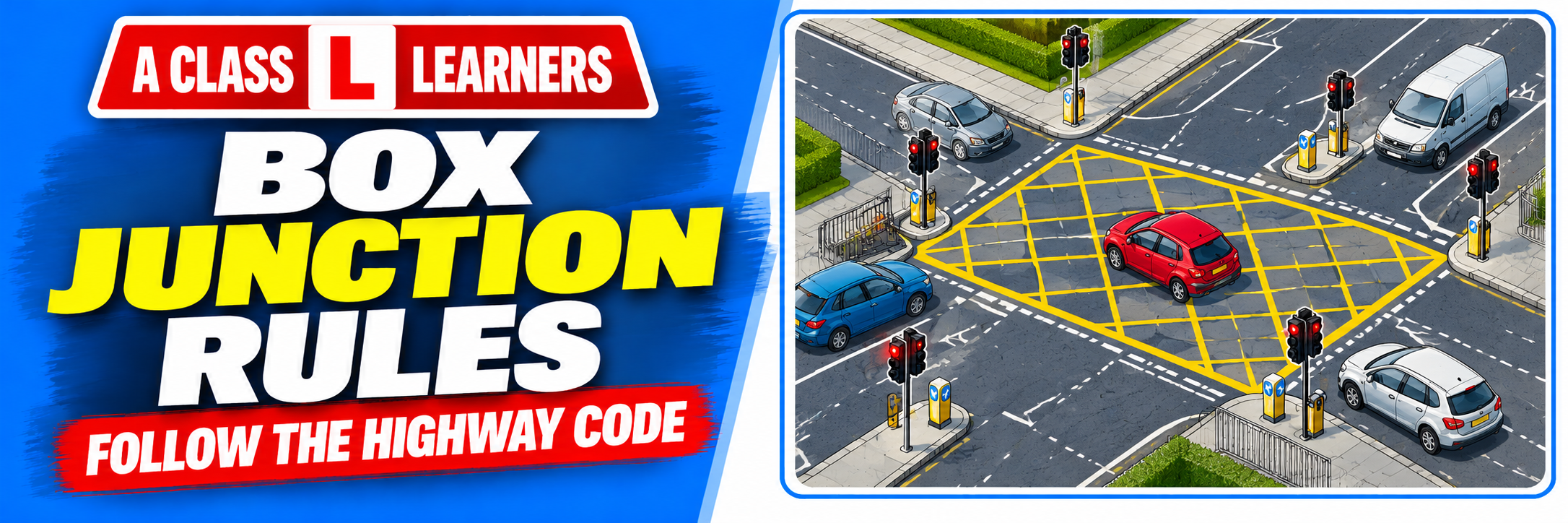
A box junction is an area of road marked with yellow criss-cross lines. It is usually found where roads meet, particularly at busy junctions where vehicles turning or travelling straight ahead could block traffic moving in other directions.
The yellow markings indicate that drivers must keep the junction clear by avoiding entering the box when their exit road or lane is blocked.
You may encounter box junctions:
- At traffic-light-controlled crossroads.
- At busy town-centre junctions.
- At junctions where queues frequently build up.
- At some roundabouts controlled by traffic signals.
- On roads where vehicles turning right could otherwise block traffic.
Box junctions can be particularly challenging during rush hour, when traffic moves in short bursts and the space beyond the junction can fill quickly. The key is to look beyond the vehicle directly in front of you and assess whether there is enough room to complete your manoeuvre.
Highway Code Rule 174: Yellow Box Junction Rules
Highway Code Rule 174 sets out the main rules for box junctions. The essential requirement is that you must not enter the box until your exit road or lane is clear.
In practical terms, before driving into a yellow box, you should check that there is sufficient space on the other side for your vehicle to clear the markings without being forced to stop inside them.
The main rules are:
- Do not enter a yellow box if your exit road or lane is blocked.
- Wait before the box until there is enough room to move through it.
- Do not follow another vehicle into the box simply because it has started moving.
- Understand the specific exception for vehicles turning right.
- At signalled roundabouts, do not enter the box unless you can cross it completely without stopping.
The Highway Code uses MUST NOT for the restriction on entering a box before your exit is clear. This is a legal requirement, not simply a driving recommendation.
You can read the official Highway Code guidance on using the road for the full wording of Rule 174.
Can You Enter a Yellow Box Junction?
You can enter a yellow box when your exit road or lane is clear and you can proceed through the junction without being forced to stop inside the markings.
For example, if the traffic lights are green but vehicles on the other side of the junction are stationary, you should check whether there is enough space for your entire vehicle beyond the box. If the queue leaves no room for you to clear the junction, wait before the yellow lines.
Do not assume that a green traffic light gives you permission to enter a blocked box junction. You must still consider the traffic ahead and whether you can clear the junction safely.
Example: Your Exit Is Clear
You approach a yellow box junction and the traffic lights are green. Traffic on the other side is moving, and there is enough space beyond the markings for your vehicle to pass through completely.
If it is otherwise safe and lawful to proceed, you can enter the box and continue through the junction.
Example: Your Exit Is Blocked
You approach the same junction, but a queue of stationary vehicles fills the road beyond the yellow markings. Even though the traffic lights are green, there is nowhere for your vehicle to go.
You should remain behind the box and wait until there is sufficient space on the other side. Entering and stopping in the box could obstruct traffic moving across the junction.
The Right-Turn Exception at a Box Junction
One of the most important parts of Rule 174 is the exception for drivers turning right.
You may enter a yellow box and wait when you intend to turn right and are prevented from completing the turn by:
- Oncoming traffic travelling straight ahead or approaching from the opposite direction.
- Other vehicles waiting to turn right.
This exception recognises that you may need to position your vehicle within the junction while waiting for a safe opportunity to complete your right turn.
However, the exception is specific. It does not mean that you can enter any yellow box and wait whenever traffic is busy. You must be turning right and be prevented from proceeding by the circumstances described in Rule 174.
How to Turn Right at a Box Junction
- Approach the junction carefully and check your mirrors.
- Position your vehicle correctly for the right turn, following road markings and signs.
- Check the traffic ahead and assess whether you can complete the turn safely.
- If you are prevented from turning by oncoming traffic or other vehicles waiting to turn right, you may enter and wait in the box under the Rule 174 exception.
- Keep watching for a safe gap in the oncoming traffic.
- Complete the turn when it is safe, making sure you do not endanger other road users.
Do not rush into the junction or assume that oncoming traffic will stop for you. You must still judge the speed and position of other vehicles and turn only when it is safe.
Box Junction Rules at Traffic Lights
Box junctions are frequently found at traffic-light-controlled crossroads. A green light means you may proceed if it is safe, but it does not remove the requirement to keep the box clear.
Before entering, check the traffic beyond the junction. If vehicles ahead are stationary and there is insufficient space for you to clear the box, wait behind the yellow markings.
When traffic is moving slowly, avoid following the vehicle in front too closely. It may move into the box and then stop because its exit becomes blocked. Leave enough space to make your own decision based on the conditions ahead.
What If the Traffic Lights Turn Red While You Are Waiting?
If you have entered the junction lawfully under the right-turn exception, continue to assess the situation and complete your turn when it is safe and lawful to do so. Never accelerate into conflicting traffic simply because the lights have changed.
Always obey the traffic signals that apply to your movement and take care not to obstruct pedestrians or other road users. If you are approaching a red light and have not entered the junction, stop behind the relevant stop line as required.
Box Junction Rules at Signalled Roundabouts
Some roundabouts have yellow box markings and traffic signals. These have an important additional restriction under Highway Code Rule 174.
At signalled roundabouts, you must not enter the box unless you can cross over it completely without stopping.
This means you should not rely on the ordinary right-turn exception to enter and wait in a box at a signalled roundabout. You need to be able to cross the marked area completely without stopping.
Check the traffic ahead before entering and make sure there is enough space to continue through the box. If the exit is blocked or traffic is likely to force you to stop within the markings, wait before entering.
What Should You Do When Traffic Is Moving Slowly?
Slow-moving traffic can make box junctions difficult because gaps may appear and disappear quickly. A vehicle ahead may begin moving, only for the queue to stop again a few seconds later.
To manage these situations safely:
- Look beyond the vehicle directly in front of you.
- Check whether your exit lane has enough space for your vehicle.
- Wait if the traffic ahead is stationary and the box cannot be cleared.
- Do not rely solely on a green traffic light.
- Avoid following another vehicle into the box without checking the space available.
- Remain patient rather than feeling pressured by drivers behind you.
If you cannot be confident that you will be able to clear the box, the safer decision is to wait before the yellow markings until the way ahead is clear.
Common Box Junction Mistakes
Box junctions require forward planning and good observation. The following mistakes can cause unnecessary obstruction and may lead to enforcement action where the relevant rules and local arrangements apply.
1. Entering When the Exit Is Blocked
This is the main mistake to avoid. If the road or lane beyond the box is not clear, you should wait before entering, unless the specific right-turn exception applies.
2. Assuming a Green Light Means You Can Go
A green light does not mean that you can enter a box junction when your exit is blocked. Always check the available space beyond the junction before proceeding.
3. Following the Vehicle in Front Too Closely
The vehicle ahead may have enough space to clear the box, but that does not guarantee that there is room for your vehicle as well. Assess the exit independently before moving forward.
4. Misunderstanding the Right-Turn Exception
The right-turn exception is not a general permission to wait inside a box. It applies when you are turning right and are prevented from proceeding by oncoming traffic or other vehicles waiting to turn right.
5. Entering a Box at a Signalled Roundabout Without Enough Space
At signalled roundabouts, you must be able to cross the box completely without stopping. Do not enter if the traffic ahead is likely to prevent you from doing so.
6. Feeling Pressured by Traffic Behind You
Drivers behind may expect you to move as soon as the lights turn green. Do not allow that pressure to influence your judgement. Wait until you can proceed in accordance with the rules.
How to Avoid a Box Junction Fine
Some yellow box junctions are monitored by cameras, and contraventions may lead to a penalty where the relevant enforcement powers apply. The precise arrangements depend on the location and the authority responsible for the road.
The most useful way to avoid a penalty is to understand Rule 174 and make the correct decision before entering the box.
- Check your exit before moving into the yellow markings.
- Leave enough room for your vehicle beyond the junction.
- Do not enter simply because the lights are green.
- Wait when the road ahead is blocked.
- Apply the right-turn exception only when the stated conditions are met.
- At signalled roundabouts, ensure you can cross the box completely without stopping.
Do not assume that every box junction has a camera or that every location uses identical enforcement arrangements. If you receive a penalty notice, check the details, evidence, deadlines and appeal procedure provided by the issuing authority.
Box Junction Tips for Your Driving Test
When learning to drive, you may encounter yellow box junctions during lessons or on your practical driving test. Your examiner will expect you to observe the road ahead, respond appropriately to traffic conditions and avoid entering a junction that you cannot clear.
- Identify yellow box markings early.
- Look beyond the traffic directly in front of you.
- Check whether the exit road or lane is clear.
- Do not treat a green light as permission to enter a blocked box.
- Understand when the right-turn exception applies.
- Remember the stricter rule at signalled roundabouts.
- Remain calm when traffic is slow or other drivers are impatient.
- Make safe, controlled decisions rather than rushing.
Good observation is essential. If the exit is blocked, waiting in the correct position shows that you are thinking ahead and responding to the traffic conditions rather than simply following the vehicle in front.
For more preparation advice, explore our complete guide to driving tests and our learner driver advice.
Box Junction Rules: Quick Summary
- Normal rule: Do not enter a yellow box until your exit road or lane is clear.
- Right-turn exception: You may enter and wait when turning right if oncoming traffic or other vehicles waiting to turn right prevent you from proceeding.
- Signalled roundabouts: Do not enter the box unless you can cross it completely without stopping.
- Green lights: A green light does not remove the requirement to keep the box clear.
- Safe driving: Look ahead, assess the space available and wait if you cannot clear the box.
For the full official wording, read Highway Code Rule 174: Box junctions. You can also consult the official Highway Code guidance on road markings.
Frequently Asked Questions About Box Junction Rules
What are the rules for a yellow box junction in the UK?
Under Rule 174, you must not enter a box junction until your exit road or lane is clear. The exception is when you are turning right and are prevented from proceeding by oncoming traffic or other vehicles waiting to turn right.
Can you stop in a yellow box junction?
You should not enter a box junction unless your exit road or lane is clear. You may enter and wait when turning right if the specific conditions in Rule 174 apply. At signalled roundabouts, you must be able to cross the box completely without stopping.
Can you enter a box junction when turning right?
Yes, if you are turning right and are prevented from proceeding by oncoming traffic or other vehicles waiting to turn right. This is a specific exception and does not permit you to enter a box whenever traffic is busy.
Can you enter a box junction if traffic is moving slowly?
Only if your exit road or lane is clear and you can proceed through the box. If the queue ahead leaves no room for your vehicle, wait before the yellow markings.
Do box junction rules apply at roundabouts?
Yes. At signalled roundabouts, Rule 174 states that you must not enter the box unless you can cross it completely without stopping.
How can learner drivers avoid stopping in a box junction?
Look well ahead, check the available space beyond the box and wait if your exit is blocked. Enter only when you can clear the box safely, subject to the specific right-turn exception.
Can you get a fine for stopping in a box junction?
Depending on the location and applicable enforcement arrangements, entering and stopping in a box junction in breach of the rules may result in a penalty. Check any notice carefully for the evidence, deadlines and appeal procedure.
Explore Our Complete Learner Driver Guides
Explore our complete guides covering every stage of learning to drive, from your first driving lesson and theory test to preparing for your practical driving test, understanding the Highway Code, mastering driving manoeuvres and keeping up to date with the latest DVSA news and updates related to driving.
- Learn To Drive: The Complete Guide For Learner Drivers
- Driving Tests: The Complete Guide For Learner Drivers
- Theory Test: The Complete Guide For Learner Drivers
- Highway Code: The Complete Guide For Learner Drivers
- Driving Manoeuvres: The Complete Guide For Learner Drivers
- Learner Driver Advice: The Complete Guide For Learner Drivers
- DVSA News & Updates: The Complete Guide For Learner Drivers
Or visit our Driving Lessons & Learner Driver Blogs to explore all our latest driving guides, advice and DVSA updates.
If you're ready to start learning, book your driving lessons online today and take the first step towards becoming a safe, confident and independent driver.
Written by A Class Learners
Providing professional driving lessons across London, Essex and the UK, alongside expert learner driver advice and comprehensive UK driving guides designed to help learners become safe, confident and independent drivers for life.